Elementary school playground.

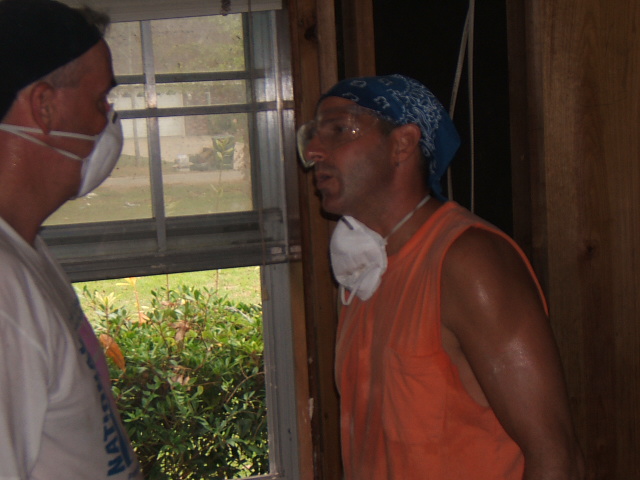
Another multi-analgesic day: gutting the interior of Alfred Jackson’s house. Mr. Jackson, an 82-year-old African-American man, has lived his entire life in the house we stripped to studs today. Katrina was the first storm to flood his house, and she left it under eight feet of brackish water.
The work is brutal in the 90-degree heat, and it doesn’t leave much time for conversation so I don’t know much about Mr. Jackson’s eight decades in
Katrina’s winds and water swept away the books and many of the mementos. They ripped the veneer right off the walls. They also ripped the veneer that has glossed over racial politics in
An octogenarian in
Yesterday we drove along the beach front road where Sen. Trent Lott’s house was destroyed. President Bush joked about sitting on the front porch again when it is rebuilt. I don’t suppose the president will ever sit out under the tree in Alfred Jackson’s front yard.
He should. Familiarity does not breed contempt; it cultivates concern and compassion. Many political observers have noted President Bush’s apparent discomfort with poor folks in general and poor African-Americans in particular. The First Lady may be honest in her insistence that Mr. Bush cares for all Americans; nevertheless, her heated defense of her husband does not change the fact that folks like Alfred Jackson will never be among Mr. Bush’s circle of familiarity and concern.
As for me, in better – and cooler – times, I am pretty darn sure that I’d rather spend an afternoon sitting in Mr. Jackson’s front yard than on Trent Lott’s front porch. The view of the
The best way to describe this Sabbath is that it has been a four ibuprofen day. We made of our work a worship, and recalled with our backs that the Sabbath was made for humankind not humankind for the Sabbath.
The “worship” began with prayer at
We are in an area spared the worst of the storm, and still the devastation along the shore is indescribable. Tornados reduce homes to matchsticks; hurricanes do the same thing and then sweep the matchsticks out to sea.
Such storms strike with a great egalitarian furry, sweeping away mansions and shacks alike. Along the beach road in
Two blocks inland the homes are far more modest – two bedrooms on a slab qualifies as middle class; working class folks inhabit trailers. Just a few days ago all were six feet under the
Of course, while the wind and waves were no respecter of class, the economic structures that will determine the course of rebuilding are entirely class driven. There is a class of folks who are insured and another class of folks who are not. There is a class of folks who can afford to rebuild and another class who cannot. The wealth on the coast line here is not as deep as the flood waters were, and thus the outpouring of volunteers is crucial. Free labor is all some folks can afford.
But it will not, on its own, be enough to ensure the return of ordinary working folks – the shipbuilders, the fishers, the shop owners, police, fire fighters, school teachers, service employees and factory workers who have lived along this coastline in homes just a stroll away from the water.
Ensuring their return will take a massive influx of public money justly distributed. These days, the tens of thousands of folks all along the
They certainly aren’t getting the concern of some insurance companies unless they have flood insurance. Homes utterly destroyed by the 25-foot storm surge aren’t covered by standard policies because the damage was caused by water not wind – never mind that the wall of water was driven by 150-mile per hour winds.
One home we worked on today was totaled by the storm surge. It had to be completely gutted, which we did. The insurance agent told the home owner to expect $10,000 to cover the roof of their shed, which was blown off by the wind, but to expect nothing for their house which was under eight feet of water when the surge rolled through. The family of five is homeless, but their shed will have a nice roof.
For now, the kindness of strangers is all that holds together many such families. Such kindness marks the first step on the road to recovery. There’s plenty of work to be done. Will there be enough strangers to do it?
It is a long, long, long way from
The long, low ridge that emerges from the broad coastal plain just south of
I cannot drive through
I am a southerner, born in
But sometimes I think those remarkable changes have been overtaken by other equally significant yet almost unremarked upon changes in the broader culture. The Civil Rights Movement itself reminds me of a time before we all became consumers instead of citizens, before we became bound more by a common market than by common humanity. I cannot think about the Movement without recalling the music that kept spirits high; a recollection that makes the destruction of music-filled
Yet driving down the “
Even after the deluge and amidst the apparent triumph of consumer culture, we remain, each of us and all of us, creatures of one earth. Perhaps we may recall this fundamental truth and live into it again as creation reveals its secrets by and by.
"In terms of relative risk, of course, I run a far greater one most afternoons when I cross Monticello Blvd. on my way for an afternoon java fix at Starbucks.
"But this decision is not about the kind of risks I choose to run, but rather about the kind of life I choose to lead. Meaningful lives are, ultimately, faithful lives. The opposite of faith is not disbelief or wrong belief. No, the opposite of faith is fear. A faithful life, a life of meaning, cannot be led in fear.
"It is faith that calls me to march in Washington this weekend -- faith in the Christ who said, “blessed are the peacemakers,” and faith that a better world is possible.
"The nation seems bent on a headlong rush into war. The talking heads assure us that most of the nation supports the president as he leads us with seeming inevitability down the same path his father walked 11 years ago.
"Faith compels me to witness: war is never inevitable. War is a choice that national leaders make, and war is a failure that they pursue as policy. Another choice is always possible, and the peacemaker’s calling is to stand in the public square and proclaim that possibility.
"So Friday night I will board a bus in Cleveland Heights with 50-some other Presbyterians-for-peace to make the long trek to the Mall in Washington.
"That 50-some Presbyterians from Ohio would hop on a bus for a 400-mile, overnight trip that will bring us home at 2 a.m. ought to raise all kinds of questions about the depth of support in the mainstream of middle America for this military adventure, but the pundits can ponder that. To me, this congregation of ordinary folk witnesses to an extraordinary truth: the peacemaker’s call compels us into the meaningful lives we would live.
"We trust that the most serious risk we run this weekend is the loss of two night’s sleep. But if our risk is bigger, we run it recalling Bonhoeffer’s reminder: when the Prince of Peace calls us, he bids us come and die. Die to lives of fear and be reborn to lives of faith. Die to lives of conventional wisdom and be reborn to lives of hope. Die to lives of age-old hatreds and be reborn to lives of exuberant love. Die to lives of war and be reborn to lives of peace.
"Why do I march this weekend? For my own offspring – beloved children of God -- I can only answer: blessed are the peacemakers, for they shall be called children of God."
OK. I’ve had a few days to digest Resident Aliens, and here’s one more small response -- although a rather lengthy post -- to add to the volumes this little book has already inspired.
How can we form communities of discipleship in the midst of what is undoubtedly a culture of disbelief? Now I mean that question to be provocative, but I don’t mean simply to suggest that the unchurched don’t believe in God. Indeed, since their numbers are huge and they are diverse in background and perspective, I don’t know what it is that they believe or disbelieve beyond the self-evident fact that few of them believe that getting up on Sunday morning to worship is worth their time and effort.
Moreover, naming our context as a culture of disbelief condemns the church far more than it does the culture. Hauerwas and Willimon are spot on when they suggest that the church itself has made disbelief an easy perspective to take because “we Christians have given atheists less and less in which to disbelieve! A flaccid church has robbed” disbelief of its edge, of its sense of avante guard and its sense of adventure.[1]
The church itself too often works – or, better, fails to work – by way of a functional atheism. This is true internally and externally. In other words, it is true of the church as it performs the necessary acts of maintaining an institution – setting budgets, recruiting and hiring staff, making decisions about its common life; and it is true of the church as it witnesses in the world through acts of mercy and of justice, as it engages the community in service and through political processes.
As Hauerwas and Willimon put it, “The church is the dull exponent of conventional secular political ideas with a vaguely religious tint.”[2]
This is true, they argued, whether we are speaking of liberal social witness or conservative social witness or of the church’s internal functions. In other words, the religious right is indistinguishable from the Republican Party while the religious left is the Democratic Party at prayer. Both sides too often seek to exercise power rather than take up a ministry of reconciliation. Churches left and right look indistinguishable from the Kiwanis Club when they make internal decisions. I’ve seen a lot of church budgets set over the years, in liberal and conservative congregations, and precious few of them developed through a deeply spiritual process of discernment.
If the church is a house of memory, if Brueggemann is correct, if we are drawn together by practices of memory, perhaps we are suffering from spiritual Altzheimer’s disease. We have forgotten that what draws us together, what makes faith a remarkable adventure, what makes our journey together a powerful and transformative witness, is that God has acted decisively in the world in the person of Jesus of Nazareth, and that in and through Jesus Christ, God calls followers of Jesus together to be the church.
When we respond – when we follow Jesus together – we become “salt and light.” We become a sign for the world – a beacon of hope, a way beyond the left and right ways of the world.
The kicker comes here, though. For, as Brueggemann clearly says, we are drawn together by practices that include suffering. This is not a call to suffer for the sake of suffering, but rather to sacrifice for the sake of the gospel and the sake of God’s good creation. When Jesus says, “follow me,” he is inviting disciples on a journey that leads to Jerusalem and to the cross. As Bonhoeffer put it so bluntly, when Jesus calls, he bids us come and die.
Not surprisingly, I suppose, this is the point at which his invitation runs smack up against our deepest desires for security. We are afraid. We live in a culture not only of disbelief, but of deep and abiding fear and insecurity. You don’t have to look very far from where I live in Northern Virginia to understand how deeply this culture values security, nor, I would guess, do any of us have to look any further than our own homes, checking accounts, jobs or investments to see how deeply we, as individuals, value security.
But Jesus calls us to a life together, as church, marked by a radical trust in the sovereign Lord of history and an utterly, foolishly adventurous life of discipleship as we follow him into a life where the poor are blessed, the mourners are comforted, the meek inherit the earth and the peacemakers are called the children of God. That world doesn’t look much like North America, nor much like the North American church, where all too often the poor are blamed for their poverty, the mourners are an embarrassment unless the grieving is “healthy” and brief, the meek are silenced and the peacemakers are called all manner of things from traitor to naïve.
Nevertheless, God is calling us to follow Jesus into the world – into our own backyards now where old memories are giving way to new opportunities – to share this radically counter-cultural gospel of going the second mile, of turning the other cheek, of loving neighbors and enemies.
Now, you have heard it said – on the talk shows, through the internet, from our political leaders, and, too often no doubt from pulpits – you have heard it said that such is not the way of the world, that this is impractical, that nobody really lives this way. But I say to you that God calls us to this life, and, by God’s grace and mercy and love, we can join the great adventure of trying to live it. If we are resident aliens, let's make a joyous noise in a foreign land, and make the life of faith a journey of adventure once again.
Last week was a difficult one: a challenge on scales both grand and global, and intimate and local.
It’s been a difficult week for the progressive church as our Roman Catholic brothers – I can’t hold the sisters accountable as they have no voice – our Roman Catholic brothers call a pope who ran the church office formerly called the Inquisition, who says that homosexuality is “objectively disordered and homosexual practices are sins gravely contrary to chastity,” who sees no way forward for women in the church and finds church teachings on contraception more important than the lives of millions of the world’s poorest who will die of AIDS.
Closer to home, Sen. Frist went on TV to tell the nation that progressives are out to filibuster faith – whatever that pernicious phrase means.
All of this is deeply troubling on a large scale. It is enough for the week, to be sure.
But this has also been a deeply troubling week on an intimate scale as well, as we have struggled to help our children with the reality of a bus wreck that struck very close to home. Our children were not on the bus the crashed in Arlington, but it carried some of their close friends and classmates, several of whom were hurt and hospitalized.
It’s been a difficult week in our household, and, for many progressives, it’s been a difficult week in the household of God.
The question for me this week then is this: is there a theological renewal possible that is both large enough to answer the challenge of a conservatism that borders on fundamentalism, and intimate enough to speak to the broken hearts of children and families?
It is perhaps providential that the lectionary placed before the church on Sunday one of those baseline places, one of those foundational passages of scripture. If we are to renew theology and the church we must not merely account for such passages but, indeed, we must be guided by them.
That’s a steep challenge for the progressive church when the passage includes John 14:6 – “I am the way, the truth and the life.” Unfortunately, this passage is one of those billboard pieces that conservatives too often use to build a barbed-wire fence of orthodoxy around the garden of faith.
If we are to imagine and then articulate a theology and a vision of church that is expansive enough to respond to the challenge of fundamentalism and also intimate enough to respond to the suffering of grieving families we’ve got to spend some time dwelling in the garden of faith; we’ve got to tear down the fences around it; and we’ve got to embrace the rich and wondrous variety of creation that springs from its soil.
So, what then are we going to do with a passage that is so well known, so often used – and, let’s face it – so often abused that it shows up on signs at baseball games? I’ve got a radical suggestion this morning: let’s take it seriously. Indeed, let’s take it literally – more literally than the literalists and, perhaps, more fundamentally than the fundamentalists.
“I am the way, the truth and the life,” says Jesus.
This is one of those passages often used as a weapon by evangelists of a certain stripe. It was a motto of the crusades, it was no doubt used by the Inquisition, and it still gets used today by some Christians to construct the gates for the club of the saved and keep out the riffraff who don’t fit the mold of a particular conservative orthodox creedal perspective.
You remember the Rainbow Wig Man who used to show up at sporting events with Bible verses plastered on signboards? He used John 14:6 almost interchangeably with John 3:16 – “for God so loved the world …” In interviews, the Rainbow Man said that he was spreading the good news about Jesus to save those souls who were condemned to hell for all eternity if they did not confess Jesus Christ as Lord and Savior, to use the words of the church’s most ancient confession. He seemed to know quite well who was in and who was out, who was us and who was them, who was saved and who was condemned.
But the funny thing is, in this wonderfully rich passage from John, Jesus doesn’t say a single thing about creedal statements or confessions. He simply says, “I’m going to fix a room for you, and believe me, Dad’s house has plenty of space: there’s a room for you there. You know the way: just follow the road.”
When Thomas gives voice to our question – which road is that, Lord? – Jesus simply says, “I am the road.”
No particular church or confession or dogma or denomination or faith tradition is lifted up here. Simply Jesus himself, his very life, a life marked by the breaking of barriers and the breaking of bread; eating with the tax collectors; touching the lepers; breaking bread and breaking silence with women of less than sterling repute; welcoming first the children and claiming a special place for them in the household of God.
Rather than creedal confession, rather than guardian of orthodoxy, Jesus offers relationship. Truth is found in relationship with God, Jesus is telling us. The way of his relationship to God – a way of deep prayer, of utter self-giving, of absolute obedience to the will of God – this is the road to the household of God.
Truth lies not in orthodox theology but in deep relationship. Cardinal Ratzinger would probably tell me that such thinking begins the slippery slope toward the tyranny of relativism, but I’m just trying to take Jesus at his word here. If Jesus is the way, the truth and the life, then the way is one of heterodoxy, the truth is manifest in relationship, and the life is one of such excessive exuberance that no creed can capture it.
Come to think of it, saying “Lord, Lord; I believe, I believe” might be a whole lot easier than following this way of Jesus. This way of Jesus might take us into places where we’d rather not go: to places of heartache and suffering, to place of deep doubt and fear, places of loneliness and persecution, places of poverty and brokenness.
That’s often the case when we are called. For although our true calling will be a place of deep joy, it is almost always also a place of deep suffering and pain, for we are called to respond to the deepest needs of the world.
Sometimes those places of deep need are quite public. These days, as Pope Benedict XVI begins his reign, one place of deep public need is for the witness of progressive Christians speaking out for the full inclusion of all women and of all men – no matter their sexual orientation – in the full life and leadership of the church catholic. Also these days, as Senator Frist takes to the airwave in support of the American conservative effort to hijack Christianity in the name of a narrow partisan agenda, another quite public deep need is for the witness of progressive Christians in the public square and on the phone to the offices of elected officials to remind them that the language of faith has no place in a partisan fight over Senate rules.
At the same time, many places of deep need are quite personal: the needs of young people for support and mentoring as they navigate the often overwhelming path of adolescence; the needs of families as they struggle with the many and manifold challenges of raising children; the needs of young couples trying to chart a way forward. And this week, in particular, the needs of children and families in our community trying to cope with an unfathomable loss.
The conservative orthodoxy embraced by the Roman church today and its Protestant twin upheld by American conservative evangelicals fails these tests. It fails because in the face of the heartbreak of the AIDS pandemic it offers nothing but death; in the face of the overwhelming and obvious giftedness of women leaders and gay and lesbian leaders, it offers nothing but flatfooted literal readings of ancient texts; and in the face of grieving families, it too often offers up a remote God of atonement theology who sacrifices a child for the sins of the world, a God whose purposes too often require human suffering. Such a god would surely not hesitate to snatch away two young children for some cause that we cannot discern, and, if you listen, you will surely hear such a god attested in many conservative pulpits in the face of tragedies as massive as the tsunami and as local as the bus accident.
To all that the progressive church must say “No;” for such a god is not worthy of our worship. But we must also say much more than “No.”
A progressive theology, a progressive church worthy of the name of Jesus Christ, must be capable of responding to each and every one of those needs. For the way that we follow is a way of compassion, the truth that we uphold is one founded in a relationship of love, and the life that we seek to emulate is one filled with grace and trust, love and justice, passion and compassion.
We follow this way, because the road that Jesus walked took him always first to the places of deepest need, to the dwelling places of those who had the most difficult time imagining for themselves a place in the dwelling place of God. Those dying from AIDS, teenagers – gay and straight – struggling to come to grips with their sexuality, women barred from the priesthood, pacifists in the midst of war, the street people looking for a handout or a hand up, families isolated in grief, children to whom the world seems so large and scary and impossible to understand. These are the ones to whom Jesus went first preaching good news.
These are the ones with whom Jesus wept in the face of deep grief, saying by his very presence, “you are beloved, you will be restored, you will be made whole.” By his very presence he acknowledged the reality of their pain and reassured the broken hearted that God was not the author of their suffering but rather offered a way through which that suffering might be redeemed.
Perhaps Jesus simply understood that in those places and times of desperation, people are more apt to recognize their need for salvation – for wholeness and healing and communion, as the Latin roots of the word salvation connote.
Let that understanding beckon the progressive church. We live in a time of often deep desperation. The world stands in need of salvation. In ways both grand and global as well as those local and intimate, creation stumbles in the dark, lost and searching for a little light by which to find a way home.
To a desperate world seeking more than anything a way home, Jesus says, “fear not, for there is room for you all where I am going.”
Christ bids us to follow the way into relation with the Holy One whose dwelling place has many rooms. The way is one of joyous service. Christ bids us to follow the truth expressed in his life: that we are the beloved ones of God. Christ bids us to follow the life he led – an abundant life of overflowing cups, of breaking bread and breaking barriers.
The way, the truth and the life: they will make a way out of the no way of weeks like this past one.
Palm Sunday – at least the original Palm Sunday – was quite clearly a political action. So celebrate it this weekend by speaking out against an unjust war. (Click here to find a peace vigil near you.)
On that first Palm Sunday, Jesus was leading a rally, a march, on the capitol and the seat of power of his world. Jesus, who was always attuned to the importance of symbol and story, rodes in on a donkey to remind the people of the messianic prophecy: “look, your king is coming to you, humble, and mounted on a donkey.”
The crowds responded in kind: “Hosanna! Hosanna!” Or, “save us, liberate us, set us free from the tyranny of our time!”
This is radical, even revolutionary stuff, and it is inherently political. But at the same time it is spiritually transformative as well. The turning of the world implicit in this entry to Jerusalem is at once deeply personal and thoroughly social and political, and the action itself – the marching, the crowds, the shouting and singing – is a spiritual practice.
Every spiritual practice aims to draw us closer to God, to help us experience God’s presence and to be shaped by that experience for lives of discipleship. So get close to God this Palm Sunday weekend by taking it to the streets.
I was going through some old files this week and I came across these notes from a speech I gave in Cleveland's Public Square two years ago this Saturday. I am saddened at how much of this has come true in the past two years. This war was wrongly conceived, wrongly executed and wrongly continues today.
Later on this evening at Forest Hill Presbyterian, we will gather for a worship service. We’ll confess our sins and pray for forgiveness. We’ll pray for the men and women fighting in Iraq today. We’ll pray for President Bush. We’ll pray for Saddam Hussein. All of this will be good and right and appropriate.
But, first things first. Let’s get one thing straight: this war is wrong!
I’m a preacher, not a policy maker, but it doesn’t take a policy expert to see that this war is wrong strategically. The risks of attacking and occupying a country at the heart of the Arab world far outweigh the risks of isolating and containing that country. This war is wrong strategically!
I’m a preacher, not a politician, but it doesn’t take a pollster to see that this war is wrong politically. It’s not just that American public opinion is divided, or even that today’s attacks threaten to divide America more deeply than it has been divided in more than a generation. No. It’s not that; it’s this: more than 90 percent of the world’s population opposes this war. That matters. This war is wrong politically!
I’m a preacher, not a diplomat, but it doesn’t take a U.N. ambassador to see that this war is wrong diplomatically. President Bush is mistaken: this war is not rendering the United Nations irrelevant. The world’s desire for peace can never be irrelevant to the community of nations. No: what is irrelevant to the community of nations is the American empire’s desire for dominance. This war is wrong diplomatically!
You know what? I’m a preacher … but I am also a parent. Last Sunday evening we held a candle light vigil at Forest Hill, and my three-year-old daughter walked with a crowd of 175 singing, praying, peaceful people of faith holding a flickering flame of hope against the darkness of these days. And when we ended, she looked up at her mother and said, “Mommy, what else do we need to do to stop the war?”
Why can’t our leaders grasp the wisdom of a three-year-old girl? She doesn’t know much about war, but when she asks we just tell her “war means that lots of children get hurt.”
Lots of innocent women, men and children will die in Iraq. Hannah Caitlin, you know this well: this war is wrong morally!
This war is wrong: strategically, politically, diplomatically, morally. This war is just plain wrong!
I’m not a policy maker. I’m not a politician. I’m not a diplomat. I’m a preacher and a disciple of the Prince of Peace.
And so this much I know: “Blessed are the peacemakers!”
I want you to look at the people standing around you. Go ahead.
You are blessed! We are all blessed. It might not feel that way today, but we are blessed because we are peacemakers.
We’ve got some difficult days ahead of us. That much is clear. But now is not the time to despair, for though our generation is tasting the curse of war, we know that the peacemakers shall be called the children of God. Now is not the time to despair, because there’s too much work to be done. Now is not the time to despair, because no matter how dark this midnight feels, joy cometh with the morning that breaks forth with peace. Now is not the time to despair, for though mighty and awful weapons have been unleashed today, we know that day is coming when we shall beat swords into plowshares and study war no more.
We don’t need to study anymore to know this: This war is wrong! This war is wrong and we want peace now!
Peacemakers: what do we want? When do we want it?
I’ve been thinking about the deep divisions within the church and the culture over sexuality, and I believe much of it comes down to the way we understand ourselves as embodied creatures. We become what we practice; if we practice honoring our bodies we will become those people “shaped by the conviction that the body is sacred, that it is holy, that it is worthy of blessing and care,” to borrow Stephanie Paulsell’s words. There are precious few places in our culture that share such a conviction. For in our culture, bodies are honored insofar as the match an idealized beauty, strength, sexuality.
The church and the culture fracture over images of bodies.
Of course, within the church we ought to remember that Jesus looked beyond these surface considerations, and calls us to do so as well. Of course, we don’t do that very well, no matter what side of the divides we fall on. We also too often forget that Jesus said it’s not what goes into a person but rather what comes out that matters spiritually. There’s deep importance to that insight for it reminds us that Jesus is always more concerned with depth than with surface, with how faith is lived out in the world rather than with ritual observances of binding dietary rules and the like.
On the other hand, the computer programmers’ watchword – garbage in, garbage out – is a good caution for the spiritual practice of honoring the body. Not only does what we consume by way of food, drink and pharmaceuticals have obvious affects on our bodily health, but what we take in by way of the culture has equally significant effects, even if they are often less obvious and more difficult to trace. Here you can imagine a picture of Janet Jackson and Justin Timberlake, and add to it a long list of porneia, to use the New Testament word that in our age should remind us not only of the various hypersexualized pieces-of-bodies commodified by our media-saturated world but also of the violated bodies-in-pieces of its crude and pervasive violence.
You see, truly honoring the body with fidelity and chastity – to use two words hotly contested in the Presbyterian Church (U.S.A.) – is a profoundly counter-cultural practice, because it reminds us that we are beautifully made in the image of a loving Creator. Honoring the body reminds us that each and every body – no matter age or gender or sexuality or appearance or sickness or health or size or status – each and every body is fearfully and wonderfully made. Honoring the body, then, turns us toward the Creator and away from images and ideologies that would devalue and devour our bodies.
As with so much in Christian practice and theology, we will understand this better if we learn if from those who are poor; in this case, poor in body. I shared a meal last week at the L’Arche community in the District. L’Arche is a global movement begun in France about 40 years ago by Jean Vanier. L’Arch communities create homes for people with severe mental and, often, physical disabilities, who live with their helpers in community. Last week, toward the end of the evening, Andrew, a young man who does not speak beyond grunts, took me by the hand and led me around making sure that I had met each member of the community, as we had gathered after dinners in a couple of houses in Adams-Morgan. Andrew has dancing, smiling eyes, and his grip on my hand conveyed an incredibly deep hospitality.
Sometimes, Andrew has trouble walking. He had a bruise on his chin where he had hit his face in a recent fall. Tuesday evening I was deeply moved by the community director’s simple question: can you imagine what it would be like if falling down were a regular part of your life?
That reminded me that some people know they have a body because it hurts.
A few years back, Jean Vanier spoke at Harvard, and he said,
Many people know they have a head because they have learned that two and two are four. They know that they have hands because they can cook eggs and do other things. Many know they have a sexuality because they have experienced strong emotions. But what they do not always know is that they have a well deep inside of them. If that well is tapped, springs of life and of tenderness flow forth. It has to be revealed in each person that these waters are there and that they can rise up from each one of us and flow over people, giving them life and a new hope.
I’m still not sure I know what fidelity and chastity really mean, or if the progressive church can really receive any gift from these words that have done such great damage to so many over the past decade in our denomination. But if there is a gift there to be discovered, I believe it has something to do with the way that honoring our embodied selves can tap that well and allow life and tenderness and love and faithfulness and wholeness and holiness to flow in and through our lives and our communities.
Stephanie Paulsell, “Honoring the Sexual Body” (delivered Nov. 5, 2004; www.covenantnetwork.org/sermon&papers/Paulsell-04.html) 5.
Jean Vanier, From Brokenness to Community (New York: Paulist Press, 1992) 27-28.
Our lives are surrounded by and suffused with stories that flow together like a river whose source sprang forth eons ago before the dawn of time. It flows past, picks us up along its way and sweeps us on in a weave of infinite complexity on channels and river beds that wind a tortuous route toward an eschatological ocean at history’s end. Sometimes our stories flow together and draw us into community, but often, along the way, each of us somehow comes to believe that our stream is the only one, and thus our lives become fragmented and we become deaf to any other story.
We live in just such a time, when the controlling mythology has us convinced that we are isolated individuals whose lives are radically disconnected from each other. The Marlboro Man is the icon of our age of rugged individualism, and the “welfare mother” is his opposite number. The dominate story in which they play leading roles frames a vision of reality in which poverty or disease are signs of moral failing and compassion is weakness.
The dominant story of our time tells us that we are part of a species that is even more radically disconnected from the rest of creation than we are from each other. In this story nature is merely economic resource, and its beauty is reduced to another consumer good or, too often, simply reduced to waste without even the dignity of returning to dust. But the poet Wendell Berry offers an alternative economy with but a handful of words:
We join our work to Heaven’s gift,
Our hope to what is left,
That field and woods at last agree
In an economy
Of widest worth.
High Heaven’s Kingdom come to earth.
Imagine Paradise.
This strikes me as the perfect Lenten discipline for a people journeying from Ash Wednesday’s reminder – you are dust and to dust you shall return. Yes, certainly, but also this: O dust, arise! Imagine paradise! Cast a vision for a future otherwise.
From “The Clearing Rests in Song and Shade,” in Wendell Berry, A Timbered Choir (Washington, DC: Counterpoint, 1998), 49.