Tuesday, March 14, 2006

Prayer Makes Us Human

Prayer provides a practice through which we come home to ourselves in the moment that God has given us with the gifts that God has provided. We do not pray to become someone else – some spiritual giant. Our prayers will not make of us more Nouwens, more Bonhoeffers, more Kings, more Coffins. Our prayers will make us ourselves – fully human, nothing more but nothing less.

As such, prayer is, as Nouwen said, resistance. It is resistance to all that would make of us something less than human. Our prayers for healing are resistance to the ways in which our own deep woundedness would deny us our humanity. That is not to suggest that woundedness is not part of humanness, but rather to acknowledge that wounds can dehumanize. Abuse suffered all too easily becomes abuse inflicted. Emotional damage too easily becomes emotional weaponry. Pain suffered too easily becomes an excuse for pain inflicted.

Prayers for healing and wholeness do not deny the reality of suffering and pain, but rather they seek a way through brokenness to compassion – to suffering with, such that our own experiences of brokenness open us to deeper connections with others in their suffering.

I tried to include a nice graphic that I found here: http://www.justpeace.org/prayer.htm. That site has a number of links on prayer from a Roman Catholic perspective as well as the picture that wouldn't cooperate when I tried to steal it -- er, borrow it -- I mean, appropriate it in an artistic fashion in keeping with the established norms of post modern art.

Tuesday, March 07, 2006

The Way of Prayer

In Peacemaking, Henri Nouwen writes, "The invitation to a life of prayer is the invitation to live in the midst of this world without being dropped in the net of its wounds and needs. The word 'prayer' stands for a radical interruption of the vicious chain of interlocking dependencies that lead to violence and war and for an entering into an entirely new dwelling place. It points to a new way of speaking, of breathing, of being together, of knowing -- truly, to a whole new way of living."
What has prayer meant to you? What practices of prayer have been most meaningful? What experiences of prayer can you recall as particularly meaningful, particularly painful, particularly joyous, particularly funny?

Wednesday, March 01, 2006

The Living Word

Scripture is the live word of the living God, made new for each generation. Of course, sometimes efforts to make the word new take a few liberties, as does this e-mail making the rounds. Not the word of God, to be sure, but pretty amusing in a partisan sort of way. Note to IRS agents looking in: no partisan endorsement is implied or emparted here, just an amusing and, one hope, faithful agitation to the powers that be. Besides, when Garrison Keillor is calling for the impeachment of the president -- in the pages of the Chicago Tribune, even -- one pastor's perspective is the least of the administration's worries.
The 23rd qualm
(written by a retired Methodist minister.)
Bush is my shepherd; I dwell in want.
He maketh logs to be cut down in national forests.
He leadeth trucks into the still wilderness.
He restoreth my fears.
He leadeth me in the paths of international disgrace
for his ego's sake.
Yea, though I walk through the valley of pollution and
war, I will find no exit, for thou art in office.
Thy tax cuts for the rich and thy media control,
they discomfort me.
Thou preparest an agenda of deception in the
presence of thy religion.
Thou anointest my head with foreign oil.
My health insurance runneth out.
Surely megalomania and false patriotism shall
follow me all the days of thy term.
And my jobless child shall dwell in my basement forever.

Thursday, February 23, 2006

Always Low Prices

Check this one on Walmart art. Makes me want to run right out and shop. And then there's this, from Frederick Douglas: "I am one of those who think the best friend of a nation is he who most faithfully rebukes her for her sins-and he her worst enemy, who, under the specious and popular garb of patriotism, seeks to excuse, palliate, and defend them. " Thanks, cle. Of course, those of us faithfully rebuking stand to be sued by Walmart for definition -- as if the Waltons haven't defamed most everything they've touched. Oh, wait, you say. Douglas was talking about rebuking the nation and I'm railing on a rapacious corporation. Well, we live in the days when what's good for Walmart and other huge corporate interests is good for America. Or so they tell us.

Monday, February 20, 2006

The Homosexual Agenda -- Oh My!

Well, since I've been accused more than once of being a dupe for the gay agenda, I was thankful to Beth Quinn for bringing to light just what my More Light friends are up to. Here it is: the gay agenda. Be afraid. Be very afraid.

Friday, February 17, 2006

a thousand words and more than that many laughs

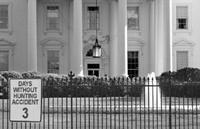
Because laughter is better than tears and more healthy than rage, here's a great list of comments about hunting with the vice president. Enjoy.

Thursday, February 16, 2006

Grace, Love, Limits

If grace is real, it must be real for everyone no matter how malevolent they may be. Limit cases interest me because they force me to reconsider the depth of the love that Jesus commands his followers to exercise always and everywhere. That's why the "does God love Osama?" question is interesting. The answers we offer to such question shape and form how we live our lives everyday in the face of the suffering inflicted upon us by others. This is true in the outsized cases such as a terror attack, but it is also true in the intimate personal cases like when a partner says something hurtful or when a colleague spitefully undercuts us or a friend speaks ill of us. The question, in a blog-size nutshell: If God is love, how are we to respond to hate?
Here's what Dr. King wrote, in Strength to Love:
"We shall match your capacity to inflict suffering by our capacity to endure suffering. We shall meet your physical force with soul force. Do to us what you will, and we shall continue to love you. Throw us in jail, and we shall still love you. Bomb our homes and threaten our children, and we shall still love you. Send your hooded perpetrators of violence into our community at the midnight hour and beat us and leave us half dead, and we shall still love you. But be assured that we will wear you down by our capacity to suffer. One day we shall win freedom, but not only for ourselves. We shall so appeal to your heart and conscience that we shall win you in the process, and our victory will be a double victory."

Thursday, February 09, 2006

Saved from What?


Marty asks the logical question: saved from what? What is this "salvation" all about? From what are we saved and to what point and purpose, if any?
I grew up in the Bible belt in the midst of the "I found It" bumper sticker craze of the 1970s. "It" meant a personal relationship with Jesus, and "it" was clearly crucial to one's personal salvation. "It" was what saved one from a life of alienation from God and an eternity of hellish alienation. More to the point, "it" was what saved you from the wrath of God. Indeed, there's a book out called Saved From What by a conservative evangelical that argues precisely that humankind needs to be saved from God.
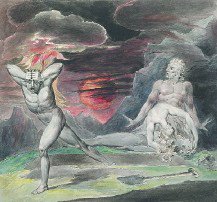
The image of a wrathful God is ancient, and certainly has Biblical roots. The word "wrath" shows up hundreds of times in scripture, and is certainly the subject of much artwork as Cain Fleeing the Wrath of God illustrates. Among my favorites is Exodus 32, where Moses talks God back from the brink of a wrathful destruction of the golden-calf worshipping people. Perhaps the most famous English-language example of wrath-of-God theology is in Jonathan Edwards' Sinners in the Hands of an Angry God. That one will send shivers down your spine.
It should come as no surprise that I don't see it this way, but it's important to acknowledge how common such theology is, even when it comes in a "kinder and gentler" version of a wrathful God who calls his (and this God is always masculine) followers to hate the sin but not the sinner. I actually prefer the old one, whose hate was right out there!
Well, no. But anyway, as is often the case, I find John Hall's work helpful here. In Why Christian?, he asks, "Do you know (most people don't, I find) that the word at the center of this whole discussion, 'salvation,' comes directly from the Latin word for 'health' -- salus? It means to be whole, to be integrated. You may think, for instance, of the way that Jesus in the Gospels, in healing someone of some debilitating illness, tells them, 'Be whole.' ... All that kind of thing lies behind the word that we too often turn into something so 'spiritual,' religious, and 'otherwordly' that it betrays the most fundamental meaning of the word itself, which is a very earthy thing: the healing of persons, the reintegrating of divided selves, the reuniting of people with those from whom they are estranged, the equipping us for the kind of life our Creator intended us to have. 'I came that they might have life and have it more abundantly.'"
Saved from what? From ourselves, I think.

Tuesday, February 07, 2006

Grace and Salvation

If you google "grace" you get about 95 million hits. If you google "salvation" you get about 20 million. I have no idea what the roughly 5 to 1 ratio of grace to salvation means.
But I was pondering these words yesterday after a couple of women came to our door peddling, I presume, salvation. I'm not certain of their pitch because I wasn't at home and my partner* was on the phone and didn't answer the door.
In any case, I'm sure most of you have, at one time or another, answered a similar knock and been asked, in one form or another, "have you been saved?"
I've seen variations on that theme become the center of debate at Presbytery meetings where the concern is not so much for the salvation of folks at the meeting -- after all, we Presbyterians are God's frozen-chosen. The question at such meetings usually arises during questions to candidates for ordination who will be asked something along the lines of "do you believe God saves all people?"
It's a trap, for universal salvation has been considered heresy according to orthodox Christian theology for roughly 1600 years. The orthodox position, crudely stated, is that Christ's death on the cross was the necessary atonement for the sins of humankind and trust/faith in that saving death is necassry to receive salvation.
Of course, as with most theological arguments, there is an orthodox tenet that undermines the orthodox position. In this case, the essential Reformed tenet of God's sovereignty. When one considers the Biblical witness that God desires communion with all of humankind on the one hand and the belief that God is sovereign -- God gets what God wants -- on the other, some form of universalism seems the logical conclusion. Don't try that on the floor of Presbytery, though, because pretty soon you'll get the Hitler question -- e.g., Do you believe Hitler was saved? Actually, Hitler is a great example, because he presumably had "accepted Jesus Christ as Lord and Savior."
Ah, salvation theology ... a sticky wicket. What do you think?


*I'm using that term just to drive a little closer to the edge all those folks out there who have had a field day speculating about my sexuality in the months since my church's stand regarding weddings was in the news.

Sunday, February 05, 2006

Happy Birthday Bonhoeffer

On the 100th anniversary of the great prophet, here are some links to Bonhoeffer including a link to a birthday reflection for seekers of peace and justice, info on a new documentary airing on PBS tomorrow, a link to the Bonhoeffer society, and the Barmen Declaration -- the statement of theological principles that guided the confessing church movement in Germany under Hitler. While Karl Barth wrote the declaration, Bonhoeffer was a central leader in the confessing church and the anniversary of his birth -- especially when it falls in a time of increasing confusion about ultimate authority and allegiance -- is a good time to reread Barmen. Happy Birthday Bonhoeffer.

Friday, February 03, 2006

What Manner of Man ... or God?

A small provocation for Friday afternoon, courtesy of Hall's Why Christian?:
What God? What is this God like? If Jesus "reveals" God, puts us in touch with God, makes God specific and particular, no longer a vague abstraction, then what sort of God do we have here? Is this a God chiefly of power and might, who is primarily concerned for "himself" and "his" own glory? Or is this a God who is out to condemn every sinner -- who, as Dorothy Sayers once wrote with characteristic irony, really hated everybody, but let his wrath fall on his beloved son instead? Or is this a legalistic, tit-for-tat sort of God, who has once and for all laid down the rules for being a "good" human being -- a moralisitic divinity who backs up the moral codes of exemplary citizens (my village!)? Or is this an internalized, gently forgiving, no-hard-feelings sort of God whose "business" as an ironic thinker of the nineteenth century said, "is to forgive"? If Jesus is for Christians the finite one through whom the Infinite is primarily glimpsed, what does that tell us, concretely, about the Infinite -- about "God"? (Hall, 25)

Monday, January 30, 2006

Why Jesus?

Theologians call it the "scandal of particularity." Why incarnation? What does it mean to call Jesus the Word made flesh? Well, before diving into the many why's, how about just a few "who's" to begin with.

Who is this One called savior and lord,

Who was from the beginning, eternal Word?

Who is this One whose birth angels would foretell?

Who is this One in whom the fullness of God was pleased to dwell?

Who is this One?

Who is this One who touched and healed?

Who is this One in whom God is revealed?

Who is this One who calls us here,

Who gathers us in from far and near?

Who is this One?

Who is this One riding in on a colt?

Who is this One, the king of kings?

Who is this One called prince of peace, the hosannas sing?

Who is this One hung on a tree,

Whose life and death and life again somehow set us free?

Who is this One?

Who is this one with a table spread,

Who offers us this daily bread,

Who pours this cup and shares this wine, and calls us out to spread the vine?

Who is this One?

Who is Jesus -- for you?

Tuesday, January 24, 2006

And another thing ...

This may be slightly off-topic, but what the heck! I just bugged out of a Presbytery meeting in which an overture from the session of the church I serve was swallowed up in parliamentary manuevering. The overture concerned removing the section (G-6.106b) in the constitution of the Presbyterian Church (U.S.A.) that stands in the way of ordaining gays and lesbians to church office.
The case for removing G-6.0106b from the Book of Order is the same today as it has been each time National Capital Presbytery has voted to seek its removal. All that is different is the final report of the Theological Task Force on Peace, Unity and Purity of the Church.
Nevertheless, no matter how many good faith efforts at relationship building we pursue, no matter how many practices of discernment we engage, no matter how many alternative means of decision making we use, there comes a time to confront this issue. G-6.0106b is a failed piece of legislation that for a decade has undermined the peace, unity and purity of the church.
The whole church was watching today as this Presbytery, which has for a long time made plain its desire to see a church whose hospitality, grace, love and justice are as wide and as deep as God's. Alas, the clarity of that desire was blurred by a vote that endorsed the Task Force's report and only provisionally endorsed removing G-6.0106b.
I believe that, as Dr. King said, the arc of the moral universe is long but it bends toward justice. I trust God's grace, and pray that it will work its way with us to further the peace, unity and purity of the church we serve.
What has this to do with scripture? Well, nothing and everything, as it is, of course, the narrow interpretation of a handful of verses that holds together the house of cards that is homophobia. If that suggest of rank bigotry is too strong, perhaps it would be better to call it a house of cards of heterosexual privilege. I live in that house -- and I use the resources of scripture to tear it down.

Monday, January 23, 2006

Why Scripture?

One of the watch words of Luther's Reformation was sola scriptura, or "by scripture alone." For Luther and for those inheritors of the Reformed tradition, scripture was to be understood as the "sole sufficient rule of conduct and belief for the Christian," as Peter Gomes puts it in The Good Book.
But what are we to make of the collection of texts we know as the Bible? After all, writing centuries before the advent of historical criticism, John Calvin himself wrote, "We know that the Evangelists were not very exact as to the order of dates or even in detailing minutely everything Christ said or did."
It is incumbent upon those of us who stand in the tradition of the Reformers to take the Bible seriously, but how do we do so in a cultural context that continuously uses scripture as a weapon in culture wars? Even more critically, how do we read a hopeful word when scripture itself has been a stumbling block to the hope of faith for so many modern readers? One of my favorite Old Testament scholars, Walter Brueggemann, offers a compelling point of departure in Hopeful Imagination. Commenting on the literature of the exile, he says, "we study the themes, metaphors, and dynamics which give new life to the tradition, which summon to faith in a fresh way, and which create hope for a community so deeply in crisis that it might have abandoned the entire enterprise of faith."
On the other hand, we might prefer to abandon the enterprise ourselves rather than accept the radical challenges the scripture poses. As Hall remarks in Why Christian? "It has been the happy fate of Protestantism, which insisted on the 'sole authority' of Scripture, to have to live with these writings, like it or not. Nothing has been more subversive of human 'religious' tendencies than this book, because the truth is ... that 'the Bible hates religion.'"
At which point, he quotes Amos: "I hate, I despise your feasts, and I take no delight in your solemn assemblies. Even though you offer me your burnt offerings and cereal offerings I will not accept them. ... Take away from me the noise of your songs; to the melody of your harps I will not listen. But let justice roll down like waters, and righteousness like a mighty stream."
So, as you consider your own faith and the future of the church, what role does scripture play? How has it been a help? A hindrance? A comfort? A challenge? What is its authority for you?

Thursday, January 19, 2006

But Why This Church ...

Brian's comment below is neither "simplistic" nor "naive." Rather, in noting that "the church is necessary because God's actions in Christ and in the Holy Spirit have made it so" he states a foundational truth. Foundational truths are essential, but they have the nasty habit of raising as many questions as they answer. This one begs the question of which church is necessary? In other words, what manifestation or expression of church necessarily arises out of God's actions in Christ and the Spirit? On the other hand, what manifestation or expression of church arises, instead, out of needs for human security, out of human fear, out of cultural expectation, and out of theologies or Christologies shaped and informed by such fear, insecurity and cultural expectation? How can we tell the difference?

Tuesday, January 17, 2006

What Church?


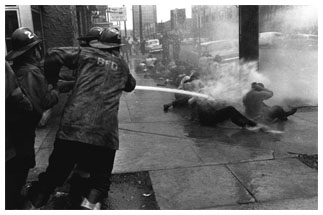
The first comment from yesterday's post raises the next question: what is the church? Our Reformed confessional heritage can be both gift and burden for all such questions, but on this one it does offer much to consider. I believe it is the Scots Confession that says the marks of the true church are that the word of God is rightly proclaimed and the sacraments are rightly administered. I can't help a day-after-King-Day provocation: perhaps the fire hoses of Birmingham were baptism, the lunch counter sit-ins were the Lord's Supper, and "I have a dream" was the word proclaimed.
In addition to the marks of the church, he constitution of the Presbyterian Church (U.S.A.) names certain purposes or ends of the church. Among them is "exhibiting the kingdom of God to the world." The Beloved Community is one compelling image of that kingdom.
Of course there are many ways to be the church and few will ever be called to look much like the Civil Rights Movement, but, as Martin Luther suggested, a church that "gives nothing, costs nothing and suffers nothing is worth nothing." Radical generosity, costly grace and redemptive suffering may just be additional "marks of the church."
Nevertheless, no matter what vision pertains -- whether conservative or progressive, Reformed or Roman, movement or institution -- the present moment demands that we think seriously about the question: is the church necessary? Why? Why not? What do you think? How does your own experience with church shape your response?

Monday, January 16, 2006

Why Church?

When I began this blog in November of 2004 I posted an e-mail from a friend who was asking, essentially, "why bother with church at all?" Martin Luther King Day is a perfect opportunity to grapple again with that essential question.
Why consider the necessity of the church on King Day? After all, King was often extremely critical of the church. In his Letter from the Brimingham Jail King wrote that "the judgement of God is upon the church as never before. If the church of today does not recapture the sacrificial spirit of the early church, it will lose its authentic ring, forfeit the loyalty of millions, and be dismissed as an errelevent social club with no meaning for the twentieth century. I am meeting young people every day whose disappointment with the church has risen to outright disgust."
On the other hand, I have always suspected that the Civil Rights Movement, at its best moments, was, precisely, the church at its best. King suggested as much in ending his famous letter when he prophesied that "One day the South will recognize its real heroes. ... They will be the young high school and college students, young ministers of the gospel and a host of their elders courageously and nonviolently sitting-in at lunch counters and willingly going to jail for conscience's sake. One day the South will know that when these disinherited children of God sat down at lunch counters they were in reality standing up for the best in the American dream and the most sacred values in our Judeo-Christian heritage" -- in other words, they were being the church.
Indeed, as Douglas John Hall notes in Why Christian?, "The first Christians were not thinking in institutional terms at all, they were thinking in terms of a movement" (page 127). Of course, as both the early church and the Civil Rights movment learned, if any movement is to be sustained over time various institutional forms become necessary. The movement gave birth to, among other institutions, the NAACP, the Congress on Racial Equality, the Southern Christian Leadership Conference, and the Student Nonviolent Coordinating Committee. The first Christians, and all of the rest of us for 2,000 years, have built, reformed, reshaped and rebuilt the church in thousands of institutional incarnations.
This King Day comparison is not without incongruencies, of course. The Civil Rights movement was not an entirely faith-based enterprise. It did not requiring creedal statements or confessions, (although it issued manifestos, including many of King's speeches, that are confessional statements). Nevertheless, I think it is a useful comparison because it can help us ask central questions about the church: in what way is it a movement? to the extent that it is a movement, toward what is it moving? what institutional forms, liturgies and traditions serve the direction of the movement? which ones distract from that direction?
Ultimately, these questions help refine our approach to the central question my friend's e-mail raised: is the church necessary and, putting my own, self-interested cards on the table, why does it remain necessary?

Friday, January 06, 2006

New Year

The new year might be time for some good reading. Especially since, as a form of self-punishment masquerading as "professional responsibility," I am trying to make it through the first book of the Left Behind series. Sack cloth and ashes would be easier. Forty days of fasting would be more pleasureable. But if I could break the fast with something from David James Duncan it might make the whole thing go down a bit easier. Duncan wrote one of my favorite novels, The Brothers K. It sits on my bedside table and I pick it up now and then just to enjoy the way he uses words. He tells stories of faith better than just about anyone I know, and obviously it gets him in a bit of trouble now and then, as this passage suggests:
AFTER THREE DECADES OF INTIMACY with some of the world's greatest
wisdom texts and some of the West's most beautiful rivers, I assumed I'd
escaped the orbit of organized religion. Then came a night in
Medford, Oregon. After giving a literary reading to a warm,
not-at-all-church-like crowd, I was walking to the car when one of the
most astute men I know -- my good friend, Sam Alvord -- clapped me on
the back and amiably remarked: "I enjoy your evangelism."
I was flabbergasted. Evangelism? I was a story-teller, not one of
those dang proselytizers! The evangelists I'd known since childhood
thought the supposed "inerrancy of the Bible" magically neutralized
their own flaming errancy and gave them an apostolic right to judge
humanity and bilk it at the same time. The evangelists I'd known
proclaimed themselves saved, the rest of us damned, and swore
that only by shouting "John 3:16! John 3:16!" at others, as if
selling Redemption Peanuts at a ball game, could we avoid an Eternal
State of Ouch.
Then honest Sam tells me: "I enjoy your evangelism"?
Shit O. Deer.

That's pretty much the way I felt the first time somebody suggested to me that I might be
well-suited for ministry.

Sunday, December 25, 2005

Christmas Peace

Never forget that we are called first to be makers of peace. As senseless, endless war rages in Iraq, the Christmas Truce of World War I should give us pause to remember that soldiers do not make wars, generals do. This is a story worth remembering. John McCutcheon wrote a beautiful folk song that tells the story. You can listen to the story and a bit of the song through the Public Radio Exchange. Search "Christmas in the Trenches." Perhaps some troops in Iraq may experience such a moment of peace this year, although the only peace for some is the eternal quiet of the grave.

Saturday, December 24, 2005

A Hoax, and a Ho, Ho, Ho

The story about the Dartmouth student turns out to be a hoax. It was, in many ways, a classic "urban legend." It reflects the fears of our times, that mount with each new revelation about domestic spying. That fear, felt with a particular closeness here in the DC area, certainly made me more than willing to believe the story.
But that's a subject for another day. For now, enjoy this little silliness -- a gift from the world wide web. Merry Christmas, and Happy New Year.

Wednesday, December 21, 2005

Merry Christmas, Big Brother

The story from Dartmouth , of a student being questioned by government agents after he requested a copy of Mao's "Little Red Book" from the library, leaves me wondering just how little one has to do these days to get the national security state's mockers in a twist. Could one simply blog on such words as Marx, communism, terrorism, assassination, 9-11, Bush, peace, redistribution, protest, poverty, war, or Israel? Is that enough to draw down the attention of those who are apparently watching our words? I'm reasonably certain I've used every one of those words in sermons before. Perhaps I'd better stop posting sermons on the church's web site.
Heaven forbid we should organize a congregational witness for peace. We might wind up like those poor Quakers in Florida. I'll think twice this Christmas Eve before making any mention of the Prince of Peace. And that e-mail I sent to Virginia's U.S. Senators about investigating this domestic spying ... on second thought maybe I should try to call that one back.
My high school son is reading Marx's Revolution and Counter Revolution -- just for fun! OK, he's an interesting child. Thank goodness he got that book from the pastor's study and not from the public library.

Tuesday, December 20, 2005

All I Want for Christmas ...

All I want for Christmas is a version of Spybot that can tell me when I am under surveillance by the national security state. How about you?

Friday, December 16, 2005

Sleepwalking Through Advent

Advent is the season of watching and waiting. It is a season of hopeful expectation. It is a season of preparation. As the paper fills with news of torture and domestic spying it is tempting to roll over and go back to sleep.

But, above all, this is a season of and for wakefulness.

Of course we know that wakefulness is not always easy. We want to turn away from what is difficult. We want the solace of sleep. This is nothing new under the sun.

Jesus’ disciples turned away from the terror in the Garden of Gethsemane and they fell asleep. Their sleep did not stop the crucifixion. Nor did it stop the resurrection. Their sleep did not stop the radical reorientation of life that is the gospel, and, of course, neither will ours. As the psalmist says, “In peace I will both lay myself down and sleep, for you, Yahweh alone, make me live in safety.” When the terror is too much, when the valley of the shadow is too deep, God promises to be with us, and keep watch over us as flocks in the night.

Nevertheless, we are called to wakefulness. Even now, in the midst of a season of great darkness; especially now when such a season cries out desperately for light and more light. For advent means coming, and we are called to be awake to what is being born in our very midst.

And what is that, or, more to the point, who is that begin born here and now among us?

It is the one who calls us to awake; the one whose coming radically reorients all of life, even our definitions of what is lowly, what is weak, what is broken.

As Bonhoeffer put it, “Where the understanding is outraged, where human nature rebels, where our piety keeps a nervous distance: there, precisely there, God loves to be; there [God] baffles the wisdom of the wise; there [God] vexes our nature, our religious instincts. There [God] wants to be. … God in lowliness – that is the revolutionary, the passionate word of Advent.”[1]


[1] Dietrich Bonhoeffer, The Mystery of Holy Night (New York: Crossroad, 1997) 8.

Thursday, December 08, 2005

Imagine

Thinking about John Lennon on the 25th anniversary of his death ...
Imagine there's no empire; no hungry war machine.
Imagine there's no vote fraud; no neoconservative movement no, well ... you can fill in whatever names come to mind.
Imagine justice mattered, and human frailty, too.
Imagine there's no corporate music machine reducing everything to tripe.
Imagine there's no Disney, no Newscorp, and no Fox.
No New York Times to lie or libel; no People full of hype.
Imagine music mattered, and artistic vision, too.
Imagine a middle school ochestra playing Vivaldi and tearing your heart out.
Imagine real religion binding us together not tearing us apart.
Imagine a child ringing a chime, and an old woman singing hymns.
Imagine no wins and losses, but mercy and compassion instead.
Imagine letting go of Truth with a capital T, in favor of love.
Imagine not getting angry when not everyone agrees with you.
Imagine not being right, but still being part of a community.
Imagine not being afraid, and trusting abundance.
Imagine grace.

Tuesday, December 06, 2005

Happy Holidays!

An informative, and somehow quite amusing, post about the ACLU in this holiday season. Enjoy, and a blessed Advent to you.

Tuesday, November 29, 2005

On Being Blogged

The past couple of weeks have been a strange introduction to news making in the age of the blog. As noted a few days ago, the church I serve has been in the news quite a bit of late, beginning with an article on the front page of the Metro section of the Washington Post.
We've learned that one story in the Post will be followed by dozens of others in papers, TV and radio. Somewhere along the line, a news producer told me to check the blogs, where apparently the action of my church's session has struck a chord with many. For some, it is a beautiful message of grace, for others it's "unbiblical" or worse.
For me, it's just been interesting. The range of reaction is fascinating, as the links below will show. The first few are additional news reporting from several sources, the next nine or ten are blogs. There's plenty more like them out there -- including something I ran across in Polish! Who would have thought that a small, mainline congregation in a red state would articulate a policy that caused such outsized reactions? But, then again, isn't "good news from unexpected places" one of the great themes of incarnational theology?
Anyway, here are a few links:
Washington Blade
Arlington Connection
Presbyterian Layman
Here are the blogs -- sorry about mucking up their names:
Monday Morning
Liberal Rage
Get Religion
McCornick
Dailykos
Beliefnet
Feministing
Editor-at-Large
Wyclif
So, what do you make of all this? Much ado about ... something ... nothing ... a third thing?

Thursday, November 24, 2005

Happy Thanksgiving

Here's a song from my daughter, for Thanksgiving:

In our house, we're reading books
We're playing games
and some of us are cooks.

We're kickin' off shoes,
and kickin' up heals.
Some of us are dancing on bannana peels.

In our house, we're gonna have fun.
The clouds are parting and here comes the sun.

Everybody's jolly and nobody's sad.
Your momma is dancing with your dad.

In our house, we're playing guitars.
We're sitting on the porch
and wishing on the stars.

Monday, November 21, 2005

In Case You Missed It ...

Well, in case you missed this story, the church I serve has been much in the news during the past week. It has been interesting to say the least. I'll blog on it after the media buzz dies down and I've had some time to reflect. In the meantime, it is worth noting that the response to this decision has been overwhelmingly positive. The full policy is available on line. We welcome all thoughtful responses -- hate mail we can do without.

Monday, November 14, 2005

A Good Read on a Good Question

I've never claimed to be a "moral giant," but it doesn't take a moral giant to understand that torture is wrong. It just is. One visit to the U.S. Holocaust Memorial museum is more than enough to teach most of us that simple truth. So I've been wondering just why the administration seems so determined to hold open the torture option against overwhelming public opinion and the express wishes of a near-unanimous U.S. Senate. After all, we've fought wars before against brutal regimes who used terrorism and torture (see the link above or consider Vietnam). But even in the worst of those conflicts, the nation never articulated anything evan vaguely resembling an official sanction of torture. Now the administration balks at inscribing in law a prohibition against torture. Why?

A post on Common Dreams today offers the best theories I've read.

Friday, November 11, 2005

The Unexamined Life

The news this week brought together two seemingly unrelated stories that are signs of the times, although it's tough to tell just which way they're pointing. First, Tony Blair last a key vote when parliament voted down a security bill. Closer to home, an appeals court judge told the Tampa Bay Bucs to stop patting down patrons upon entering the stadium to watch NFL games.

Defenders of the patdown policy and of Blair's proposal said such restrictions are necessary because "we are at war."

That may be, but I still do not believe it when they tell me that limits on our freedom are necessary to stop the terrorists who, we are told, hate our freedom. Such justifications make me wonder why, if the terrorists hate freedom, they don't attack Canada or Sweden or one of the dozen or so democracies around the world that are arguably more free than we? More than that, though, I do not believe it when they tell me – through their actions – that the unilateral projection of American military power is going to make me safer and the world more free.

If we are to make ourselves more secure and the world safer for freedom, we would do well to turn back to Plato now – not in moderation, but in following the Delphic oracle’s other wisdom: the unexamined life is not worth living. We are living a remarkably unexamined national life. Our actions as a nation since the crimes of September 2001 have been those of a wounded animal, and no wounded animal can make the world safe for itself or for others.

Indeed, if we are, as Aristotle argued, the “rational animal,” our actions since September 2001 have completely dehumanized us. Leaving aside the insanity that is Iraq, so many domestic actions have been completely irrational. Policies promulgated under the so-called Patriot Act and under numerous state and local initiatives only appear rational when one accepts their premise of extreme risk. But the premise itself is based not on reason but on emotions – chiefly deep-seated fear, constant unease and a deep desire to exact revenge for the horrors of September 11.

Fear rises subtly every time one stands in security lines at an airport, yet reason would tell us that any one of us is still far more likely to die in an accident on the way to the airport than to be the victim of any air piracy. This is true even as we see the latest news of bombs in Jordan. Fear rises subtly every time one walks through a security checkpoint to enter a museum on the Mall, yet reason would tell us that we are far more likely to die walking across the Mall from heart disease than we are to be the victims of bioterrorism. Fear rises subtly at each report of another horrific suicide bombing, yet reason would tell us that we are far more likely to be the victim of random street violence in our nation’s capital than we are to be the victim of terrorism, even if we lived in Jerusalem rather than in DC or New York or LA or any other large American city, never mind any smaller American city where the irrational fears still rule the day. And yet we do not question or remark upon the public and economic policies that, in large part, reinforce the life styles that are at the root of the very real dangers of heart disease, traffic congestion, home-grown violence, and so on and on.

And finally, fear rises subtly whenever the national security budget is defended by reference to September 11, yet reason – or, at least, history -- would tell us that we are made far less free and even less secure in a hyper-militarized state than we would be in a nation whose aims were less overtly imperialistic.

Reason has given way to fear, and as my favorite philosopher, the Jedi master Yoda, reminds us, fear is the path to the dark side.

Indeed, if we would pause for a long moment in our head-long rush toward a militarized police state, we might realize that fear is what drives our “enemies” toward the dark side. When internet polls – admittedly far from scientific but nevertheless interesting indicators – suggest that more of the world’s people fear the United States than fear Iraq or North Korea, a people with even a shred of capacity for self-reflection ought at least to be curious about that fact. Rather than ask, as so many did four years ago in wide-eyed naivety, “why do they hate us?” we might better ask “why do they fear us?”

A reasoned dialogue would no doubt raise questions about the rise in religious fundamentalism in the developing world, and the lack of effective public responses to religious violence in many (especially Middle Eastern) nations. That same reasoned dialogue ought to press the nations of the world toward increased responsibility for their home grown fanatics. And that reasoned dialogue may well acknowledge some clearly defined uses for international military force where the fanatics have gained control.

My own deeply held commitment to Christian nonviolence insists that any such role be limited to policing and peacekeeping, but sometimes my Calvinist roots remind me that in a broken world our choices are never between a perfect good and a clear evil, but rather more often between lesser evils. At such points, I reach the end of reason and am reminded that fear is, after all, the opposite not of reason, but of faith. And clearly, such times as these call forth deep faithfulness.

But no matter what questions any reasoned dialogue raises about “them,” if such dialogue raises questions about “us,” about our national life, then we have a responsibility to address them. And clearly such a dialogue will raise questions about such things as America’s role in the vastly unequal distribution of the world’s resources; about such things as the remarkably undemocratic international institutions -- beholden to America and its interests -- that underpin global inequality; questions about such things as America’s role in supporting repressive regimes over the course of the past half century and overthrowing them when their utility is exhausted; and questions about such things as America’s perceived and articulated imperial intentions.

We have a responsibility to address those questions. More than that, as Reinhold Niebuhr's great prayer for serenity reminds us, we have a responsibility to act on them. For if serenity, comes from accepting the things that cannot be changed, then justice and the peace that rests upon justice comes with the strength “to change the things that should be changed.” Until we engage in a faithful and reasoned dialogue, we cannot lay any claim on the wisdom to know the difference.

One could certainly argue that “a decent respect to the opinions of mankind” (sic) requires such reflection and such action, and I would agree. But more than that, we owe it to ourselves and our posterity. If an unexamined life is not worth living, nothing short of our national life is at stake. If we are, indeed, rational animals, nothing short of our own humanity is at stake. If we are, after all, children of a loving God, nothing short of our deepest faith commitments and our ultimate concerns are at stake. Let the national examination begin.

Saturday, November 05, 2005

Still Walking With the Wind

I was going through some old files this morning and came upon a sermon that got me fired from a job about five years ago. As the congregation I currently serve announces a new policy concerning weddings and holy unions (we will no longer function as agents of the state in an unjust system that unfairly denies to same-sex couples the full legal rights and recognitions of marriage), it struck me that the words from half a decade ago remain pretty fresh. It's a little long for a post, but I am wondering again, as I consider a job lost years ago, "was it something I said?"

Almost 40 years ago, Martin Luther King, Jr. gave voice to a vision. He articulated a dream that many of us still share: a dream of a beloved community, a community gathered at table, a community, he said, where “black men and white men, Jews and Gentiles, Protestants and Catholics” would be able to sit together at one table and sing together in one voice: free at last, free at last.

This morning, I want to suggest to you that the work of dreaming is not yet done; the vision of the beloved community is not yet realized; there are yet more places to set at the table of brotherhood … and sisterhood. I have a dream today to share with you.

You see, I am utterly convinced that if Dr. King were alive today, his roll call to the table would have sounded something like this: black people and white people; sisters and brothers, Jews and Gentiles, Protestants and Catholics, gays and straights … singing together, free at last.

Dr. King claimed that his vision was deeply rooted in the American Dream, and so it was. But his vision was also deeply rooted in gospel truth. In expanding his dream today, my vision is deeply rooted in the American Dream. It is deeply rooted in Dr. King’s dream. And it is deeply rooted in gospel truth, as well.

Now some might say it is a risky rhetorical strategy to lay claim to the American Dream at a time when there is shrinking support in legislative halls for expanded protection for gays and lesbians. And some might say it is risky strategy to lay claim to Dr. King’s vision and image knowing full well that King was quite conservative with respect to sexual politics. And still others might say it is risky strategy – indeed might charge that it is heretical -- to lay claim to gospel truth when the church seems bent on narrowing its vision.

Nevertheless, as our denomination debates an amendment to our church constitution that would bar our ministers from performing ceremonies of Holy Union between same-sex couples, the Sunday of the holiday weekend honoring the life and memory of our nation’s greatest prophet of freedom and justice is the right time for some risk taking. It is the right time to say “no” to Amendment O.

So let’s examine these three rhetorical risks and see if we can uncover together a prophetic truth that outstrips all rhetoric just as it touches real lives in our churches.

The first risk is the easiest to answer. Even in the midst of our deepest divisions about church polity, the Presbyterian Church has stood firmly for full civil rights and protections for sexual minorities. We do not struggle there. We proclaim with one voice – albeit a bit of a weak one from some quarters in the church – that all Americans are entitled to their full claim on the American Dream. So my vision is deeply rooted in the American Dream.

The second risk is a bit tougher, because here we are moving into the realm of interpretation. King died before the sexual revolution made it remotely possible for gays to leave the closet and lay claim to full civil rights, much less full ecclesial ones. But in choosing this day to speak to these issues, I am in pretty good company. Members of Dr. King’s family, including Coretta Scott King, and many of his closest aides have argued persuasively that Dr. King’s vision of the beloved community was evolving at the time of his assassination, and they believe he would have been out front in the march toward justice for sexual minorities.

In his “Letter from the Birmingham Jail,” Dr. King answered his white clergy critics who had called him an “outside agitator,” saying, “I am in Birmingham because injustice is here.”

For Christians, any understanding of justice must be based on love. Dr. King understood this and preached it often. In his letter from jail, King challenged the church to join the struggle, because his dream was founded first and foremost on that gospel truth of justice based on love.

Unfortunately, in the midst of the current crisis, it is precisely the church that is framing issues of justice on a legalistic interpretation of a handful of passages of scripture, while ignoring the very real pain suffered by individuals who are locked out, left behind, ignored, scorned and even hatefully spited because of their sexual identity. And this injustice is done in the name of a certain conception of the gospel.

So my most risky rhetorical strategy is to lay claim to that same gospel truth. But truly, this is the only claim that matters.

Now some will argue that scripture is clear with respect to issues of homosexual behavior. Those who disagree with me – and let’s be clear: there are many who do -- will point to the Sodom and Gomorrah story, to the Leviticus Holiness Codes, and to Paul’s letters to the Romans and the Corinthians as the seven citations of the Biblical witness against homosexuals. There are almost as many interpretations of these passages as there are interpreters. And the interpretations vary widely with respect to meaning, context and centrality of the passages.

But without dragging through the mud of exegesis here, let us at least agree that what’s going on here is precisely that: the interpretation of texts. I am interpreting several this morning: the “text” of the American Dream; the “text” of Dr. King’s dream; and the “text” of gospel truth. We cannot come to any text – holy scripture or the Sunday Times – without interpreting.

Let us also agree that the central text at stake – the Biblical text – is inherently a living text. It is the live word of the living God, as the theologian Walter Brueggeman puts it. And the evangelical truth of scripture is focused on and lives out of its main claims not its lesser claims, as Brueggeman argued last fall at East Liberty. The dispute lies here: what is central, what is provisional in scripture?

The sodomy of the Sodom and Gomorrah story, the particulars of the holiness codes, the examples in Romans and Corinthians are lesser claims, just as those passages that for so many years were used to deny women their rightful and ordained places of leadership in the church are lesser claims. Issues of context and translation support that claim strongly although we do not have the time this morning to trace out the arguments.

Indeed, as the Methodist clergywoman Maurine Waun writes, “The pain of sexual minorities is, at this moment, so ponderous and so enormous that the church is missing the mark by not even daring to look beyond the scriptural debate toward the hurts and issues of persons who are bravely and genuinely struggling in their everyday experience.”

No matter where you stand on Amendment O, or on ordination standards, these genuine struggles – and this deeply felt hurt – compel us to be welcoming and open to individuals in this house no matter what their sexual orientation.

Looking beyond the scriptural debate, however, does not necessitate looking beyond scripture. Our passages this morning from Amos and Isaiah are central. They are central to my sense of call and ministry. They are central to my understanding of justice. They are central to my understanding of gospel truth.

We must come to these texts with imagination. We are called to do so, and we do so all the time. Through our faithful imaginations the live word of the living God moves beyond itself in ways that were previously unavailable to the community of faith. Dr. King imagined a beloved community in which, as Amos said, “justice would roll down like water and righteousness like an everflowing stream.” Dr. King dreamed that “every hill and mountain shall be made low, the rough places shall be made plain, and the crooked places shall me made straight and the glory of the Lord will be revealed and all flesh shall see it together.” Now Amos, in chapter 5, and Isaiah, in chapter 40, were not thinking about Martin Luther King having a dream … but he did.

And now, so we are called to dream, to catch the wind of the Holy Spirit blowing afresh and anew and carrying us toward the beloved community. We stand, on this Martin Luther King, Jr. holiday Sunday morning, in a long line of heroes of the faith who have caught the wind and walked with it.

Congressman John Lewis, who, as chairman of the Student Nonviolent Coordinating Committee in August of 1963 on the steps of the Lincoln Memorial delivered the speech preceding Dr. King’s, relates a story in the introduction to his memoir of the Civil Rights Movement. Now you should know that John Lewis is, along with Dr. King, one of my heroes of the faith. Lewis was born less than 100 miles from where I was born. And this story goes back to his rural Alabama roots. Let me read it to you:

On this particular afternoon – it was a Saturday, I’m almost certain – about fifteen of us children were outside my Aunt Seneva’s house, playing in her dirt yard. The sky began clouding over, the wind started picking up, lightning flashed far off in the distance, and suddenly I wasn’t thinking about playing anymore; I was terrified. I had already seen what lightning could do. I’d seen fields catch on fire after a hit to a haystack. I’d watched trees actually explode when a bolt of lightning struck them, the sap inside rising to an instant boil, the trunk swelling until it burst its bark. The sight of those strips of pine bark snaking through the air like ribbons was both fascinating and horrifying.

Lightning terrified me, and so did thunder. My mother used to gather us around her whenever we heard thunder and she’d tell us to hush, be still now, because God was doing his work. That was what thunder was, my mother said. It was the sound of God doing his work.

But my mother wasn’t with us on this particular afternoon. Aunt Seneva was the only adult around, and as the sky blackened and the wind grew stronger, she herded us all inside.

Her house was not the biggest place around, and it seemed even smaller with so many children squeezed inside. Small and surprisingly quiet. All of the shouting and laughter that had been going on earlier, outside, had stopped. The wind was howling now, and the house was starting to shake. We were scared. Even Aunt Seneva was scared.

And then it got worse. Now the house was beginning to sway. The wood plank flooring beneath us began to bend. And then, a corner of the room started lifting up.

I couldn’t believe what I was seeing. None of us could. This storm was actually pulling the house toward the sky. With us inside it.

That was when Aunt Seneva told us to clasp hands. Line us and hold hands, she said, and we did as we were told. Then she had us walk as a group toward the corner of the room that was rising. From the kitchen to the front of the house we walked, the wind screaming outside, sheets of rain beating on the tin roof. Then we walked back in the other direction, as another end of the house began to lift.

And so it went, back and forth, fifteen children walking with the wind, holding that trembling house down with the weight of our small bodies.

More than half a century has passed since that day, and it has struck me more than once over those many years that our society is not unlike the children in that house, rocked again and again by the winds of one storm or another, the walls around us seeming at times as if they might fly apart.

It seemed that way in the 1960s, at the height of the civil rights movement, when America itself felt as if it might burst at the seams – so much tension, so many storms. But the people of conscience never left the house. They never ran away. They stayed, they came together and they did the best they could, clasping hands and moving toward the corner of the house that was the weakest.

And then another corner would lift, and we would go there.

And eventually, inevitably, the storm would settle, and the house would still stand.

But we knew another storm would come, and we would have to do it all over again.

And we did.

And we still do, all of us. You and I.

Children holding hands, walking with the wind.

Today in the church we are buffeted by winds of strife. That wind, that strife, threatens to tear the house apart. The splinters are evident already and when the wind of strife blows them they strike deep wounds into individuals in the house.

But we are called, by another wind, to join hands, to walk with the wind and to hold the house together. For in the midst of the wind there is a dream. In the center of the house rests a table. And around the table, we can still be gathered: black folks and white folks, Protestants and Catholics, gays and straights -- one people sharing one hope, one faith, one Lord. Free at last. Free at last.

Thursday, October 27, 2005

Signs of the Times

You don't need a weatherman to know which way the wind blows, said Dylan. Of course, Jesus said you can tell the signs of the skies and still not know the signs of the times. All I know is Cheryl Swoopes is out of her closet while Harriet Miers is going back into hers. Here in Washington it is chilly today. The winds are calm. The grand jury is quiet. But I think I can begin to see a little light in a dark sky.

Saturday, October 22, 2005

Choose Hope

One of the most pernicious false gods that we cling to here in the new Rome is the illusion of control. But even here, we have no control over the time in which we live, and often no control over the events that mark our lives.

Nevertheless, we are given the choice of how we shall live in the time we are given and how we shall respond to the events that mark our time.

Most of us have very little control over the institutions where we work or go to school, we have no control over our family of origin, but we can choose how we respond to the stresses of our jobs or school life or family life. It is often overwhelmingly tempting to respond to work or school or family with cynicism.

In fact, it is often hip, stylish and celebrated to be cynical. Sometimes it’s fun, and it can often be genuinely funny – think Seinfeld for a moment. And in this city in particular, it is often expected and it is certainly easy to turn to cynicism.

But cynicism is not a faithful response to the world. We are called to a stewardship of attitude.

This is not a call to naiveté, or to Pollyanna-ish living. Critical engagement with the world is crucial. But when life places before you hopelessness and hope, faith demands that we choose hope.

That may just be the most difficult choice we are ever called to make. Choosing hope requires taking responsibility. Abandoning hope lets us off the hook. At the same time, choosing hope requires that we trust others. Abandoning hope allows us to slip into a splendid isolation where we can wallow in hip, detached despair or sink into genuine depression. Choosing hope draws us deeply into the messiness of real life and real community. Abandoning hope allows us to dwell in dark fantasy.

Friday, October 14, 2005

The Future?

I watched Seabiscuit last night with a group from church. It's a charming film with a classic triumph of the underdog theme. Throughout the movie, Charles Howard, played by Jeff Bridges, aims at "the future." As the American waster frontier settles, the sky becomes the limit. As the American economy falls into the Great Depression, Howard still believes in the power of the future.

It was an interesting film to watch with a group from a church whose future has been in doubt for many years, and continues to be an open question as we stumble along from one crisis to the next.

It leaves me wondering, is there a future for the progressive church?

We all know that the so-called Christian Right is an extremely powerful cultural and political force in the nation. The Christian Right dominates the cultural perspective on Christianity so much that most folks outside of the walls of progressive churches do not even know that such a thing as progressive Christianity exists.

Years ago, when I worked for a short while on the Nuclear Freeze campaign, I recall the shock that a friend expressed when he learned that I was going to the Divinity School at the University of Chicago. "What’s a good progressive like you doing in a divinity school?” he wanted to know. I tried to explain that there was a tradition of progressive Christianity, but he had never encountered it. Most folks haven’t.

For most Americans, Christianity has become synonymous with a particular legalistic, conservative, evangelical movement whose vocal, media-savvy leaders are quick to condemn anyone who sees the world differently than they do.

Gays and other sexual minorities? An abomination. Women? Remain silent and “gracefully submissive,” in the words of the Southern Baptist Convention. Jews? In need of salvation. Feminists, lesbians, the ACLU, People for the American Way? Responsible for September 11, according to Pat Robertson and Jerry Falwell.

At a meeting of conservative Presbyterians a while back, one speaker said that liberals were like bugs devouring the foundation of the church. He called for stomping as the appropriate response to such an infestation. I’m not sure, but I believe they broke into a spontaneous version of “Guide My Feet” at that point!

In the face of such attacks from some conservatives and such widespread ignorance from the population as a whole, we have to ask: is there a future for progressive Christianity?

As for me, I firmly believe and have dedicated my own life to the conviction that God is calling forth a progressive, inclusive, engaged, diverse church upon which to build the beloved community. Now this future remains to be worked out in our living together as church.

Yes, there is a future. But whether it is a future of exile, decline, death and memorial stones or a future of foundation stones and building together and vibrant worship and call and response … remains to be worked out in our living together as church.

Indeed, the foundation was laid for a progressive, inclusive and diverse church by Jesus himself, as one can see in passages such as Mark 7:24-37, where Jesus encounters the Syrophoenician woman.

What might the future look like, if we live into our calling? A progressive Christianity will not be afraid. It will welcome contact and dialogue and deep conversation with other cultures and traditions including with our conservative, evangelical brothers and sisters, and it will be open to being transformed itself in and through such relationships, just as Jesus was transformed in his meeting with the Syrophoenician woman.

Now most commentators don’t want to read it this way, but the plain and clear story line here shows us that Jesus is changed by his encounter.

Jesus went to a Gentile region to get away. A Jewish healer and prophetic teacher ought to be able to rest in quiet anonymity for a while in the region of Tyre. Yet a gentile woman comes and pleads for healing and wholeness for her daughter.

Jesus tries to brush her aside – after all, he is Jewish and is focused on the spiritual condition of his own people. Yet her faithful pleading opens him up to the possibility that his mission is broader than he had previously understood.

In this moment, Jesus comes to more fully understand that, as William Sloan Coffin put it, “There is no way that [faith] can be spiritually redemptive without being socially responsible. A [faithful person] cannot have a personal conversion experience without experiencing at the same time a change in social attitude. God is always trying to make humanity more human.”

In this encounter with a marginalized woman, Jesus becomes more human, he becomes more clearly a child of a loving, merciful, just creator.

As Bonhoeffer put it, “Jesus tells us: You are standing under God’s love; God is holy and you, too, are to be holy.”

And in this story from Mark, Jesus radically expands the reach of that good news. For the good news is not just to one sect, defined by a set of legalistic boundaries designed to keep folks out. No. The good news is for everyone, for we are all heirs to the promise of wholeness and healing that is proclaimed through Jesus.

There is no East or West, male or female, slave or free, Gentile or Jew, black or white, straight or gay – for we are all children of the same God.

Jesus goes way out of his way to demonstrate this when he travels to the Decapolis on his way back to Galilee. Going by way of the Decapolis is like traveling from DC to New York by way of Cleveland – only more so, for the Decapolis was an unclean region avoided by Jews. Perhaps more like Pittsburgh!

His route and his actions – healing a Gentile from an unclean region – proclaim good news for all people. Jesus shows us here that grace is abundant; that the power of healing and wholeness is everywhere for everyone.

The people were astounded beyond measure, scripture tells us. Why? Was it the miracle healing? No doubt that was part of it, but healers were not uncommon. The larger miracle was this: for a people used to hearing that they were unclean, excluded, beyond salvation, Jesus proclaims this good news: God’s radically inclusive love for all people brings healing and wholeness to all of our wounded and broken lives; God’s radically inclusive love brings peace into our warring lives; God’s radically inclusive love for all creation brings light into the present darkness.

This is the foundational truth upon which we will build the future for progressive Christian faith and life. This is the bright light that will illuminate the way for that progressive life and faith to journey toward the future of God’s calling. And this promised future marks the most profound difference between progressive Christian faith and life and its other.

For, as William Sloan Coffin suggests, the theology of the Christian Right offers a present that has only a past. To that I say God calls forth a bright new morning -- in this place; at this moment.

God is calling us to risk the new day, to step into a bright new morning – a new morning of restored relationships following a long night of barriers and barbed wired; a new morning of reparation in our streets following a long night of injustice; a new morning of peace following a long nightmare of warfare; a new morning of light and more light following a long dark midnight. Arise, our light is come!

Hey, maybe the progressive church is just a beat up old undersized race horse that just happens to be the wave of the future. It could happen.

Thursday, October 06, 2005

Katrina Diaries: From the Gulf Coast to the Gulf War

I left the coast Thursday evening and drove as far as Birmingham before sleepiness caught up with me. Even there, in the lobby of the hotel where I spent the night, I found reminders of what and who I was leaving behind: FEMA forms for reimbursement for those seeking shelter from the storm.

On Friday morning I detoured into downtown to walk through Kelly Ingram Park past the 16th Street Baptist Church. There, while sitting on a statue commemorating the children of the Birmingham campaign of 1963, I was reminded of others seeking shelter. A homeless man approached me and asked for a couple of dollars for food. I asked him if there was somewhere nearby to eat and he pointed across the park. I said, “are you hungry?” and, when he nodded “yes,” I said, “come on, I’ll buy you some breakfast.”

We walked through the park and shared bits of our stories. His name is Theodore. He is 30, African-American, born in Huntsville. I am almost 45, white, born in Tuscaloosa. Two sons of the Southland whose journeys crossed momentarily in this park in which the right to journey together was secured.

We talked a bit about what had happened in the park when I was a child. I shared with him how my own sense of ministry, and my own feeling of being called into ministry were shaped by the memories of what people of faith had done in places like Kelly Ingram Park to transform the world we grew up in.

He told me he wanted to find a job as a painter. I asked him if he had any construction experience and, when he said “no,” I suggested asking the folks at the 16th Street church to connect him to someone who could teach him to hang drywall. If you can hang drywall you can make a living on the Gulf Coast for years to come. There will be jobs for drywall workers far after the last volunteer pastors have left the coast.

In the grand scheme of things, hanging drywall – or ripping it down when it’s been flooded out – are probably more necessary jobs than pastoral ministry. In any case, such work certainly offers the great satisfaction of immediate results.

I left the Gulf Coast in time to make it back to Washington for the major demonstration calling for an end to the Gulf War. Alas, that work offers no immediate results. It is, however, inextricably bound to the work on the Gulf Coast and to the fate of folks like Theodore in Birmingham and in cities across the nation.

As Martin Luther King said in calling for an end to the war in Vietnam, “a nation that year after year continues to spend more money on national defense than it does on programs of social uplift is approaching spiritual death.”

Signs and symptoms of spiritual death are all around us in the American empire. We continue to be, as Dr. King noted 40 years ago, the greatest purveyor of violence in the world. Our coarsened culture has become also the greatest purveyor of cheapened sexuality, mass consumerism and hyperindividualism.

Despite what some preachers will contend, and despite what some passages of scripture seem to suggest, I cannot believe that God sends down huge storms to destroy wayward societies. But the still, small voice of God does speak through the whirlwind, calling us in the wake of Katrina to refocus our priorities, to rebuild the commonwealth, to restore justice to the public square and repair the breaches of the cities’ streets to live in. In such work, a profound joy meets our time’s deepest need.

Wednesday, October 05, 2005

Katrina Diaries: Pretty, Witty and Gay

Another day of moldy drywall. It remains hot and humid and we are so disgusting that I can barely stand to be in the same room with myself. In the heat of this afternoon, two irrepressible young women who have joined us from Indiana broke into song. With sweat streaking the dust on their faces they sang together, “I feel pretty! Oh, so pretty!” When they got to the phrase, “I feel pretty, and witty …” my friend, Tom, chimed in, “… and gay!”

The deepest joy I have discovered in this journey has come in watching Tom exercise his immense gifts of organization, leadership, energy and good humor. The entire team has been moved by his capacity for compassion – for true suffering with and alongside the families we are serving. We have been guided by his experience with plumbing and electricity, too, and have managed to remove fixtures from bathrooms and kitchens without making a bad situation worse and without electrocuting anyone! His ministry here is surely a sign of the reign of God in the world.

It’s a shame – one might call it a sin – that the world does not recognize such ministry. The church and the broader culture are torn apart by issues concerning gay, lesbian, bisexual and transgendered people, yet the people themselves remain often invisible. Whether it is ordination issues within the church, or marriage and other civil rights issues in the society, GLBT people are painted with broad brushes and their individual lives are obscured. As a result, the conversation is diminished. Indeed, it is not even ever a conversation, because conversation demands partners rather than stereotyped images.

For this one week, at least, conservative and progressive people of faith have shared a common mission: to serve the people in most need along one small stretch of the battered Gulf Coast. Remarkably enough, through this shared mission, genuine conversation has emerged about precisely the concerns that divide us. But the conversation has an entirely different tone to it among us, because we are not talking now about “an issue” but rather about an incarnation, flesh and blood human beings who may be “pretty, witty and gay” or not.

Houses may not be the only thing that is rebuilt along the Gulf Coast. Perhaps a richer, fuller national conversation about the issues that divide us can also be constructed out of the relationships built among those who are sharing in the common struggle to respond to the unprecedented need in places like Gautier. God is not a Democrat nor a Republican, but God’s people come as each and as neither. Only when we can begin to see one another as individuals, created in our rich variety in the image of an unfathomably creative God, will we be able to reach beyond the lines of difference we have constructed. In any case, it’s clear that the folks down here whose lives Tom has touched are less concerned about his sex life than about the faith life that drives him to service in the name of Jesus.

Tuesday, October 04, 2005

Katrina Diaries: Theological Storms

Rita swirls out in the Gulf, bringing sporadic rain and a steady breeze with sweet relief from stifling heat and humidity. No amount of wind can clear the air of the bad theology that clings to the aftermath of Katrina. The other day I heard a radio preacher talking about the judgment of God on the voodoo-welcoming people of New Orleans.

Never mind that a god so narrow minded as to wipe out people seeking various ways to the divine does not deserve praise and worship. A god who discounts as collateral damage the hundreds of people who probably shared the radio evangelist’s faith doesn’t even deserve respect. A jealous and angry god is one thing – perhaps even a Biblical thing – but a god with such lousy aim is worthless. A god who unleashes flood waters on poor people trapped in New Orleans by a system that forgot to evacuate them is not the God of Moses who parted the waters for a people escaping a system that enslaved them.

I met some folks today at a church that sits right on the coast in Biloxi among a row of houses built just after the Civil War. The homes on either side of the church were destroyed, but the church itself escaped with nothing more than a flooded basement and a few damaged doors. One of the people I met there said, “God must have been watching out for his house.”

Less than two blocks away, 30 people died when the motel they were in collapsed. Here’s a god with pin-point precision but confused priorities. A god too busy watching over a temple of bricks and mortar to protect the flesh and blood next door is not the God made known in Jesus Christ, the suffering servant.

But when you wander through streets that look like a war zone, it’s hard not to wonder who and where God is in all of this.

Desmond Tutu has written, “The God we worship is the Exodus God, the great liberator God who leads us out of all kinds of bondage. Do you remember what God told Moses? [God] said, ‘I have seen the suffering of My people. I have heard their cry. I know their suffering and am come down to deliver them.’ Our God is a God who knows. Our God is a God who sees. Our God is a God who hears. Our God is a God who comes down to deliver. But the way that God delivers us is by using us as […] partners, by calling on Moses, on you and me.”

Ah, and therein lies the rub. Lousy theology lets us off the hook. It is fatalistic rather than faithful. If spirit is wind and fire – pnuema and ruah – then surely God can speak to us through the ferocious winds of Katrina and Rita, and surely part of the message is simply this: “here I am; where are you? Here I am, come and join me.”

Monday, October 03, 2005

Katrina Diaries: Justice Among the Ruins

Today I heard someone remark that those who had the most lost the most while those who had the least lost the least in this storm. While that may be true from a certain market orientation, people of faith are called to measure according to a different economy. There’s more than lousy politics going on; there’s lousy theology, too! Moreover, even within the framework of a market economy it would be more accurate to say that those with much lost much but those with little lost everything.

Within a more comprehensive economy, perhaps the economy of the kingdom of God, there is no accounting of the things that have been accumulated against what’s been swept away. Rather, we are accountable for treasure that has been given away and for hearts that have been swept away. As Albert Einstein put it, “not everything that counts can be counted and not everything that can be counted counts.”

All of the folks we’ve been trying to help down here count themselves blessed and lucky. All of them lost homes, but none of them lost loved ones. Still, it is heartbreaking to pick up stuffed animals encrusted in mud, to find graduation pictures plastered to moldy furniture, to find a photograph date-stamped “December, 1974” and know that someone’s memories will be forever diminished by such losses.

Walter Brueggemann has said that the Biblical definition of justice amounts to sorting out what belongs to whom and returning it. In the wake of Katrina that is an improbably huge task.

Some things are easy. Today we were hanging drywall in the home of a soldier whose entire leave has been spent gutting his house and trying to get at least a little of it livable for his wife before he returns to active duty the last week of September.

I asked him if he was a fisherman. He said “yes,” and, pointing toward his back yard, I said, “well, at least your boat looks like it’s in good shape.” He said, “that’s not my boat. It belongs to the guy four houses down and across the street. It wound up there when the water went back down.”

Other things are more difficult. Another neighbor was cleaning out his house – a trailer he’d lived in for more than 15 years. His insurance was cancelled a few weeks before Katrina hit because the company was getting out of business in hurricane prone areas. No other company would sell him a policy until the end of hurricane season.

What belongs to whom? How can it be returned? Courts and legislatures will have to do some of the sorting. People of faith across the nation will be called upon to remind public officials that food belongs to the hungry, clothing belongs to the naked, healthcare belongs to the sick, jobs belong to the unemployed, and shared risks belongs to the commonwealth. Such sorting is the work of justice.

Among the few households we were able to help, the work of justice was on a smaller scale. While the folks we worked with counted themselves lucky, they were also experiencing an almost unfathomable loss and grief. Papers rescued from a crushed desk unleashed anger at an insurance company. A picture pulled from the muck brought on a torrent of tears. Some losses exceed any calculus.

What belongs to those whose losses cannot be counted? How can it be returned? Working at the level of compassion, perhaps the first gesture of justice is recognizing that dignity belongs to the suffering. The first part of this relief effort lies not in gathering scattered possessions but in helping the suffering restore their fractured dignity.