Wednesday, January 31, 2007

Why I'll Watch

In case you missed it, there’s a little football game being played this weekend. Last month, when the Network of Spiritual Progressives met on a Sunday evening, we were scheduling for the coming months, and I noted that the date under consideration at the moment would fall on the highest holy day of the American calendar: Super Bowl Sunday.

While my comment was met with some derision by a few of the stalwart progressives, you’ll notice that the February meeting of the Northern Virginia NSP is, in fact, on Feb. 11.. Personally, I’ve never been one of those progressives with a knee-jerk dismissal of sports; probably because I love to play, and only recently gave up my life-long dream of playing professional basketball.

Hey! What was it that Carl Sandburg said? “Nothing happens unless first we dream.”

On the other hand, dreaming won’t make you 6’5” when DNA offers only 5’11 ¾.”

Of course I can recite a sound, progressive critique of the horribly skewed values that lead cities and states to spend hundreds of millions on playgrounds for the rich while neglecting public schools and health care and public safety. And I can join the chorus of complaints about paying worn-out relief pitchers $5 million while paying teachers and firefighters and police officers one percent of that amount. And I can rail against the media frenzy that so easily lets us entertain ourselves to death while an unjust war rages in our name.

All those critiques of misplaced values and misspent money are spot on; but still, I watch the games, and play them myself whenever I get a chance, because I see something when I watch great athletes perform.

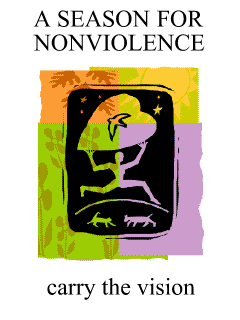
I see human beings fully alive, and, as Augustine said, “the glory of God is a human being fully alive.” (Check out the "Human Being ..." pictured above.)

I see human beings fully alive, seizing a moment in time to use their singular gifts and become – for a brief moment – precisely what they are called to be as athletes.

Most of us, of course, will never experience such moments when our bodies behave precisely as our minds imagine and desire. Indeed, few of us experience many moments when we feel that we are using our own gifts to become precisely what we are called to be – not as athletes, surely, but as human beings.

So, I’ll watch the game this weekend with only a smidge of liberal guilt, which I’ll set aside as I witness a small group of men try to live into their own particular calling for the one sphere of their lives lived on the field of play.

I’ll watch with jealousy – not of their skill, nor of their stardom, nor of their salaries. Rather, I’ll watch with jealousy because these guys seem to know, with great clarity, precisely what it is that they are called to do with their gifts.

Granted, if we use Frederick Buechner’s provocative definition of call – that place where your deep joy meets the world’s deep need – one can quickly question what need in the world athletes meet? Most of the answers that one could offer – beauty, excellence, play itself – are gratuitous; on the other hand, most every human culture has celebrated athletic achievement in some fashion.

That our culture and economy have created a place of incredible financial reward for certain highly marketable athletic gifts no doubt helps athletes in some sports reach clarity of purpose. I imagine multi-million dollar contracts have a way of focusing one’s attention! Still, I’m willing to bet that most of the truly gifted athletes we watch play for insane amounts of money would be playing games for nothing if the money were not there.

That’s certainly one way of measuring the deep joy dimension of call: what would you do with your time if money were no object? When Michael Jordan signed his first huge contract, he had a so-called “love of the game” provision included that allowed him to play pick-up basketball games at any time, even though that posed a considerable financial risk to his team if he were injured.

In the end, the way we spend our time is the way we spend our lives. How, then, do we measure it, and dole it out, and decide how to spend what we have been given – life itself, and our several seasons in which to live it?

Tuesday, January 30, 2007

The Deciders

The weather is back to January. The war continues. Life ... and death go on as before.
So now I wonder: what would it look like across the river in DC if we took Molly Ivins' advice? In a piece last week she wrote,

We are the deciders. And every single day, every single one of us needs to step outside and take some action to help stop this war. Raise hell. Think of something to make the ridiculous look ridiculous. Make our troops know we're for them and trying to get them out of there. Hit the streets to protest Bush's proposed surge. If you can, go to the peace march in Washington on January 27. We need people in the streets, banging pots and pans and demanding, "Stop it, now!"

Marching around the capitol was a start. Those few miles of walking, a first step. But what would it look like if we the people actually decided and insisted that this war is a disaster and must be stopped now? My favorite chant at every march is "this is what democracy looks like!" I always smile as I join that one, and think, "yes, it's amazing and beautiful and incredibly messy and ineffecient." It's certainly no way to run a war. Is it any way to end one?

Monday, January 29, 2007

Martin Lederle-Ensign

Everybody ought to be able to ego-surf and find themselves somewhere in cyber space. Now my adorable 12-year-old can do so. This is him -- dressed like his dad for Halloween. Very scary.

Wake Up to Peace

It may be a bit hard to tell from this photo, but Saturday was the only warm, sunny day in a stretch of cold and dreary ones in DC. Creation itself cries out for peace.
Saturday evening at a small gathering with Michael Lerner and NSP organizers, a woman from Pax Christi noted the mix of hope and despair. She told us that, having come of age in Poland during the days of Solidarity, she could never succumb to hopelessness. She had witnessed the radical transformation of an entire society. However, she also reminded us that deep suffering had inspired that transformation and wondered how, in a society as affluent as contemporary America, any profound transformation could be inspired.
Her comments burn like fire, and remind me that the first step toward transformation of American society is to ring bells loudly enough to wake people of from the slumber of affluence that numbs us to the suffering in our midst.

Saturday, January 27, 2007

Peace!

Whatever the news said about today's peace march in DC, they no doubt missed it. Pictures tomorrow, and some thoughts on a just-ended session with Michael Lerner. For today, at the end of a very long day, suffice it to say "my feets is tired, but my soul is rested." Peace, out.

Thursday, January 25, 2007

Amnesia

Over the past week or so I've received several reports and dozens of photos from a young adult mission trip to New Orleans. The work of recovery continues slowly, but the photos reminded me of how much remains to be done. In fact, some of them were almost identical to ones I took in Mississippi 16 months ago when the storm was fresh in mind. The only real difference was that folks down there working in January don't look quite as hot as we did!
So, when I watched President Bush's State of the Union address the other night I listened for word of the recovery. If nothing else, surely the president would use the success of the New Orleans Saints to offer a homily about perseverance, or give a nod to the incredible outpouring of volunteer support. But no, not a single word.
The devastation on the Gulf Coast remains as a reminder to the nation of presidential amnesia. Forgetting all kinds of history -- even when it's not even past -- we surge forward and stumble blindly back into the same mistakes.

Wednesday, January 24, 2007

Wide World of Religion

This is a bit more devotion than I care to see, but I ran across it looking for pictures of Jesus. Just thought you might like to know. Just scanning the web to bring you the endless variety of human religious expression.

Wednesday, January 17, 2007

Shalom

Don’t let the sun go down on an opportunity to speak out for peace! Join the Network of Spiritual Progressives and a half million or so of your closest friends in a march for a world without war: Saturday, Jan. 27.

Begin that day with a joyous, interfaith worship service at the Church of the Reformation at 212 East Capitol Street, at 9:00 a.m., then walk together to the rally between 3rd & 7th Streets at 11:00 a.m. More details at http://www.spiritualprogressives.org/ .

The United for Peace and Justice-sponsored march pushes off at 1:00 p.m. More rally & march details at: http://www.unitedforpeace.org/.

If you’re interested in participating with NSP folks from Northern Virginia, contact me at revdocdee@verizon.net.

Peace

Tuesday, January 16, 2007

Reimagining Christianity 2.2

The 12th, and final affirmation holds that loving ourselves includes acting on the faith that we are born with a meaning and purpose; a vocation and ministry that serves to strengthen and extend God’s realm of love. This rings close to the essential Reformed belief that God calls us all to lives of service, or, as Mr. Rodgers put it once, "the meaning of life is service." (Mr. Rodgers was arguably the best-known Presbyterian minister of the last 50 years ... "can you say, 'Presbyterian'?") Quaker educator Parker Palmer puts it this way: "Our deepest calling is to grow into our own authentic selfhood, whether or not it conforms to some image of who we ought to be." Truth faith, whether it focuses on the way to God that Christians find in Jesus or on the way to God that Muslims find in the Prophet or on some other way, is always a way to ourselves -- for our deepest calling is to be that which God made us to be. Are you on the way? What gets in the way? Is you job related to your vocation? Should it be? Who are you called to be? Who are you ... and to whom do you belong? Just asking.

Friday, January 12, 2007

Reimagining Christianity 2.1

Affirmation 11 charges us to care for our bodies, and insist on taking time to enjoy the benefits of prayer, reflection, worship and recreation in addition to work. This affirmation takes the fourth commandment seriously and reminds us of the central importance of Sabbath time. In a culture addicted to work and productivity, this may be the most countercultural idea of all. So, how do you find Sabbath time? Are you able to do so in a practiced manner, or is it random? How does such time shape the rest of life? How do you re-create yourself?

The Sabbath commandment is meant for liberation and not to create rule that condemns -- remember that the Sabbath was made for us, not the other way around. And, if that scriptural reminder to tread lightly is not enough, perhaps this is:

Morris and Lenny are strolling home from shul one Saturday morning. Suddenly a cab speeds past, and their friend, Irving, is running frantically behind it, flailing his arms wildly.
"Well," said Lenny, "I never imagined our good friend Irving was a Sabbath violator! Look at him running for that taxi."
"Wait a minute," Morris replied. "Didn't you read that book I lent you, 'The Other Side of the Story', about the command to judge other people favorably? I'll bet we can think of hundreds of excuses for Irving's behavior."
"Yeah, like what?"
"Maybe he's sick and needs to go to the hospital."
"Come on! He was running 60 miles an hour after that cab - he's healthier than Arnold Schwartzeneger."
"Well, maybe his wife's having a baby."
"She had one last week."
"Well, maybe he needs to visit her in the hospital."
"She's home."
"Well, maybe he's running to the hospital to get a doctor."
"He is a doctor."
"Well, maybe he need supplies from the hospital."
"The hospital is a three minute walk in the opposite direction."
"Well, maybe he forgot that it's Shabbos!"
"Of course he knows it's Shabbos. Didn't you see his tie? It was his paisley beige 100% silk Gucci tie from Italy. He never wears it during the week."
"Wow, you're a really observant! I didn't even notice he was wearing a tie."
"How could you not notice? Didn't you see how it was caught on the back fender of the taxi?"

Wednesday, January 10, 2007

I have a dream ... if anybody cares

I've been pondering the upcoming King Day holiday, and I ran across this picture from the 1963 March on Washington where King delivered "I Have a Dream."
I've been to rallies and demonstrations on the Mall numerous times, and to several events centered at the Lincoln Memorial, so I've got a sense of scale. I've never seen this many people there. Which makes me wonder -- in the midst of an unpopular war -- what would it take in our time to stoke the passions and turn out the people on such a scale as this? If unjust war, unresponsive government, and attacks on civil liberties don't stir us, what would? Loss of cable service? A shortage of i-pods?
In any case, I hope you'll join me over the last weekend of this month on the Mall to raise our voices against this stupid war. King would be there.

Thursday, January 04, 2007

Happy New Year ... Let's Hope It's a Good One ...

I was looking back through some old files and I ran across this, from a speech I gave on the night of the invasion of Baghdad what seems like a lifetime ago. It still amazes me how much of this remains both timely and largely ignored by the powers that be. It's not that we were right back then. Rather, it's that the information available then on which to make these judgments remains both available and, again, largely ignored. Why does a war lurch onward that was wrong to begin with, that was wrong in its reasons, wrong in its execution and wrong in its continuation? I'll say again what I said then: this war is wrong.
So, here's what I said then:

Let’s get one thing straight: this war is wrong! Let’s say it loud so the whole world can hear it: this war is wrong!

I’m a preacher, not a policy maker, but it doesn’t take a policy expert to see that this war is wrong strategically. The risks of attacking and occupying a country at the heart of the Arab world far outweigh the risks of isolating and containing that country. So tonight we say to the world, strategically, this war is wrong!

I’m a preacher, not a politician, but it doesn’t take a pollster to see that this war is wrong politically. It’s not just that American public opinion is so divided, or even that today’s attacks threaten to divide America more deeply than it has been divided since the Vietnam War. No, it’s not just that; it’s this: more than 90 percent of the world’s population opposes this war. That matters. So tonight we say to the world, politically, this war is wrong!

I’m a preacher, not a diplomat, but it doesn’t take a U.N. ambassador to see that this war is wrong diplomatically. President Bush is mistaken: this war is not rendering the United Nations irrelevant. The world’s desire for peace can never be irrelevant to the community of nations. No: what is irrelevant to the community of nations is the American empire’s desire for domination. So tonight we say to the world, diplomatically, this war is wrong!

I’m a preacher, not a historian, but it doesn’t take a scholar nor a great distance in time to see that this war is wrong historically. You see, the greatness of a nation is not measured solely by its accomplishments. The moral greatness of a nation is measured by the means it employs to accomplish its purposes. History will judge us according to the death and destruction that issue forth from the actions initiated today. So tonight we say to the world, historically, this war is wrong!

You know what? I’m a preacher ... but I am also a parent. Last Sunday evening we held a candle light vigil at Forest Hill, and my three-year-old daughter walked with a crowd of about 175 singing, praying, peaceful people of faith holding a flickering flame of hope against the darkness of these days. And when we ended, she looked up at her mother and said, “Mommy, what else do we need to do to stop the war?”

Why can’t our leaders grasp the wisdom in the heart of a three-year-old girl? She doesn’t know much about war, but when she asks about it we just tell her “war means that lots of children get hurt.”

Lots of women, men and children will die in Iraq, and so tonight we say to the world, morally, this war is wrong.

This war is wrong: strategically, politically, diplomatically, historically, morally. This war is just plain wrong!

Tonight our tears flow together into rivers of anguish that threaten to form a mighty flood tide of anger and outrage. Let us channel these rivers of anguish into a force more powerful until justice rolls down like a mighty water and righteousness like an everflowing stream.

I think I heard somebody once say, “blessed are the peacemakers!”

I want you to look at the people standing around you here tonight.

You are blessed! We are all blessed! It might not feel that way today, because war rages and some call us unpatriotic. But dissent in support of the values of freedom, justice and peace is the most patriotic response we can make. But even in the face of suspicion, we are blessed because we are makers of peace.

We’ve got some difficult days ahead of us. That much is clear. But now is not the time to despair, for though our generation is tasting the bitter curse of war, we know that the peacemakers shall be called the children of God. Now is not the time to despair, because there’s too much work to be done. Now is not the time to despair, because no matter how dark this midnight feels, joy cometh with the morning that breaks forth with the bright light of shalom. Now is not the time to despair, for though mighty and awful weapons have been unleashed today, we know that day is coming when we shall beat our swords into plowshares and study war no more!

We don’t need to study any more to know one thing for certain: this war is wrong! This war is wrong and we want peace now!

Saturday, December 23, 2006

Wednesday, December 20, 2006

Dining While Gay, and Other Crimes

Of all the things I've seen responding to the local Episcopalians departure from the American Anglican church, this one, forwarded to me by a colleague, is the sharpest. It was written by Jim Naughton.
"The members of Truro and the Falls Church have now declared that belonging to a church that permits gays and lesbians to become bishops is too great a tax on their conscience, while belonging to a church that believes gay people should be imprisoned for eating together in public is not.
"I can suggest three reasons that Bishop Martyn Minns and his flock may have taken this decision. The first is naked bigotry. The second is a willingness to trade the human rights of innocent Africans for a more advantageous position in the battle for control of the Anglican Communion. The third is a profoundly distorted understanding of who Jesus was and what he taught.
"I'd like to believe that the last of these reasons explains the majority of the votes, because I recognize that my own salvation may depend on God showing mercy to those of us who are sincere in our misapprehensions.
"But, if Bishop Minns and his followers do, indeed, believe that gay Nigerians should be imprisoned for visiting a restaurant together, they need to inform us whether they believe gay Americans should be imprisoned for similar activities. And if they do not support the criminalization of such behavior in the United States, they need to explain why they favor--or, at the very least, acquiesce--in depriving Nigerians of rights that Americans enjoy."

Monday, December 18, 2006

Who Do We Shoot? And How ...

When confronted with the overwhelming complexity of Dust Bowl agricultural economics, Pa Joad in The Grapes of Wrath, asked a great question: "who do we shoot?" Pa Joad came to mind when reading an article by Daniel Schrag, a Harvard climate scientist, lamenting the state of public debate about climate change. Having testitfied at a Senate hearing this month, Schrag wrote, "As our leaders accept the outrageous spectacle I saw the other day as just a normal day in Congress, we will have to take the first step without them." I just wonder how. How do citizens of a democracy -- so called -- take effective steps on huge, systemic issues when the public institutions of the democracy no longer function? Sure, if the people lead, the leaders will follow -- but how, exactly, does that happen on a scale large enough to make a difference? Who do we shoot? Just asking.

Wednesday, December 13, 2006

Reimagining Christianity 2.0

Affirmation 10 holds that loving ourselves includes claiming the sacredness of both our minds and our hearts, recognizing that faith and science, doubt and belief serve the pursuit of truth. This seems, again, straightforward and in accordance with the scriptural command to love God with heart and mind and soul. But one doesn't have to look far at all to find faith, science and the pursuit of truth utterly confused. Whether the subject is creationism (check this scary site), atomic warfare, or sexual orientation, the views of science and the "literal word of God" (an interesting phrase when you consider who uses it and who doesn't so much anymore) are held to be at odds in the minds of many.
The heart breaking results of such confusions are plain to see in a piece in the New York Times on gay evangelicals trying to find a faith home. Robert Gagnon, quoted in the Times piece, is correct about one thing: "the concept gay evangelical is a contradiction.” Of course, he's wrong about everything else. The concept is a contradiction precisely because we have for too long allowed the rest of the key words that he uses -- authority of scripture, self-affirming, evangelical -- to be construed narrowly in a discourse controlled by a conservative orthodoxy. The entire enterprise of reimagining Christianity, it seems to me, aims at wresting control of the discourse away from such narrow-minded voices.

Tuesday, December 05, 2006

Reimagining Christianity 1.9

Affirmation 9 holds that "loving ourselves includes ... basing our lives on the faith that, in Christ, all things are made new, and that we, and all people, are loved beyond our wildest imagination – for eternity."
I suppose that means, "God is good, all the time ... for all time." Pretty basic -- until we actually try living as if it were true, or until we raise questions of theodicy (the problem of evil, as suggested by the picture.)
Both challenges are fundamental. As Bonhoeffer observed, the knowledge that God loves my worst enemy as much as God loves me must challenge the way I view the enemy. At the same time, the knowledge of what the worst in us can result in -- pain, suffering, injustice, war -- challenges our understanding of the goodness of God.
So, how do we trust this affirmation, and how do we live out of it?

Thursday, November 30, 2006

Good Intentions and the Road to Hell


I went searching for an image for the "road to hell" and came across, instead, the image here of the road to the Bahgdad airport. It is certainly a hellish route made that way by the intentions -- good or ill -- of the empire and its insurgent opposition in Iraq.
My own intentions had nothing to do with such a route -- just looking for an imaginative way of saying "sorry for being dark for a while."
I don't know if a week with a board meeting, a Presbytery meeting and a newsletter deadline can be called one of "good intentions," but it has certainly overloaded a few circuits, including the virtual ones of the blog.
But the show will go on again soon. I promise. Thanks for checking back.

Tuesday, November 21, 2006

Happy Thanksgiving!

It's a Texas Turkey! Everything is bigger in Texas -- even the turkeys. You can insert your own political joke .

Reimagining Christianity 1.8

Affirmation 8 holds that loving ourselves means walking humbly with God, acknowledging our own shortcomings while honestly seeking to understand and call forth the best in others, including those who consider us their enemies.
Hm, seeking understanding and calling forth the best from ... our enemies? Sounds risky and naive to me -- a call likely answered with a suicide bomb (do I play the conservative fear card well?)
I'm reminded of something Tony Campolo wrote after 9-11: "What has made it the very worst of times is that it is becoming more and more difficult to get away with talking about Jesus within the church. If you dare to quote Jesus in some Christian gatherings, you are likely to encounter hostility. ... If, without the required apologies, you should quote what Jesus had to say about how to treat enemies, it should be expected that one or more in the congregation will stand up and walk out. This is not a time when there are ready ears for words such as, 'Love your enemies and do good to those who would hurt you.'" (In Strike Terror No More.)
I had lunch this afternoon with some folks from the Rumi Forum, an organization that fosters interfaith dialogue between Muslims and nonMuslims. They spoke of both the difficulty and importance of such work in the post 9-11 world.
At a moment when some in the Christian world consider Islam itself the enemy of the West, seeking deeper mutual understanding and calling forth the best from one another sounds a bit less like risky naivete and a bit more like practical politics -- as the Confession of 1967 suggested a few years back.

Monday, November 13, 2006

Reimagining Christianity 1.7

Affirmation 7: Loving our neighbors includes preserving religious freedom and the church’s ability to speak prophetically to government by resisting the commingling of church and state.
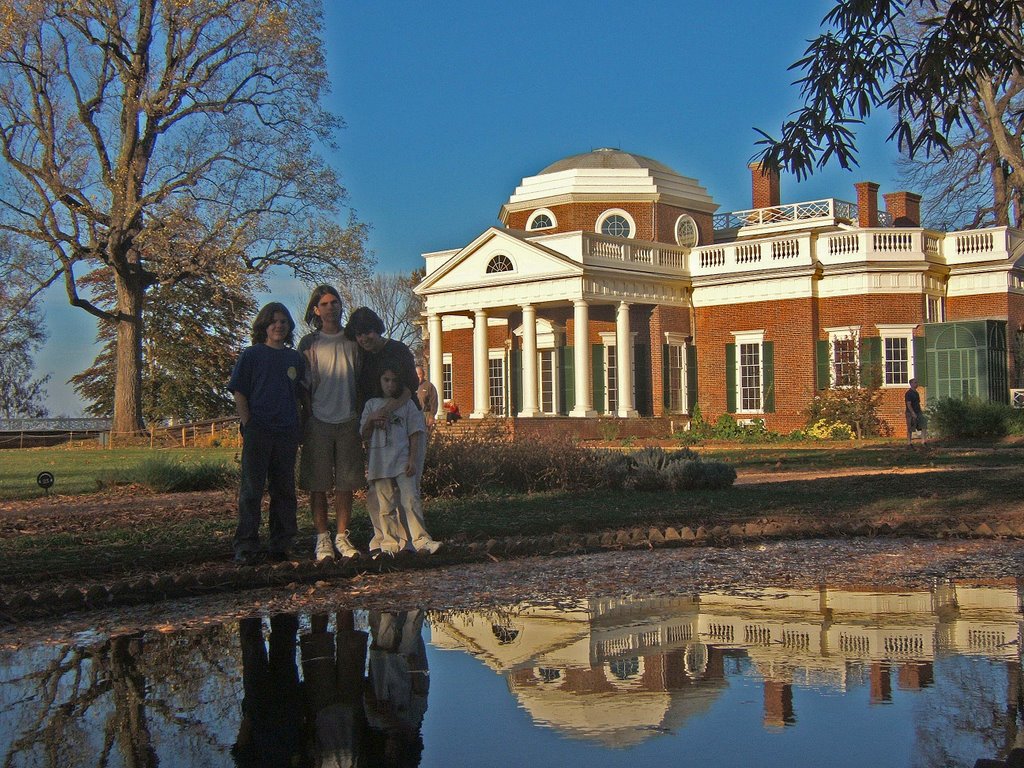
Last week, on a stunningly beautiful autumn day, we loaded up the kids and drove down to Charlottesville to visit Monticello. It was the perfect setting to contemplate the separation of church and state.
In 1802, Jefferson wrote, "Believing... that religion is a matter which lies solely between man and his God, that he owes account to none other for his faith or his worship, that the legitimate powers of government reach actions only, and not opinions, I contemplate with sovereign reverence that act of the whole American people which declared that their Legislature should 'make no law respecting an establishment of religion, or prohibiting the free exercise thereof,' thus building a wall of separation between Church and State."
Of course, Jefferson was wary also of the church mingling in the affairs of state. In 1815, he wrote, "Whenever... preachers, instead of a lesson in religion, put [their congregation] off with a discourse on the Copernican system, on chemical affinities, on the construction of government, or the characters or conduct of those administering it, it is a breach of contract, depriving their audience of the kind of service for which they are salaried, and giving them, instead of it, what they did not want, or, if wanted, would rather seek from better sources in that particular art of science."
Clearly, he did not think too highly of preachers!
But what happens when "lessons in religion" happen to turn on questions of justice? What is the role of the church in a time of war? What should the church say in the face of unjust economic structures? What of "love of neighbor" pushes us to an understanding of neighborliness that transgresses societal or even legal definitions such as Jim Crow laws, slavery, women's suffrage, same-sex relationships?
Just wondering ... that's all. And certainly no offense to Mr. Jefferson, who is one of my heroes.

Wednesday, November 08, 2006

Tending Hearts and Bending Arcs

I know many of our hearts are hurting this morning as a result of the passage of the marriage amendment in Virginia yesterday. But no result of a ballot measure – for better or for worse – is going to herald the coming of the kingdom. The arc of the moral universe is long, but it bends toward justice. Sometimes it seems longer than others, and this is one of those times for GLBT folks and their allies here. But this I know: our fundamental equality does not rise or fall on the result of any election, because each and every one of us is created equally in the image of a loving God.

Let our hearts be reassured by that unshakeable conviction, and let us tend to each other’s hearts with compassion.

While the news on this front was bad, the broader political picture is more hopeful as progressive voices were heard and progressive candidates elected in many places across the country. So maybe the arc bends a bit more today.

The image here -- note the arc -- comes from the Center for the Advancement of Nonviolence.
Now is the time for a season of nonviolence -- especially after the passage of an ugly and violent amendment.

Tuesday, November 07, 2006

Reimagining Christianity 1.6

Affirmation 6 holds that loving our neighbors means standing, as Jesus does, with the outcast and oppressed, the denigrated and afflicted, seeking peace and justice with or without the support of others.
This is the heart of an authentic theology of incarnation. While classical Reformed understandings of the incarnation focus on the challenge of holding God and the human person, Jesus, in creative and saving relationship, this affirmation pushes us to think of incarnation as an unfolding reality in the world.
This affirmation pushes us to think about location: where do we stand, and where does Jesus stand? Taking the gospels seriously -- especially Matthew 25 -- makes it clear that Jesus stands with the outcasts and oppressed, the poor and the sick, those seeking peace and justice. If we want to stand with him, if we feel any desire to know him and be known by him, we have to go where he is.

Monday, November 06, 2006

Bending the Arc

Every once in a while progressive people of faith manage to get their voices heard above the cacaphony of the "religious loud." When 300 or so Virginia clergy came together over the past several weeks to craft, sign and present a public statement of opposition to the proposed Marshall-Newman amendment to the state constitution we did not come close to drowning out the loud, but we did manage to get heard. The voice we raised helped frame the issue for at least one editorial board that came out against the amendment today. If we do the work of love, we will bend the arc one degree at a time closer to justice.

Friday, November 03, 2006

blogging on ... the antichrist

Fifteen or twenty years ago, a Sunday Doonesbury comic showed college students bent over notebooks taking careful but mindless notes. Realizing that the students aren't actually listening to anything, he professor began spouting nonsense: "Up is down. Black is white. Left is right. Thomas Jefferson was the Antichrist." Without pausing in his notetaking, one student whispered to another, "I didn’t know any of this stuff."
Lecturing is a lot like blogging. Suppose I said, "Bush is the Antichrist"? Would anyone respond with a comment?

Thursday, November 02, 2006

Vote No! A Pastoral Plea: Pass It On

On November 7, Virginian's will be asked to write discrimination into a constitution crafted in a spirit of "forbearance, love and charity."
In the name of a narrow and restricted view of marriage based on an impoverished reading of scripture, leaders of the Religious Right are encouraging their followers to support this amendment.
Marshall-Newman is bad law, and such support is bad theology. Bad law and bad theology make a dangerous and volatile mix that Virginia does not need.
Marshall-Newman is bad law because it fails the first measure of good law: clarity of purpose. When two of the commonwealth's statewide elected officials come to diametrically opposed and fundamentally incompatible conclusions about the effects of a proposed constitution amendment -- as Gov. Tim Kaine and Attorney General Bob McDonell have -- you have a recipe for clogged courts and judicial confusion.
Supporting such bad law in the name of one-sided readings of brief passages of scripture taken out of their historical contexts is bad theology. Blaming a loving, grace-filled God for our own human tendency to fear those who are different from ourselves is even worse theology. Acting on those fears in ways that will hurt others is nothing short of demonic. Just as we opponents of Marshall-Newman say "read the whole thing," a faithful response to scripture requires that we read fully as well. A full reading reveals a God in love with all of creation and humankind made fully -- each and every one of us -- in the image of the divine.
As the full text of the proposed Marshall-Newman amendment reads, the amendment could deny legal rights and protections to the more than 100,000 unmarried couples in Virginia -- roughly 90 percent of whom are heterosexual. Domestic violence protections have been threatened in Ohio under an almost identical constitutional amendment.
In other words, a vote for ballot question 1 (the Marshall-Newman amendment) will affect someone you know and it could well hurt them. Passage of the amendment will not help anyone.
That many Virginia families are struggling no one denies. That many Virginia marriages are strained is equally undeniable. Only 17 states have higher divorce rates. Ten percent of Virginians live below the federal poverty rate. Surely these are signs that point to real suffering.
But Marshall-Newman will do nothing to support Virginia families or strengthen marriages in the Commonwealth.
Rather, it seems a smokescreen designed to focus attention on scapegoats instead of on the poverty of ideas that plagues the commonwealth.
In my own Presbyterian tradition we say that we are the church Reformed and always open to being reformed according to the will of God and the movement of the Spirit. In other words, we share a deep conviction that God is not through with us.
Virginia has an opportunity next Tuesday to speak boldly from that very conviction. God is calling forth a new vision of the commonwealth.
God calls us to loving and faithful relationships. Marshall-Newman inscribes hate-filled discrimination into the constitution.
God calls us to be filled with grace and mercy. Marshall-Newman is full of judgment and condemnation.
God calls us to build a commonwealth of belovedness. Marshall-Newman rests on a poverty of compassion.
God is not through with us.
With that deep conviction, I urge you to vote No on ballot question 1.

Wednesday, November 01, 2006

Reimagining Christianity 1.5


Affirmation 5: Loving our neighbor includes engaging people authentically, as Jesus did, treating all as creations made in God’s very image, regardless of race, gender, sexual orientation, age, physical or mental ability, nationality, or economic class.
So, is this the gospel or just a manifesto for identity politics? Do we have to treat meanies as creations made in God's very image? Does that mean no more "mean people suck" bumper stickers? How about those with whom we profoundly disagree? Beyond praying for those who persecute us, do we have to engage them authentically? What might that look like?
The rubber hits the road here, and I'm not so sure I like it. It might require me to hold in my heart people I don't like very much, after all, not every neighbor is loveable.
In fact, last night -- Halloween -- some of them stayed hidden behind closed doors, and missed out seeing my middle child trick-or-treating dressed up as ... me! Clerical collar and all. Pretty scary, I assure you.

Monday, October 30, 2006

Yea, Rick!

Rick Ufford-Chase is at it again. Way to go, Rick!
Arizona Daily StarPublished: 10.30.2006
Guest Opinion: Rick Ufford-Chase -- No on Prop. 107
Proposition 107 would explicitly deny any "marriagelike" benefits to persons who are not married and would constitutionally define marriage as being available only to persons of opposite gender. Like the broader society, the faith community is deeply divided on this issue.
My experience as the highest elected official of the Presbyterian Church (USA) from June 2004 to June 2006 gave me a glimpse into the passion and divisiveness of this debate. Though it is clear that there is currently no consensus in our churches to broaden the definition of marriage, our denomination has been clear that we will not become unwitting participants in any movement to isolate gay and lesbian persons as a group, nor will we condone discriminatory practices against the lesbian, gay, bisexual or transgender community from our legislative, executive or judicial branches of government.
This is entirely consistent with our denomination's historic advocacy for women, persons of color, undocumented persons, and those who live with mental or physical disabilities, all of whom also face the possibility of discrimination because of who they are.
I long for the day when all who desire to make a lifelong commitment to one another are able, as I am, to do so within the bonds of the covenant of marriage. Someday, it could happen. After all, the biblical story is full of examples of God's people being surprised by what God had in mind for them.
We Presbyterians believe that God is constantly being revealed to us in ways that challenge, trouble and occasionally delight us. For that reason, I will continue to be in dialogue with my sisters and brothers with whom I disagree about this matter.
As people of faith, all of whom are struggling to be faithful to their understanding of God, we must find respectful ways to wrestle with this and many other issues that divide us. However, what we must not tolerate are laws motivated by hate or discrimination, or that single out an entire class of people to be treated differently from the rest of us.
Prop. 107 would take away domestic-partner benefits such as health insurance from public employees. It would remove domestic-violence protections from unmarried persons. It makes simple things like the right to visit a loved one in the hospital impossible.
Questions of how marriage is defined will continue to be debated within our faith communities and across our society. In the meantime, let's assure that our laws embody the best of what our country has always been: a safe haven for those who might be targeted elsewhere because of who they are or what they believe.
Let's honor our country's history as a place of tolerance, mutual forbearance, care and concern for all members of our communities. Those are values that all of us, both in and out of the church, ought to be able to affirm.
Please, vote "no" on Proposition 107.
Rick Ufford-Chase was the Moderator of the 216th General Assembly of the Presbyterian Church (USA). He now serves as the Executive Director of the Presbyterian Peace Fellowship. Write to him rickuffordchase@gmail.com.

Tuesday, October 24, 2006

Reimagining Christianity 1.4


Affirmation 4: Loving God means expressing our love in worship that is as sincere, vibrant, and artful as it is scriptural.
What might that entail for a community that calls itself progressive, inclusive, diverse? What, to begin with, constitues "sincere worship"? If you Google the phrase, you get more than 16,000 hits. Now that probably says as much about the search engine as it does about the interest in worship, but clearly a lot of folks are writing about this from perspectives that range from evangelical Christian to Muslim to Native American spirituality to Budhism.
My favorite Biblical definition of worship comes from Paul's letter to the Romans, where he says, "I appeal to you therefore, brothers and sisters, by the mercies of God, to present your bodies as a living sacrifice, holy and acceptable to God, which is your spiritual worship. Do not be conformed to this world, but be transformed by the renewing of your minds, so that you may discern what is the will of God—what is good and acceptable and perfect."
Sincere worship, it seems, has to do with discernment -- with listening for and coming to understand how God calls us to live transformed lives.
There are just as many hits on "vibrant worship," and just as much confusion over what it means. Perhaps any worship in which people come to hear and understand something true, powerful and transformative is, by definition, vibrant.
There are far fewer hits on "artful worship." Why do you suppose that is? What would such worship look like? feel like? sound like? I hope it would be full of beauty, which is why I snagged the painting above for all to look at. It's called Creation.

Wednesday, October 18, 2006

Reimagining Christianity 1.3


Affirmation 3: Loving God includes celebrating the God whose Spirit pervades and whose glory is reflected in all of God’s Creation, including the earth and its ecosystems, the sacred and secular, the Christian and non-Christian, the human and non-human.
Perhaps that is another way of asking "WWJD?" -- what would Jesus drive? One would think that this affirmation would be essentially noncontraversial, what with evangelicals joining the conversation and even the green movement.
Of course, when one affirms that the glory of God is reflected in the non-Christian as well as the Christian one is treading dangerously close the the radical Paul -- in Christ there is no Jew or Greek. At its deepest level, Paul's call for unity is not a call for "conversion" to Christ but rather an affirmation of Paul's faith that the reality of Christ marked God's decisive "yes" to all the world, not simply to the small part of the world that related to God through the community of practice gathered around the traditions of Judaism.
I suppose, though, that a call to reflect our deepest convictions in the way we actually live -- what we drive, what we purchase, how we tread on the planet -- is probably a far more difficult challenge for most of us that grappling with the theological implications of this affirmation. So, how do we make these decisions? What are we driving? What toys are we using right now, to read and comment?

Thursday, October 12, 2006

Pastors & Politics


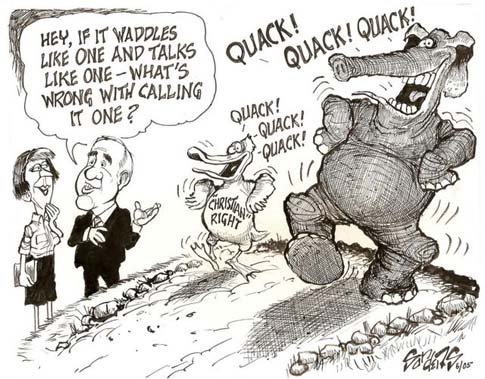
It's not surprising, but it's still worth reading about how the so-called Christian Right is pushing voters toward the Republican party. I particularly love the advice to tell folks that Jesus would be more concerned about gay marriage than about war and peace. Now there is no endorsement of any party or candidate implied here, but I do think it's time to be afraid, be very afraid. There's an election coming and the "Christians" are on the loose. (The cartoon comes from the blog of Bill Sanders, retired cartoonist from the Milwaukee Journal.)

Wednesday, October 11, 2006

Midweek Despair


The news is never good these days. War and rumors of war. Climate catastrophe in the making. Scandal. Violence. Injustice. The Braves missed the playoffs. It is enough to bring despair.
We rest uneasily between two countervailing pressures. One imagines a way out of the present malaise by longing to go back to an imagined past that never was. The other longs to imagine a way forward. Yet the work of imagination necessary for that way forward is blocked by the desolation of the very institutions necessary for that imaginative work.
For example, take Congress ... please. The people's house will not or cannot not tend to the people's work. It will not because too many of its members are beholden to those who long to go back to that imagined past. It cannot because its structures are corrupted by money and vested interests that do not want a way forward.
For another example, take the church ... again, please. It will not or cannot cast a vision and do the work of imagination necessary in these times. It will not because it is too timid and too tepid to shake the foundations of the status quo. It cannot because, again beholden to or cowed by those who long to go back, it no longer attracts those who have been graced by the prophetic imagination so crucial for such a moment.
At such a time as this ... well, it's a good time for a mystery novel and a doughnut.

Tuesday, October 10, 2006

Reimagining Christianity 1.2

Affirmation 2: Loving God includes listening for God’s Word which comes through daily prayer and meditation, through studying the ancient testimonies which we call Scripture, and through attending to God’s present activity in the world.
Perhaps this stuff seems tame. Maybe it's old hat. Or perhaps it is, in its own subtle way, so powerful as to be overwhelming. Certainly the first affirmation, that the way of Christ is not the only way to God, is heretical according to a traditional orthodoxy. Next to that, this second affirmation does not seem to say much.
On the other hand, as Karl Barth observed, "to clasp the hands in prayer is the beginning of an uprising against the disorder of the world."
Indeed, prayer is not seeking to bend God's will to that of the world, but rather seeking to bend ourselves to God's will for the world. If we pray that God's will be done "on earth as it is in heaven," then we are calling forth a social order of love and justice out of the chaos and disorder of a world in which power flows from the end of a gun or the bottom line of a bank statement.
Daily prayer and meditation are the power practices of an alternative community of compassion that casts a vision for a politics of justice. There is, indeed, a politics of prayer and it runs counter to the prevailing politics of empire.
Affirmation 1 may challenge the orthodoxy of Christian theology. Affirmation 2 challenges the orthodoxy of empire.

Friday, October 06, 2006

About Last Night ...

Last evening on the campus of George Mason out in Fairfax, the Commonwealth Coalition had a rally to encourage students to vote no on the constitutional amendment concerning marriage that will be on the November ballot in Virginia. The rally began with a prayer vigil at which a number of clergy spoke.
Here's what I said.
For too long, those who oppose acceptance and equality of LGBT people and their families have misappropriated the terms pro-marriage and pro-family in the service of an anti-gay agenda. Too often they have based their theft of these terms on midguided, selected reading of scripture. But somehow they missed the part about "letting justice roll down like a mighty water and righteousness like an ever-flowing stream."
Right here, right now we reclaim the language of marriage and family, of justice and of righteousness, as our own.
Authentically pro-marriage laws extend the rights, responsibilities and values of marriage to all adults in committed and loving relationships regardless of sexual orientation or gender identity.
Authentically pro-family laws sustain, uphold and protect the diversity of human families throughout God's good creation.
We call on all those who support justice and equality to reclaim the true meaning and values of marriage and family, and to let the justice waters roll down across the Commonwealth on Nov. 7.
The journey to justice is often long and seldom smooth. But when we do the work of love, we shorten the journey and smooth the way. The arc of the moral universe is long, but it bends towards justice. We are the ones to bend the arc. Thank you for being here. Thank you for your energy and your hope. Now go and bend the arc a little closer to justice.

Tuesday, October 03, 2006

Reimagining Christianity 1.1

This week the blog returns, off and on, to the joyous work of being site of an on-line adult Christian education conversation. CW will continue to interrupt with random comments on whatever happens to strike his curious brain, but "major" posts will focus for the next six weeks or so on topics related to Reimagining Christianity. The jumping off point for the conversations comes from the Phoenix Affirmations.
Affirmation 1 says this: for Christians, loving God includes walking fully in the path of Jesus, without denying the legitamcy of other paths God may provide humanity.
For a long time now, there has been a kind of "lazy lay liberalism" that affirms this point. It has been liberal in accepting the validity of other paths. It has been lay in that the attitude is broadly shared "in the pews." Alas, it has been "lazy" in that it has been articulated as a doubt concerning orthodoxy rather than as a principle of Christian theology based in scripture and in our understanding of God.
The image above -- found when I googled "salvation" -- should tell you all you need to know about what conservative evangelicals think about affirmation 1. If not, then, imbedded in an otherwise obnoxious article, First Things provides a helpful description of what conservatives think of lay liberalism. They pretty much think we need to be saved from our own thoughts and that they are the ones to do it.
So, for the sake of beginning a conversation, a few questions:
First, what's your "first-blush" response to affirmation 1?
Second, where might you turn in scripture to support this view? (In other words, how might this affirmation transcend the label of "lay liberalism"?)
Third, how might such an affirmation change the church?
And for those of you spying on progressive pastors and looking for grounds for heresy charges let me just help you out: I absolutely believe that following Jesus does not mean salvation for all can be found only in Jesus. God's thoughts are higher than our thoughts. God's ways higher than our ways. There is nothing more human than imagining that our way is the only way.
At the risk of "truthiness" and with appropriate cautions, there is an informative piece on universal salvation on Wikipedia.

Saturday, September 30, 2006

Proud, for once, to be Presbyterian


There are times -- many times -- when I am angry at the denomination in which I serve. There are time -- many times -- when I am saddened by it. And there are times -- many, many times -- when I am simply bored by it.
But today I am proud of the church, or, at least, of the immediate past moderator of our General Assembly. Elder Rick Ufford-Chase was arrested in DC this week leading a witness for peace and protest against the war in Iraq. The picture here is from the "die in" in the rotunda of one of the Senate office buildings. Way to go Rick!

Wednesday, September 27, 2006

Feeling American


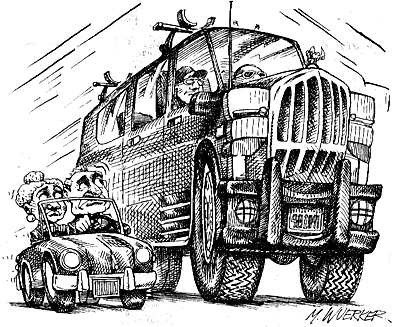
I am feeling so American this week. First, we took a trip -- very American -- over the weekend. We wound up driving a big-butt SUV (full-size Dodge Durango, a testosterone machine if ever there was one) because our minivan died an untimely death last week. Driving an SUV makes you want to squish things -- like small cars, especially hybrids!
While on the road we heard from our mechanic. He told us about the van using the same tone a doctor might in saying, "sir, you've got a malignant mass in your brain."
Or, as Dr. McCoy would say, "it's dead, Jim."
So, still feeling very American, we went car shopping. Actually, being 21st-century Americans we managed this entirely on Craigslist, quite likey the greatest invention ever.
Of course, something about Craigslist is quite un-American -- or, at least not too much like America has become in the post-war years. As you enter the marketplace -- perfectly American -- you also enter a community -- not so American anymore. I've met some of the most interesting people in buying guitars, bikes and furniture and in selling or giving away books, TVs and assorted things we've outgrown.
This time, we met a woman who works for EPA. She was selling a hybrid Honda. Car selling and buying is most American. Working for the common good through a public agency ... highly questionable. Hybrids? Well, maybe not so much, yet.
So now we've donated away to public radio the washed up van and we're the downsized drivers of one hot little Honda. God bless America!

Tuesday, September 19, 2006

A Jesus Agitation

The constitution for that commonwealth of belovedness is found in the fifth, sixth and seventh chapters of Matthew – the sermon on the mount.
When I lose sleep it’s because Jesus’ words haunt my own life. If, as Jesus said, the poor are blessed, how do I, I who live comfortably among the richest one percent of the global population, participate in this blessedness?
If, as Jesus said, the meek are blessed, how do we Christians who dwell in the heart of the American empire participate in this blessedness?
If, as Jesus said, the mourners are blessed, how do we, who live in a culture built on security and the denial of death, participate in this blessedness?
If, as Jesus said, those who hunger and thirst for justice are blessed, how do we who profit so much from systemic economic injustice, participate in this blessedness?
If, as Jesus said, the merciful are blessed, how can we who live in a culture blinded by one eye traded for another, participate in this blessedness?
If, as Jesus said, the pure of heart are blessed, how do we who live in a hypersexualized, violent and utterly banal culture participate in this blessedness?
If, as Jesus said, the peacemakers are blessed, how do we, in whose name and with whose money endless war if waged, participate in this blessedness?
If, as Jesus said, those who are persecuted for the sake of justice are blessed, how can we who seem way too comfortable to speak of being persecuted participate in this blessedness?

Monday, September 18, 2006

Vote No!

In about six weeks the good people of the Commonwealth of Virginia will vote on one of those constitutional amendments “to protect the sanctity of marriage.” Well my own marriage feels relatively sanctified … or something, without such language, but it does make me wonder why some folks feel compelled to write such things. As thrice-married Rep. Bob Barr was famously asked when he proposed the federal defense of marriage act some years ago, “which of your marriages are you defending?”

Why is this the current front line on the culture wars? Martin Luther King observed that many “say that war is a consequence of hate, but close scrutiny reveals this sequence: First fear, then hate, then war, and finally deeper hatred.”[1]

Following King, one might suggest an even broader sequence: first fear, then hate, then injustice – and then war or codified bigotry or institutionalized economic injustice.

The fear of terror – certainly grounded in experience – has so easily become a hatred of the Arab-Muslim world fueled by prejudices and willed ignorance that combine to make the path to war all too easy for our nation to follow. And now we can see so clearly the spiraling cycle of deeper hatred.

The fear of gays and lesbians – grounded in ignorance and fueled by bigotry – becomes a hatred that makes the path to constitutional amendments all too easy for our nation to follow. And I do not even want to imagine the spiraling cycle of deeper hatred these politics of fear will engender.

The fear of the outcast, the marginalized, the homeless poor – grounded, perhaps, in our own deep-seated economic fears – becomes a disdain functionally indistinguishable from hatred that blames victims for their plight and makes the choices that lead to greater injustice seem inevitable. And deeper hatred will continue its spiral.

So vote “no” on all of these fear-filled proposals, and strike a blow for fearless hope.


[1] This version of the quote comes from Quotable King, Steve Eubanks, ed. (Nashville: TowleHouse Publishing 2002) 72.

Thursday, September 14, 2006

Agitation for Today


Why is it that the blowhards from the so-called Christian Right never want to post the Sermon on the Mount on the front lawns of the courthouses across the land? Just wondering, that's all. And, still just wondering, doesn't that thing pictured here have the look of a graven image? Perhaps it would work better to tattoo the commandments on the butt of a golden cow. Surely then we would have a righteous nation.

Tuesday, September 12, 2006

The Spiritual Politics of Yes & No

The primary confession of Christian faith, Kurios Christos, or Christ is Lord, is a political claim even as it is a confession of faith whose repetition is a spiritual practice. In the time of the early church, when that simple confession emerged, the Roman Empire required every citizen to make an annual public profession of loyalty that said “Kurios Caesar” or Caesar is Lord. To say “Christ is Lord” in such a world was an act of dissent and even disloyalty to the Empire.

As the machinery of war grinds on, questions of dissent and disloyalty press in. The vice president accuses war critics of aiding the terrorists. The flag is waved higher and higher. The terror threat level will rise just as surely as the sun as the November elections draw closer.

In the midst of all that, to say Kurios Christos threatens the empire. As Robert McAfee Brown put it, “Caesars don’t like that one bit, whether they reside in Rome or in Washington. So the First Commandment, ‘You shall have no other gods before me,’ and the earliest Christian confession, ‘Christ is Lord,’ are making the same claim in different language, a claim around which all of us not only can, but must, rally. In the name of saying yes to what is ultimate for us, we must be prepared to say no to whatever falsely claims that place of ultimacy. To say yes to the true God is to say no to the idols, wherever and whatever they are.”[1]

Obviously, such saying yes and saying no is a political act, but just as clearly, it is a spiritual practice of Christian faith for it reshapes and reforms us closer to the image of Christ.

Just as the heart of the earliest confession of the faith is deeply political, so too is the heart of our most cherished prayer. When we pray “thy kingdom come … on earth as it is in heaven,” what we’re saying is truly revolutionary: let us live as if God were the ruler of the earth and not the kings and generals and presidents and CEOs whose actions dominant. As Marcus Borg said, “The Kingdom of God is about God’s justice in contrast to the systemic injustice of the kingdoms and domination systems of the world.”[2]

Saying the Lord’s Prayer is saying “no” to the powers and principalities and saying “yes” to God. It is most clearly a deeply spiritual practice of the faith for it ought to transform us, but it is also just as significantly a political gesture that aims at transforming the world.

Even in the deeply personal act of prayer, then, we recognize that while God is, indeed, personal, God is not private. As Jim Wallis says, the “personal God demands public justice as an act of worship. We meet the personal God in the public arena and are invited to take our relationship to that God right into the struggle for justice.”[3]

Of course, one wants to know how? How do we engage in a spiritual practice of social action and protest that does not simply devolve into competing factions shouting beyond one another in endless rounds of mounting anger? We do well to keep in mind William Sloan Coffin’s caution that a “politically committed spirituality contends against wrong without becoming wrongly contentious.”[4] That must involve the deep conviction that those we oppose in the social arena are also beloved children of God, and that we must always seek to find and honor the Christ in them even as we work to achieve an often radically different vision of social arrangements.

Then there is that question of vision. What is the vision of justice toward which we aim and on what is it grounded? Put simply, provisionally and decidedly nonprogramatically, the Biblical vision of justice is this: sorting out what belongs to whom and returning it.[5]

So, for example, in a world of plenty food belongs to those who are hungry; in an economy of abundance work belongs to those who seek jobs; in the 21st century health care belongs to those who are sick, shelter belongs to those who are homeless, and clothing belongs to those who are naked; in our nation’s cities good schools belong to children left behind; in the Presbyterian Church (U.S.A.) ordination belongs to those who are called; in the Commonwealth of Virginia and across these United States marriage belongs to those who are in love regardless of sexual orientation; in Northern Ireland, in Israel, in Palestine, in Darfur, in Iraq and everywhere that plow shares still give way to swords and shields peace belongs to us all.

It is far past time for sorting this stuff out. It is far past time.

It is far past time to move beyond religion that focuses only on the next world, that insists on an unbiblical distinction between the sacred and the secular, and that, as a result, blesses the status quo even as that status crushes millions beneath the weight of injustice, oppression, sexism, heterosexism, racism, militarism and neoconservative globalism.

It is far past time to recognize that the doing of justice is the primary expectation of the God of the Bible.[6]


[1] Robert McAfee Brown, Speaking of Christianity (Louisville: Westminster/John Knox Press, 1997) 43.

[2] Marcus J. Borg, The Heart of Christianity (San Francisco: Harper, 2003) 132-3.

[3] Jim Wallis, God’s Politics (San Francisco: Harper, 2005) 40.

[4] William Sloan Coffin, Creedo (Louisville: Westminster/John Knox Press, 2004) 69.

[5] Walter Brueggemann, in Brueggemann, Parks, Groome, To Act Justly, Love Tenderly, Walk Humbly (New York: Paulist Press, 1986) 5.

[6] Brueggemann, 5.

Friday, September 01, 2006

Check this Out

If you haven't seen it, this is must reading/viewing: MSNBC's Keith Olberman's commentary on Rumsfeld. It's the strongest statement I've seen from the mainstream media in six years. It figures: it takes a sports announcer to understand the game that's being played.

Tuesday, August 29, 2006

Fascism, Anyone?

It's been a long, long time since I posted. Thanks to Jamie and all who participated in the "Bible and Politics" sojourn on this site over the summer.
Here's another Common Dreams piece worth the read as the term fascism gets tossed around in the political discourse of the moment.
Although the article does a fine job of reminding us of what fascism really looks like, I'm not sure the word has a lot of use anymore. It's historical precedent is lost to most folks and it has become like the "H-bomb" of calling someone "Hitler." It stops conversation and ends education -- although Lewis Lapham's recent piece in Harper's may be an exception.
Rather than calling the present powers-that-be fascist, would it be more useful to show people precisely how the interests of the people are being subverted to the interests of corporate power? That may be the definition of fascist, but calling Wal-Mart fascist doesn't move the political conversation anywhere when the vast majority of folks feel that they are living on an economic edge that makes finding "always low prices" feel more like a matter of survival than a matter of politics.
Of course, as Roosevelt knew amidst the rise of German and Italian fascism, fear itself is the fertile ground in which fascism's seeds are planted. Toiling in that ground is crucial if we are to move beyond a politics of fear into something more hopeful.

Thursday, August 17, 2006

The Bible and Politics, pt. 6.6

This is my final post for the Bible and Politics class. Thanks for reading and commenting; I hope we've all learned something and can continue to move to a more faithful political engagement. Thanks!

Anabaptist(ic) Theologians: Yoder and Hauerwas

Yoder
John Howard Yoder, a Mennonite, was a theology professor at Notre Dame until his death in 1997. More than any other figure, Yoder brought Anabaptist perspectives on theology, ethics and politics, to the attention of the larger church.

In his groundbreaking book, The Politics of Jesus, Yoder painted a convincing picture of Jesus as a nonviolent radical. Challenging conventional notions of 'politics' as the exclusive domain of the state, Yoder articulated a church-centered politics that is based on the imitation of Jesus' nonviolent way. Because Jesus' way reveals the ultimate goal of history, putting most of our political efforts into following Jesus is quite 'realistic,' contrary to what many 'Christian realists' insist. Likewise, as a sociological institution rooted in the world, the church's politics are public, a light for all the world to see.

As the previous sentence indicates, the church's involvement with politics outside of itself is in the form of witness; the life of the church is to be a sign to the world of what God is doing. In this sense, the Bible as the central document of the church has a direct function politically, in that it shapes the church's witness.

Yoder also examined the language with which the church speaks to society. Although he remained firm that the only thing the church ever says is 'Jesus is Messiah and Lord,' he felt that--since the church is a thoroughly historical, sociological entity--it can do nothing but say those words by using the various languages and concepts of the day. In speaking to the state, this means proposing policies in realistic terms readily understood by the state.

The biblical vision of society, therefore, is to strictly guide the church's practice, but can be communicated to the state in pragmatic terms. For example, though the Bible teaches Christians to be strict pacifists, it is highly unlikely the state would ever adopt such a position; thus Christians are to critique and restrain specific wars as much as possible, not call the state to an ideal which it will easily ignore.

Hauerwas
Hauerwas, a Methodist, was a colleague of Yoder's at Notre Dame before moving to Duke, where he still teaches. Named 'America's best theologian' by Time in 2001, Hauerwas espouses a highly philosophical version of Yoder's theology--with significant differences.

Whereas Yoder maintained the possibility of a faithful church speaking effectively to the state in pragmatic terms, Hauerwas is skeptical of the possibility of the church speaking in any other terms than its own. For Hauerwas, any attempt to change the terminology waters down the content to a point that compromises the church's witness. (It should be noted that Hauerwas claims continuity with Yoder on this subject.)

As a virtue ethicist and follow of Yoder, Hauerwas devotes the vast majority of his efforts to articulating the church practices that form Christians into a different kind of people--a political, public community whose inner life witnesses to the world. The church should eschew political terminology that is easily confused with the world's (like 'justice' and 'rights'), and speak only its 'thick' language of Christian discipleship.
As indicated by Hauerwas's claim of continuity with Yoder on this subject the difference between the two is probably one of degree. As Anabaptist-minded theologians, both work hard to base their vision of social ethics in the church community first, and in the rest of the world (a distant) second. Both are convinced of the necessity of the church to speak the one message it has been given, but Yoder seems more optimistic about the ability to put this message into practical terms that the state can understand and use in its policies.

In terms of this class, these theologians see the Bible's primary political function as shaping the church into a community whose politics exhibits God's reign. When speaking to the state, Yoder is more willing to couch biblical language in other terms, while Hauerwas believes those are the only terms with which we can speak.

Questions:
1) Is the church a primary location for political action? Is it subordinate to the state's politics?

2) How has the Bible functioned to shape the politics of your church community?

3) What do you think about Christians' ability to speak to the state in 'pragmatic' terms? Do Christians only have Christian language, or do we speak Christian messages in other languages?

Sources:
Stanley Hauerwas, Resident Aliens (Nashville: Abingdon Press, 1989).

John Howard Yoder, The Christian Witness to the State (Scottdale, PA: Herald Press, 1964).

Yoder, The Politics of Jesus, 2d edition (Grand Rapids: Eerdmans, 1994).

Yoder, The Priestly Kingdom (Notre Dame: University of Notre Dame Press, 1984).

Tuesday, August 15, 2006

The Bible and Politics, pt. 6.5

This is the final week for our class, and the final installment in the lesson on theological approaches to the use of the Bible in politics. This post talks about recent moves in Anabaptist theology (Anabaptist denominations include Mennonite, Brethren in Christ, etc.). The final post will look at a few Anabaptist theologians' treatment of our issue.


Anabaptism

In the last 50 years or so, Anabaptist theologians have made their church’s distinct approach to religion and politics known to the rest of the church. John Howard Yoder and Gordon Kaufmann are perhaps the best known recent Anabaptists, and their students Stanley Hauerwas, Duane Friesen, and Glen Stassen have popularized their treatments of the issue beyond the confines of Anabaptism.

Central to the Anabaptist approach is attention to the church as a primary location for discipleship. In regards to our question, an Anabaptist asks first, ‘How can the politics of the Bible be lived out in the community of the church’ well before asking, ‘How can the Bible be used in political situations outside the church.’ This church-first stance means an Anabaptist response to racism, ecological disaster, or poverty will rely heavily on the church’s own use of the Bible in those situations.

Viewing the church in such a way implies some sort of separation between the church as a political unit, and other political units (such as the U.S. government). This separation is precisely what Anabaptists want, and, indeed Anabaptists were among the first to propose a doctrine of the separation between church and state. Part of the reason for such a separation is Anabaptism’s historic stance as a peace church. Because Anabaptists (usually) reject violence, they (usually) reject some degree of participation in any state that uses violence. (Various Anabaptists define ‘participation’ differently, but for most this means not running for office.)

When it does come time to interact with political entities outside of the church, many Anabaptists are pessimistic about using language that is not deeply rooted in Christian tradition. This pessimism comes about from a deep conviction that, through baptism, a Christian’s identity is first and foremost derived from the church. In other words, the primary language of Christians is explicitly Christian, and to attempt a translation would invariably lose much of the meaning that makes Christianity’s politics work. However, because of the priority of the church and it separation from the state, Anabaptists do not go out of their way to tell the state what to do—in biblical or any other terms—and mostly focus on the church’s responsibility to live out a different kind of politics.

Questions:

1) How do you feel about Anabaptism's prioritization of the church? Is the church political? Can political change happen within the church?


2) What do you think about the claim that Christians' primary identity is as Christians? Does this affect how you view your ability to use non-biblical language in politics? Can Christian (and biblical) language be translated for use in politics?