William Sloan Coffin, who put the militant in "the church militant," has joined the church triumphant. As we say in the church, his baptism is now complete in his death.
His was a life well lived and an eloquent voice for peace and justice. The world is a bit darker today for his light having left it. The nation, not to mention the Nation, is a lesser place for his passing, but a richer one for his having passed our way. There is a nice remembrance posted on Common Dreams. Oh, and another one, too.
Years ago, he was president of SANE/Freeze, for which I worked. Although I never met him, it turns out that he might have been my boss for a while -- I'm not sure if our tenures overlapped. Small world.
Thursday, April 13, 2006


Wednesday, April 12, 2006
Pride Goeth Before ...

The religious left. Whatever it is, it's been getting a bit of press of late. Slate ran an interesting piece the other day, and this week's Nation has a lengthy article as well. So I'm wondering, what does the phrase "religious left" bring to mind? What questions does it raise? What challenges? What are the advantages and disadvantages of its use? What theological issues are at stake? Hm ... what would Jesus say? Just wondering, as usual.
Thursday, March 30, 2006

Wednesday, March 29, 2006
Prayerful Thoughts
Hm, sorry for the lag in posts -- I've had many prayerful thoughts of late but few thoughts on prayer. I suppose that's what happens during a time of almost relentless bad news -- immigration policy that would have us welcome the stranger,* a mean-spirited proposal on marriage at Presbytery,** and endless war.*** Even the prospect of opening day for baseball brings its own asterisks this year, what with the steroid scandals. On the other hand, the cherry blossoms are bursting out, it was 65 and sunny and we walked to Maggie Moos for ice cream. A few prayers were answered today! The impossible will take a little while longer.
* provided the stranger has proper documentation.
** overwhelmingly defeated, thanks be to God.
*** no asterisk needed, actually.
* provided the stranger has proper documentation.
** overwhelmingly defeated, thanks be to God.
*** no asterisk needed, actually.
Wednesday, March 22, 2006
An Iraq Prayer
We've been talking about what it means to be human and to be dehumanized. Then I ran across this essay on Common Dreams that quotes from the blog of Tom Fox, the Christian Peacemaker abducted and murdered in Iraq. His life in Iraq, I would suggest, amounted to an extended prayer for peace. Perhaps it is time for some prayer in the streets.
As the Common Dreams piece says:
Tom's Iraq blog is his sad and informative legacy. His last entry was written the day before he was abducted. Why are we here?
"If I understand the message of God, his response to that question is that we are to take part in the creation of the Peaceable Realm of God. As I survey the landscape here in Iraq, dehumanization seems to be the operative means of relating to each other. We are here to root out all aspects of dehumanization that exists within us. We are here to stand with those being dehumanized by oppressors and stand firm against that dehumanization. We are here to stop people, including ourselves, from dehumanizing any of God's children, no matter how much they dehumanize their own souls."
Tuesday, March 21, 2006
To Be Human?

A proposition for your consideration: If prayer is what makes us human, then what stands between us and a prayerful life is dehumanizing. So, what gets in the way of prayer for you? Meanwhile, here's a little Griz for the mill:
Monday, March 20, 2006
When We Pray ... Then What?

When we pray, we seek the Spirit. That is the essence of prayer. Of course, it is excellent advice to be careful what you ask for because you just might get it. Jesus promises, “if you then, who are evil, know how to give good gifts to your children, how much more so will the heavenly Father give the Holy Spirit to those who ask.” The gift of the Spirit is the answer to our prayers, for it brings us peace where we need it, serenity for what requires our courageous engagement, courage and strength to change what needs changing and a loving wisdom for discerning where we are called to engage and where we are called to step back.
OK. So now I’m curious in a practical sort of way. How do we seek the Spirit? How do we know when what we feel is, in fact, the presence of the Spirit and not just, oh, say, the spirits I just consumed (one glass of red wine, in case you’re counting) or the meatballs, or anger left over from some recent unpleasantness, or sadness at a loss? How do we move with the Spirit when we’re reasonably sure that it is the Spirit leading us? What steps to you take to pray? Are there words or phrases or thoughts that you find helpful? Are there actions? Are there places? Times of day? Situations? Does circling a fire and banging drums help? Just curious, that’s all.
Tuesday, March 14, 2006
Prayer Makes Us Human
Prayer provides a practice through which we come home to ourselves in the moment that God has given us with the gifts that God has provided. We do not pray to become someone else – some spiritual giant. Our prayers will not make of us more Nouwens, more Bonhoeffers, more Kings, more Coffins. Our prayers will make us ourselves – fully human, nothing more but nothing less.
As such, prayer is, as Nouwen said, resistance. It is resistance to all that would make of us something less than human. Our prayers for healing are resistance to the ways in which our own deep woundedness would deny us our humanity. That is not to suggest that woundedness is not part of humanness, but rather to acknowledge that wounds can dehumanize. Abuse suffered all too easily becomes abuse inflicted. Emotional damage too easily becomes emotional weaponry. Pain suffered too easily becomes an excuse for pain inflicted.
Prayers for healing and wholeness do not deny the reality of suffering and pain, but rather they seek a way through brokenness to compassion – to suffering with, such that our own experiences of brokenness open us to deeper connections with others in their suffering.
I tried to include a nice graphic that I found here: http://www.justpeace.org/prayer.htm. That site has a number of links on prayer from a Roman Catholic perspective as well as the picture that wouldn't cooperate when I tried to steal it -- er, borrow it -- I mean, appropriate it in an artistic fashion in keeping with the established norms of post modern art.
Tuesday, March 07, 2006
The Way of Prayer
In Peacemaking, Henri Nouwen writes, "The invitation to a life of prayer is the invitation to live in the midst of this world without being dropped in the net of its wounds and needs. The word 'prayer' stands for a radical interruption of the vicious chain of interlocking dependencies that lead to violence and war and for an entering into an entirely new dwelling place. It points to a new way of speaking, of breathing, of being together, of knowing -- truly, to a whole new way of living."
What has prayer meant to you? What practices of prayer have been most meaningful? What experiences of prayer can you recall as particularly meaningful, particularly painful, particularly joyous, particularly funny?
What has prayer meant to you? What practices of prayer have been most meaningful? What experiences of prayer can you recall as particularly meaningful, particularly painful, particularly joyous, particularly funny?
Wednesday, March 01, 2006
The Living Word
Scripture is the live word of the living God, made new for each generation. Of course, sometimes efforts to make the word new take a few liberties, as does this e-mail making the rounds. Not the word of God, to be sure, but pretty amusing in a partisan sort of way. Note to IRS agents looking in: no partisan endorsement is implied or emparted here, just an amusing and, one hope, faithful agitation to the powers that be. Besides, when Garrison Keillor is calling for the impeachment of the president -- in the pages of the Chicago Tribune, even -- one pastor's perspective is the least of the administration's worries.
The 23rd qualm(written by a retired Methodist minister.)
Bush is my shepherd; I dwell in want.
He maketh logs to be cut down in national forests.
He leadeth trucks into the still wilderness.
He restoreth my fears.
He leadeth me in the paths of international disgrace
for his ego's sake.
Yea, though I walk through the valley of pollution and
war, I will find no exit, for thou art in office.
Thy tax cuts for the rich and thy media control,
they discomfort me.
Thou preparest an agenda of deception in the
presence of thy religion.
Thou anointest my head with foreign oil.
My health insurance runneth out.
Surely megalomania and false patriotism shall
follow me all the days of thy term.
And my jobless child shall dwell in my basement forever.
He maketh logs to be cut down in national forests.
He leadeth trucks into the still wilderness.
He restoreth my fears.
He leadeth me in the paths of international disgrace
for his ego's sake.
Yea, though I walk through the valley of pollution and
war, I will find no exit, for thou art in office.
Thy tax cuts for the rich and thy media control,
they discomfort me.
Thou preparest an agenda of deception in the
presence of thy religion.
Thou anointest my head with foreign oil.
My health insurance runneth out.
Surely megalomania and false patriotism shall
follow me all the days of thy term.
And my jobless child shall dwell in my basement forever.
Thursday, February 23, 2006
Always Low Prices
Check this one on Walmart art. Makes me want to run right out and shop. And then there's this, from Frederick Douglas: "I am one of those who think the best friend of a nation is he who most faithfully rebukes her for her sins-and he her worst enemy, who, under the specious and popular garb of patriotism, seeks to excuse, palliate, and defend them. " Thanks, cle. Of course, those of us faithfully rebuking stand to be sued by Walmart for definition -- as if the Waltons haven't defamed most everything they've touched. Oh, wait, you say. Douglas was talking about rebuking the nation and I'm railing on a rapacious corporation. Well, we live in the days when what's good for Walmart and other huge corporate interests is good for America. Or so they tell us.
Monday, February 20, 2006
The Homosexual Agenda -- Oh My!
Well, since I've been accused more than once of being a dupe for the gay agenda, I was thankful to Beth Quinn for bringing to light just what my More Light friends are up to. Here it is: the gay agenda. Be afraid. Be very afraid.
Friday, February 17, 2006
a thousand words and more than that many laughs
 Because laughter is better than tears and more healthy than rage, here's a great list of comments about hunting with the vice president. Enjoy.
Thursday, February 16, 2006
Grace, Love, Limits
If grace is real, it must be real for everyone no matter how malevolent they may be. Limit cases interest me because they force me to reconsider the depth of the love that Jesus commands his followers to exercise always and everywhere. That's why the "does God love Osama?" question is interesting. The answers we offer to such question shape and form how we live our lives everyday in the face of the suffering inflicted upon us by others. This is true in the outsized cases such as a terror attack, but it is also true in the intimate personal cases like when a partner says something hurtful or when a colleague spitefully undercuts us or a friend speaks ill of us. The question, in a blog-size nutshell: If God is love, how are we to respond to hate?
Here's what Dr. King wrote, in Strength to Love:
"We shall match your capacity to inflict suffering by our capacity to endure suffering. We shall meet your physical force with soul force. Do to us what you will, and we shall continue to love you. Throw us in jail, and we shall still love you. Bomb our homes and threaten our children, and we shall still love you. Send your hooded perpetrators of violence into our community at the midnight hour and beat us and leave us half dead, and we shall still love you. But be assured that we will wear you down by our capacity to suffer. One day we shall win freedom, but not only for ourselves. We shall so appeal to your heart and conscience that we shall win you in the process, and our victory will be a double victory."
Here's what Dr. King wrote, in Strength to Love:
"We shall match your capacity to inflict suffering by our capacity to endure suffering. We shall meet your physical force with soul force. Do to us what you will, and we shall continue to love you. Throw us in jail, and we shall still love you. Bomb our homes and threaten our children, and we shall still love you. Send your hooded perpetrators of violence into our community at the midnight hour and beat us and leave us half dead, and we shall still love you. But be assured that we will wear you down by our capacity to suffer. One day we shall win freedom, but not only for ourselves. We shall so appeal to your heart and conscience that we shall win you in the process, and our victory will be a double victory."
Thursday, February 09, 2006
Saved from What?
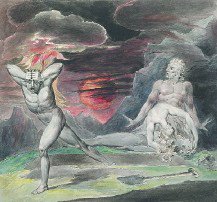
Marty asks the logical question: saved from what? What is this "salvation" all about? From what are we saved and to what point and purpose, if any?
I grew up in the Bible belt in the midst of the "I found It" bumper sticker craze of the 1970s. "It" meant a personal relationship with Jesus, and "it" was clearly crucial to one's personal salvation. "It" was what saved one from a life of alienation from God and an eternity of hellish alienation. More to the point, "it" was what saved you from the wrath of God. Indeed, there's a book out called Saved From What by a conservative evangelical that argues precisely that humankind needs to be saved from God.
The image of a wrathful God is ancient, and certainly has Biblical roots. The word "wrath" shows up hundreds of times in scripture, and is certainly the subject of much artwork as Cain Fleeing the Wrath of God illustrates. Among my favorites is Exodus 32, where Moses talks God back from the brink of a wrathful destruction of the golden-calf worshipping people. Perhaps the most famous English-language example of wrath-of-God theology is in Jonathan Edwards' Sinners in the Hands of an Angry God. That one will send shivers down your spine.
It should come as no surprise that I don't see it this way, but it's important to acknowledge how common such theology is, even when it comes in a "kinder and gentler" version of a wrathful God who calls his (and this God is always masculine) followers to hate the sin but not the sinner. I actually prefer the old one, whose hate was right out there!
Well, no. But anyway, as is often the case, I find John Hall's work helpful here. In Why Christian?, he asks, "Do you know (most people don't, I find) that the word at the center of this whole discussion, 'salvation,' comes directly from the Latin word for 'health' -- salus? It means to be whole, to be integrated. You may think, for instance, of the way that Jesus in the Gospels, in healing someone of some debilitating illness, tells them, 'Be whole.' ... All that kind of thing lies behind the word that we too often turn into something so 'spiritual,' religious, and 'otherwordly' that it betrays the most fundamental meaning of the word itself, which is a very earthy thing: the healing of persons, the reintegrating of divided selves, the reuniting of people with those from whom they are estranged, the equipping us for the kind of life our Creator intended us to have. 'I came that they might have life and have it more abundantly.'"
Saved from what? From ourselves, I think.
Tuesday, February 07, 2006
Grace and Salvation
If you google "grace" you get about 95 million hits. If you google "salvation" you get about 20 million. I have no idea what the roughly 5 to 1 ratio of grace to salvation means.
But I was pondering these words yesterday after a couple of women came to our door peddling, I presume, salvation. I'm not certain of their pitch because I wasn't at home and my partner* was on the phone and didn't answer the door.
In any case, I'm sure most of you have, at one time or another, answered a similar knock and been asked, in one form or another, "have you been saved?"
I've seen variations on that theme become the center of debate at Presbytery meetings where the concern is not so much for the salvation of folks at the meeting -- after all, we Presbyterians are God's frozen-chosen. The question at such meetings usually arises during questions to candidates for ordination who will be asked something along the lines of "do you believe God saves all people?"
It's a trap, for universal salvation has been considered heresy according to orthodox Christian theology for roughly 1600 years. The orthodox position, crudely stated, is that Christ's death on the cross was the necessary atonement for the sins of humankind and trust/faith in that saving death is necassry to receive salvation.
Of course, as with most theological arguments, there is an orthodox tenet that undermines the orthodox position. In this case, the essential Reformed tenet of God's sovereignty. When one considers the Biblical witness that God desires communion with all of humankind on the one hand and the belief that God is sovereign -- God gets what God wants -- on the other, some form of universalism seems the logical conclusion. Don't try that on the floor of Presbytery, though, because pretty soon you'll get the Hitler question -- e.g., Do you believe Hitler was saved? Actually, Hitler is a great example, because he presumably had "accepted Jesus Christ as Lord and Savior."
Ah, salvation theology ... a sticky wicket. What do you think?
*I'm using that term just to drive a little closer to the edge all those folks out there who have had a field day speculating about my sexuality in the months since my church's stand regarding weddings was in the news.
But I was pondering these words yesterday after a couple of women came to our door peddling, I presume, salvation. I'm not certain of their pitch because I wasn't at home and my partner* was on the phone and didn't answer the door.
In any case, I'm sure most of you have, at one time or another, answered a similar knock and been asked, in one form or another, "have you been saved?"
I've seen variations on that theme become the center of debate at Presbytery meetings where the concern is not so much for the salvation of folks at the meeting -- after all, we Presbyterians are God's frozen-chosen. The question at such meetings usually arises during questions to candidates for ordination who will be asked something along the lines of "do you believe God saves all people?"
It's a trap, for universal salvation has been considered heresy according to orthodox Christian theology for roughly 1600 years. The orthodox position, crudely stated, is that Christ's death on the cross was the necessary atonement for the sins of humankind and trust/faith in that saving death is necassry to receive salvation.
Of course, as with most theological arguments, there is an orthodox tenet that undermines the orthodox position. In this case, the essential Reformed tenet of God's sovereignty. When one considers the Biblical witness that God desires communion with all of humankind on the one hand and the belief that God is sovereign -- God gets what God wants -- on the other, some form of universalism seems the logical conclusion. Don't try that on the floor of Presbytery, though, because pretty soon you'll get the Hitler question -- e.g., Do you believe Hitler was saved? Actually, Hitler is a great example, because he presumably had "accepted Jesus Christ as Lord and Savior."
Ah, salvation theology ... a sticky wicket. What do you think?
*I'm using that term just to drive a little closer to the edge all those folks out there who have had a field day speculating about my sexuality in the months since my church's stand regarding weddings was in the news.
Sunday, February 05, 2006
Happy Birthday Bonhoeffer
On the 100th anniversary of the great prophet, here are some links to Bonhoeffer including a link to a birthday reflection for seekers of peace and justice, info on a new documentary airing on PBS tomorrow, a link to the Bonhoeffer society, and the Barmen Declaration -- the statement of theological principles that guided the confessing church movement in Germany under Hitler. While Karl Barth wrote the declaration, Bonhoeffer was a central leader in the confessing church and the anniversary of his birth -- especially when it falls in a time of increasing confusion about ultimate authority and allegiance -- is a good time to reread Barmen. Happy Birthday Bonhoeffer.
Friday, February 03, 2006
What Manner of Man ... or God?
A small provocation for Friday afternoon, courtesy of Hall's Why Christian?:
What God? What is this God like? If Jesus "reveals" God, puts us in touch with God, makes God specific and particular, no longer a vague abstraction, then what sort of God do we have here? Is this a God chiefly of power and might, who is primarily concerned for "himself" and "his" own glory? Or is this a God who is out to condemn every sinner -- who, as Dorothy Sayers once wrote with characteristic irony, really hated everybody, but let his wrath fall on his beloved son instead? Or is this a legalistic, tit-for-tat sort of God, who has once and for all laid down the rules for being a "good" human being -- a moralisitic divinity who backs up the moral codes of exemplary citizens (my village!)? Or is this an internalized, gently forgiving, no-hard-feelings sort of God whose "business" as an ironic thinker of the nineteenth century said, "is to forgive"? If Jesus is for Christians the finite one through whom the Infinite is primarily glimpsed, what does that tell us, concretely, about the Infinite -- about "God"? (Hall, 25)
What God? What is this God like? If Jesus "reveals" God, puts us in touch with God, makes God specific and particular, no longer a vague abstraction, then what sort of God do we have here? Is this a God chiefly of power and might, who is primarily concerned for "himself" and "his" own glory? Or is this a God who is out to condemn every sinner -- who, as Dorothy Sayers once wrote with characteristic irony, really hated everybody, but let his wrath fall on his beloved son instead? Or is this a legalistic, tit-for-tat sort of God, who has once and for all laid down the rules for being a "good" human being -- a moralisitic divinity who backs up the moral codes of exemplary citizens (my village!)? Or is this an internalized, gently forgiving, no-hard-feelings sort of God whose "business" as an ironic thinker of the nineteenth century said, "is to forgive"? If Jesus is for Christians the finite one through whom the Infinite is primarily glimpsed, what does that tell us, concretely, about the Infinite -- about "God"? (Hall, 25)
Monday, January 30, 2006
Why Jesus?
Theologians call it the "scandal of particularity." Why incarnation? What does it mean to call Jesus the Word made flesh? Well, before diving into the many why's, how about just a few "who's" to begin with.
Who is this One called savior and lord,
Who was from the beginning, eternal Word?
Who is this One whose birth angels would foretell?
Who is this One in whom the fullness of God was pleased to dwell?
Who is this One?
Who is this One who touched and healed?
Who is this One in whom God is revealed?
Who is this One who calls us here,
Who gathers us in from far and near?
Who is this One?
Who is this One riding in on a colt?
Who is this One, the king of kings?
Who is this One called prince of peace, the hosannas sing?
Who is this One hung on a tree,
Whose life and death and life again somehow set us free?
Who is this One?
Who is this one with a table spread,
Who offers us this daily bread,
Who pours this cup and shares this wine, and calls us out to spread the vine?
Who is this One?
Who is Jesus -- for you?
Tuesday, January 24, 2006
And another thing ...
This may be slightly off-topic, but what the heck! I just bugged out of a Presbytery meeting in which an overture from the session of the church I serve was swallowed up in parliamentary manuevering. The overture concerned removing the section (G-6.106b) in the constitution of the Presbyterian Church (U.S.A.) that stands in the way of ordaining gays and lesbians to church office.
The case for removing G-6.0106b from the Book of Order is the same today as it has been each time National Capital Presbytery has voted to seek its removal. All that is different is the final report of the Theological Task Force on Peace, Unity and Purity of the Church.
Nevertheless, no matter how many good faith efforts at relationship building we pursue, no matter how many practices of discernment we engage, no matter how many alternative means of decision making we use, there comes a time to confront this issue. G-6.0106b is a failed piece of legislation that for a decade has undermined the peace, unity and purity of the church.
The whole church was watching today as this Presbytery, which has for a long time made plain its desire to see a church whose hospitality, grace, love and justice are as wide and as deep as God's. Alas, the clarity of that desire was blurred by a vote that endorsed the Task Force's report and only provisionally endorsed removing G-6.0106b.
I believe that, as Dr. King said, the arc of the moral universe is long but it bends toward justice. I trust God's grace, and pray that it will work its way with us to further the peace, unity and purity of the church we serve.
What has this to do with scripture? Well, nothing and everything, as it is, of course, the narrow interpretation of a handful of verses that holds together the house of cards that is homophobia. If that suggest of rank bigotry is too strong, perhaps it would be better to call it a house of cards of heterosexual privilege. I live in that house -- and I use the resources of scripture to tear it down.
The case for removing G-6.0106b from the Book of Order is the same today as it has been each time National Capital Presbytery has voted to seek its removal. All that is different is the final report of the Theological Task Force on Peace, Unity and Purity of the Church.
Nevertheless, no matter how many good faith efforts at relationship building we pursue, no matter how many practices of discernment we engage, no matter how many alternative means of decision making we use, there comes a time to confront this issue. G-6.0106b is a failed piece of legislation that for a decade has undermined the peace, unity and purity of the church.
The whole church was watching today as this Presbytery, which has for a long time made plain its desire to see a church whose hospitality, grace, love and justice are as wide and as deep as God's. Alas, the clarity of that desire was blurred by a vote that endorsed the Task Force's report and only provisionally endorsed removing G-6.0106b.
I believe that, as Dr. King said, the arc of the moral universe is long but it bends toward justice. I trust God's grace, and pray that it will work its way with us to further the peace, unity and purity of the church we serve.
What has this to do with scripture? Well, nothing and everything, as it is, of course, the narrow interpretation of a handful of verses that holds together the house of cards that is homophobia. If that suggest of rank bigotry is too strong, perhaps it would be better to call it a house of cards of heterosexual privilege. I live in that house -- and I use the resources of scripture to tear it down.
Subscribe to:
Posts (Atom)

