Thursday, October 27, 2005
Signs of the Times


Saturday, October 22, 2005
Choose Hope
One of the most pernicious false gods that we cling to here in the new Rome is the illusion of control. But even here, we have no control over the time in which we live, and often no control over the events that mark our lives.
Nevertheless, we are given the choice of how we shall live in the time we are given and how we shall respond to the events that mark our time.
Most of us have very little control over the institutions where we work or go to school, we have no control over our family of origin, but we can choose how we respond to the stresses of our jobs or school life or family life. It is often overwhelmingly tempting to respond to work or school or family with cynicism.
In fact, it is often hip, stylish and celebrated to be cynical. Sometimes it’s fun, and it can often be genuinely funny – think Seinfeld for a moment. And in this city in particular, it is often expected and it is certainly easy to turn to cynicism.
But cynicism is not a faithful response to the world. We are called to a stewardship of attitude.
This is not a call to naiveté, or to Pollyanna-ish living. Critical engagement with the world is crucial. But when life places before you hopelessness and hope, faith demands that we choose hope.
That may just be the most difficult choice we are ever called to make. Choosing hope requires taking responsibility. Abandoning hope lets us off the hook. At the same time, choosing hope requires that we trust others. Abandoning hope allows us to slip into a splendid isolation where we can wallow in hip, detached despair or sink into genuine depression. Choosing hope draws us deeply into the messiness of real life and real community. Abandoning hope allows us to dwell in dark fantasy.
Friday, October 14, 2005
The Future?
It was an interesting film to watch with a group from a church whose future has been in doubt for many years, and continues to be an open question as we stumble along from one crisis to the next.
It leaves me wondering, is there a future for the progressive church?
We all know that the so-called Christian Right is an extremely powerful cultural and political force in the nation. The Christian Right dominates the cultural perspective on Christianity so much that most folks outside of the walls of progressive churches do not even know that such a thing as progressive Christianity exists.
Years ago, when I worked for a short while on the Nuclear Freeze campaign, I recall the shock that a friend expressed when he learned that I was going to the Divinity School at the University of Chicago. "What’s a good progressive like you doing in a divinity school?” he wanted to know. I tried to explain that there was a tradition of progressive Christianity, but he had never encountered it. Most folks haven’t.
For most Americans, Christianity has become synonymous with a particular legalistic, conservative, evangelical movement whose vocal, media-savvy leaders are quick to condemn anyone who sees the world differently than they do.
Gays and other sexual minorities? An abomination. Women? Remain silent and “gracefully submissive,” in the words of the Southern Baptist Convention. Jews? In need of salvation. Feminists, lesbians, the ACLU, People for the American Way? Responsible for September 11, according to Pat Robertson and Jerry Falwell.
At a meeting of conservative Presbyterians a while back, one speaker said that liberals were like bugs devouring the foundation of the church. He called for stomping as the appropriate response to such an infestation. I’m not sure, but I believe they broke into a spontaneous version of “Guide My Feet” at that point!
In the face of such attacks from some conservatives and such widespread ignorance from the population as a whole, we have to ask: is there a future for progressive Christianity?
As for me, I firmly believe and have dedicated my own life to the conviction that God is calling forth a progressive, inclusive, engaged, diverse church upon which to build the beloved community. Now this future remains to be worked out in our living together as church.
Yes, there is a future. But whether it is a future of exile, decline, death and memorial stones or a future of foundation stones and building together and vibrant worship and call and response … remains to be worked out in our living together as church.
Indeed, the foundation was laid for a progressive, inclusive and diverse church by Jesus himself, as one can see in passages such as Mark 7:24-37, where Jesus encounters the Syrophoenician woman.
What might the future look like, if we live into our calling? A progressive Christianity will not be afraid. It will welcome contact and dialogue and deep conversation with other cultures and traditions including with our conservative, evangelical brothers and sisters, and it will be open to being transformed itself in and through such relationships, just as Jesus was transformed in his meeting with the Syrophoenician woman.
Now most commentators don’t want to read it this way, but the plain and clear story line here shows us that Jesus is changed by his encounter.
Jesus went to a Gentile region to get away. A Jewish healer and prophetic teacher ought to be able to rest in quiet anonymity for a while in the region of Tyre. Yet a gentile woman comes and pleads for healing and wholeness for her daughter.
Jesus tries to brush her aside – after all, he is Jewish and is focused on the spiritual condition of his own people. Yet her faithful pleading opens him up to the possibility that his mission is broader than he had previously understood.
In this moment, Jesus comes to more fully understand that, as William Sloan Coffin put it, “There is no way that [faith] can be spiritually redemptive without being socially responsible. A [faithful person] cannot have a personal conversion experience without experiencing at the same time a change in social attitude. God is always trying to make humanity more human.”
In this encounter with a marginalized woman, Jesus becomes more human, he becomes more clearly a child of a loving, merciful, just creator.
As Bonhoeffer put it, “Jesus tells us: You are standing under God’s love; God is holy and you, too, are to be holy.”
And in this story from Mark, Jesus radically expands the reach of that good news. For the good news is not just to one sect, defined by a set of legalistic boundaries designed to keep folks out. No. The good news is for everyone, for we are all heirs to the promise of wholeness and healing that is proclaimed through Jesus.
There is no East or West, male or female, slave or free, Gentile or Jew, black or white, straight or gay – for we are all children of the same God.
Jesus goes way out of his way to demonstrate this when he travels to the Decapolis on his way back to Galilee. Going by way of the Decapolis is like traveling from DC to New York by way of Cleveland – only more so, for the Decapolis was an unclean region avoided by Jews. Perhaps more like Pittsburgh!
His route and his actions – healing a Gentile from an unclean region – proclaim good news for all people. Jesus shows us here that grace is abundant; that the power of healing and wholeness is everywhere for everyone.
The people were astounded beyond measure, scripture tells us. Why? Was it the miracle healing? No doubt that was part of it, but healers were not uncommon. The larger miracle was this: for a people used to hearing that they were unclean, excluded, beyond salvation, Jesus proclaims this good news: God’s radically inclusive love for all people brings healing and wholeness to all of our wounded and broken lives; God’s radically inclusive love brings peace into our warring lives; God’s radically inclusive love for all creation brings light into the present darkness.
This is the foundational truth upon which we will build the future for progressive Christian faith and life. This is the bright light that will illuminate the way for that progressive life and faith to journey toward the future of God’s calling. And this promised future marks the most profound difference between progressive Christian faith and life and its other.
For, as William Sloan Coffin suggests, the theology of the Christian Right offers a present that has only a past. To that I say God calls forth a bright new morning -- in this place; at this moment.
God is calling us to risk the new day, to step into a bright new morning – a new morning of restored relationships following a long night of barriers and barbed wired; a new morning of reparation in our streets following a long night of injustice; a new morning of peace following a long nightmare of warfare; a new morning of light and more light following a long dark midnight. Arise, our light is come!
Hey, maybe the progressive church is just a beat up old undersized race horse that just happens to be the wave of the future. It could happen.
Thursday, October 06, 2005
Katrina Diaries: From the Gulf Coast to the Gulf War
On Friday morning I detoured into downtown to walk through
We walked through the park and shared bits of our stories. His name is Theodore. He is 30, African-American, born in
We talked a bit about what had happened in the park when I was a child. I shared with him how my own sense of ministry, and my own feeling of being called into ministry were shaped by the memories of what people of faith had done in places like
He told me he wanted to find a job as a painter. I asked him if he had any construction experience and, when he said “no,” I suggested asking the folks at the
In the grand scheme of things, hanging drywall – or ripping it down when it’s been flooded out – are probably more necessary jobs than pastoral ministry. In any case, such work certainly offers the great satisfaction of immediate results.
I left the
As Martin Luther King said in calling for an end to the war in
Signs and symptoms of spiritual death are all around us in the American empire. We continue to be, as Dr. King noted 40 years ago, the greatest purveyor of violence in the world. Our coarsened culture has become also the greatest purveyor of cheapened sexuality, mass consumerism and hyperindividualism.
Despite what some preachers will contend, and despite what some passages of scripture seem to suggest, I cannot believe that God sends down huge storms to destroy wayward societies. But the still, small voice of God does speak through the whirlwind, calling us in the wake of Katrina to refocus our priorities, to rebuild the commonwealth, to restore justice to the public square and repair the breaches of the cities’ streets to live in. In such work, a profound joy meets our time’s deepest need.
Wednesday, October 05, 2005
Katrina Diaries: Pretty, Witty and Gay
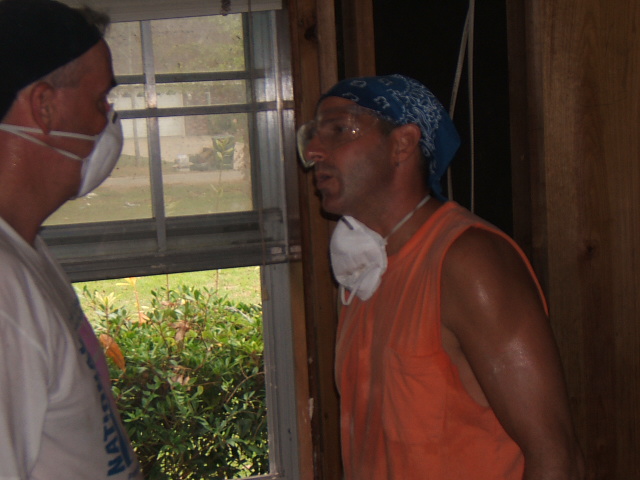
Another day of moldy drywall. It remains hot and humid and we are so disgusting that I can barely stand to be in the same room with myself. In the heat of this afternoon, two irrepressible young women who have joined us from
The deepest joy I have discovered in this journey has come in watching Tom exercise his immense gifts of organization, leadership, energy and good humor. The entire team has been moved by his capacity for compassion – for true suffering with and alongside the families we are serving. We have been guided by his experience with plumbing and electricity, too, and have managed to remove fixtures from bathrooms and kitchens without making a bad situation worse and without electrocuting anyone! His ministry here is surely a sign of the reign of God in the world.
It’s a shame – one might call it a sin – that the world does not recognize such ministry. The church and the broader culture are torn apart by issues concerning gay, lesbian, bisexual and transgendered people, yet the people themselves remain often invisible. Whether it is ordination issues within the church, or marriage and other civil rights issues in the society, GLBT people are painted with broad brushes and their individual lives are obscured. As a result, the conversation is diminished. Indeed, it is not even ever a conversation, because conversation demands partners rather than stereotyped images.
For this one week, at least, conservative and progressive people of faith have shared a common mission: to serve the people in most need along one small stretch of the battered
Houses may not be the only thing that is rebuilt along the
Tuesday, October 04, 2005
Katrina Diaries: Theological Storms
Rita swirls out in the Gulf, bringing sporadic rain and a steady breeze with sweet relief from stifling heat and humidity. No amount of wind can clear the air of the bad theology that clings to the aftermath of Katrina. The other day I heard a radio preacher talking about the judgment of God on the voodoo-welcoming people of
Never mind that a god so narrow minded as to wipe out people seeking various ways to the divine does not deserve praise and worship. A god who discounts as collateral damage the hundreds of people who probably shared the radio evangelist’s faith doesn’t even deserve respect. A jealous and angry god is one thing – perhaps even a Biblical thing – but a god with such lousy aim is worthless. A god who unleashes flood waters on poor people trapped in
I met some folks today at a church that sits right on the coast in
Less than two blocks away, 30 people died when the motel they were in collapsed. Here’s a god with pin-point precision but confused priorities. A god too busy watching over a temple of bricks and mortar to protect the flesh and blood next door is not the God made known in Jesus Christ, the suffering servant.
But when you wander through streets that look like a war zone, it’s hard not to wonder who and where God is in all of this.
Desmond Tutu has written, “The God we worship is the Exodus God, the great liberator God who leads us out of all kinds of bondage. Do you remember what God told Moses? [God] said, ‘I have seen the suffering of My people. I have heard their cry. I know their suffering and am come down to deliver them.’ Our God is a God who knows. Our God is a God who sees. Our God is a God who hears. Our God is a God who comes down to deliver. But the way that God delivers us is by using us as […] partners, by calling on Moses, on you and me.”
Ah, and therein lies the rub. Lousy theology lets us off the hook. It is fatalistic rather than faithful. If spirit is wind and fire – pnuema and ruah – then surely God can speak to us through the ferocious winds of Katrina and Rita, and surely part of the message is simply this: “here I am; where are you? Here I am, come and join me.”
Monday, October 03, 2005
Katrina Diaries: Justice Among the Ruins
Today I heard someone remark that those who had the most lost the most while those who had the least lost the least in this storm. While that may be true from a certain market orientation, people of faith are called to measure according to a different economy. There’s more than lousy politics going on; there’s lousy theology, too! Moreover, even within the framework of a market economy it would be more accurate to say that those with much lost much but those with little lost everything.
Within a more comprehensive economy, perhaps the economy of the
All of the folks we’ve been trying to help down here count themselves blessed and lucky. All of them lost homes, but none of them lost loved ones. Still, it is heartbreaking to pick up stuffed animals encrusted in mud, to find graduation pictures plastered to moldy furniture, to find a photograph date-stamped “December, 1974” and know that someone’s memories will be forever diminished by such losses.
Walter Brueggemann has said that the Biblical definition of justice amounts to sorting out what belongs to whom and returning it. In the wake of Katrina that is an improbably huge task.
Some things are easy. Today we were hanging drywall in the home of a soldier whose entire leave has been spent gutting his house and trying to get at least a little of it livable for his wife before he returns to active duty the last week of September.
I asked him if he was a fisherman. He said “yes,” and, pointing toward his back yard, I said, “well, at least your boat looks like it’s in good shape.” He said, “that’s not my boat. It belongs to the guy four houses down and across the street. It wound up there when the water went back down.”
Other things are more difficult. Another neighbor was cleaning out his house – a trailer he’d lived in for more than 15 years. His insurance was cancelled a few weeks before Katrina hit because the company was getting out of business in hurricane prone areas. No other company would sell him a policy until the end of hurricane season.
What belongs to whom? How can it be returned? Courts and legislatures will have to do some of the sorting. People of faith across the nation will be called upon to remind public officials that food belongs to the hungry, clothing belongs to the naked, healthcare belongs to the sick, jobs belong to the unemployed, and shared risks belongs to the commonwealth. Such sorting is the work of justice.
Among the few households we were able to help, the work of justice was on a smaller scale. While the folks we worked with counted themselves lucky, they were also experiencing an almost unfathomable loss and grief. Papers rescued from a crushed desk unleashed anger at an insurance company. A picture pulled from the muck brought on a torrent of tears. Some losses exceed any calculus.
What belongs to those whose losses cannot be counted? How can it be returned? Working at the level of compassion, perhaps the first gesture of justice is recognizing that dignity belongs to the suffering. The first part of this relief effort lies not in gathering scattered possessions but in helping the suffering restore their fractured dignity.
Sunday, October 02, 2005



Katrina Diaries: The View from the Front Porch
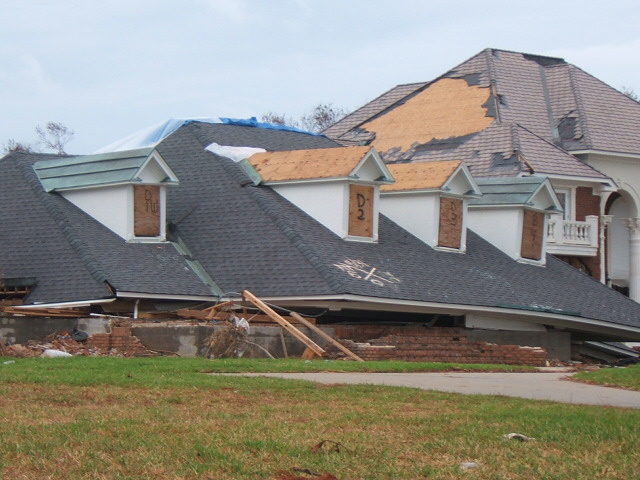
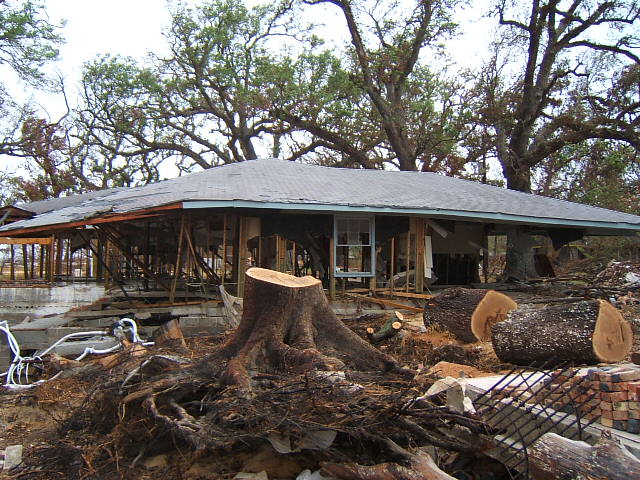
Another multi-analgesic day: gutting the interior of Alfred Jackson’s house. Mr. Jackson, an 82-year-old African-American man, has lived his entire life in the house we stripped to studs today. Katrina was the first storm to flood his house, and she left it under eight feet of brackish water.
The work is brutal in the 90-degree heat, and it doesn’t leave much time for conversation so I don’t know much about Mr. Jackson’s eight decades in
Katrina’s winds and water swept away the books and many of the mementos. They ripped the veneer right off the walls. They also ripped the veneer that has glossed over racial politics in
An octogenarian in
Yesterday we drove along the beach front road where Sen. Trent Lott’s house was destroyed. President Bush joked about sitting on the front porch again when it is rebuilt. I don’t suppose the president will ever sit out under the tree in Alfred Jackson’s front yard.
He should. Familiarity does not breed contempt; it cultivates concern and compassion. Many political observers have noted President Bush’s apparent discomfort with poor folks in general and poor African-Americans in particular. The First Lady may be honest in her insistence that Mr. Bush cares for all Americans; nevertheless, her heated defense of her husband does not change the fact that folks like Alfred Jackson will never be among Mr. Bush’s circle of familiarity and concern.
As for me, in better – and cooler – times, I am pretty darn sure that I’d rather spend an afternoon sitting in Mr. Jackson’s front yard than on Trent Lott’s front porch. The view of the
Saturday, October 01, 2005
Katrina Diaries: Lord's Day
The best way to describe this Sabbath is that it has been a four ibuprofen day. We made of our work a worship, and recalled with our backs that the Sabbath was made for humankind not humankind for the Sabbath.
The “worship” began with prayer at
We are in an area spared the worst of the storm, and still the devastation along the shore is indescribable. Tornados reduce homes to matchsticks; hurricanes do the same thing and then sweep the matchsticks out to sea.
Such storms strike with a great egalitarian furry, sweeping away mansions and shacks alike. Along the beach road in
Two blocks inland the homes are far more modest – two bedrooms on a slab qualifies as middle class; working class folks inhabit trailers. Just a few days ago all were six feet under the
Of course, while the wind and waves were no respecter of class, the economic structures that will determine the course of rebuilding are entirely class driven. There is a class of folks who are insured and another class of folks who are not. There is a class of folks who can afford to rebuild and another class who cannot. The wealth on the coast line here is not as deep as the flood waters were, and thus the outpouring of volunteers is crucial. Free labor is all some folks can afford.
But it will not, on its own, be enough to ensure the return of ordinary working folks – the shipbuilders, the fishers, the shop owners, police, fire fighters, school teachers, service employees and factory workers who have lived along this coastline in homes just a stroll away from the water.
Ensuring their return will take a massive influx of public money justly distributed. These days, the tens of thousands of folks all along the
They certainly aren’t getting the concern of some insurance companies unless they have flood insurance. Homes utterly destroyed by the 25-foot storm surge aren’t covered by standard policies because the damage was caused by water not wind – never mind that the wall of water was driven by 150-mile per hour winds.
One home we worked on today was totaled by the storm surge. It had to be completely gutted, which we did. The insurance agent told the home owner to expect $10,000 to cover the roof of their shed, which was blown off by the wind, but to expect nothing for their house which was under eight feet of water when the surge rolled through. The family of five is homeless, but their shed will have a nice roof.
For now, the kindness of strangers is all that holds together many such families. Such kindness marks the first step on the road to recovery. There’s plenty of work to be done. Will there be enough strangers to do it?
Friday, September 30, 2005
Katrina Diaries: Heroes Highway
It is a long, long, long way from
The long, low ridge that emerges from the broad coastal plain just south of
I cannot drive through
I am a southerner, born in
But sometimes I think those remarkable changes have been overtaken by other equally significant yet almost unremarked upon changes in the broader culture. The Civil Rights Movement itself reminds me of a time before we all became consumers instead of citizens, before we became bound more by a common market than by common humanity. I cannot think about the Movement without recalling the music that kept spirits high; a recollection that makes the destruction of music-filled
Yet driving down the “
Even after the deluge and amidst the apparent triumph of consumer culture, we remain, each of us and all of us, creatures of one earth. Perhaps we may recall this fundamental truth and live into it again as creation reveals its secrets by and by.
Thursday, September 29, 2005
Katrina Diaries: A Long Day's Journey
If Frederick Buechner is right – if call emerges at the intersection of deep joy and deep need – then I am less called than confused. Why am I heading to the Gulf Coast to join a group of volunteers from National Capital Presbytery? The pictures from Katrina’s wake are compelling, to be sure. I am a pastor, and pastors are supposed to serve, right? After all, I have some experience in cleaning up after hurricanes and in leading mission trips. In addition, to my great surprise, an openly gay member of my congregation is heading down with the team. I am surprised at his participation not for doubts about his gifts – he holds a construction e license – but because the last time he joined a Presbytery mission trip he and his partner had to reenter the closet for the sake of the sensibilities of their Kenyan hosts and the experience was more than a little abusive. I am going, in part, to support Tom.
So I feel obligation and duty, longing and loneliness but little joy as I drive south. Already I miss my children and my wife and wonder about the faithfulness of leaving them and the congregation I serve behind.
Of course, while I may sense little joy as I embark on this journey, the dire need that awaits us in Mississippi is not in doubt. The images that have flashed across screens for the past two weeks are unprecedented in my lifetime. Although we’ve seen utter destruction before and too many times, the scope of Katrina’s devastation exceeds any natural disaster in the United States in the past half century.
On top of the breadth of destruction, the storm’s effects have clearly split along lines of class and race, and thus made clear the deep divisions and fault lines still running through American society. What most Americans don’t want to know or believe about their country has been laid bare in the Third World images beamed out of New Orleans. The commonwealth has collapsed.
A generation of Reaganomics and neo-conservative policies has eviscerated the public sector, intensified the radical individualism of American culture and widened the gap between the haves and have nots to a distance not seen since the Gilded Age. Grover Norquist, who has been called “field marshall of the Bush plan,” once famously remarked that he would like to shrink the federal government to the size where it can be flushed down the bathtub drain. The response of FEMA as New Orleans and the Gulf Coast were being flushed down the drain suggests that Norquist’s dream has come true – with disastrous consequences.
Meanwhile, right-wing Christianity, with its focus on narrowly circumscribed personal piety and individual salvation, has played chaplain to this movement.
In the faces of the women, children and men abandoned in the rising flood waters we are confronting the limits of the conservative social and theological imagination.
The deep need of the world is in those faces. They call forth both the immediate response of disaster relief – the hands on, boots in the mud work of thousands of volunteers, and also for a sustained political engagement confronting the powers in the board rooms of the corporations that will profit from this misery or fail to cover its victims adequately, and the hearing rooms of a Congress that still seems more interested in cutting the taxes of the wealthy than in meeting the needs of the poor.
Christ is in those mud-smeared faces, too. The incarnate one is in our midst: homeless, poor, feeling as abandoned as on the cross. As I drive toward Mississippi, I am realizing that it does bring me deep joy to witness to the reality that some still seek Christ in such places. When that joy of encounter meets such desperate need, Christ beckons – calling us to the public square and to public squalor to be repairers of the breaches in both places.
Thursday, September 15, 2005
Coming Out
I'll confess that I stopped seeking further information right there. After all, in a More Light Presbyterian congregation that is welcoming, affirming and empowering of individuals regardless of sexual orientation, one that hosts "coming out" support groups for people discerning their own sexual identity, anything resembling the "ex-gay" movement is incongruent with our mission. The request to use our space may have been motivated by deeply held values of compassion and concern. It came from a main-line Protestant church that would surely eschew the label of fundamentalism. Nevertheless, I can't help thinking that such a request is also deeply intertwined with the very thing about which mowers warns.
As he put it, "This is the crux of the matter: To these fundamentalist radicals there is only one legitimate religion and only one particular brand of that religion that is right; all others who call on God are immoral or wrong. They believe the Bible to be literally true and that they alone know what it means."
The problem, of course, is that the witness of scripture is multivalent and overdetermined. Just as there are conservative scholars who insist on a quasi-literalist reading of the handful of passages sometimes interpreted as relating to homosexuality there are many others who insist that such readings are, at best, inaccurate and, at worst, based more on contemporary prejudice than Biblical scholarship.
For my money, the best brief and readable such progressive critique remains the one authored more than 20 years ago by Walter Wink.
As Wink insists, "The Bible only knows a love ethic, which is constantly being brought to bear on whatever sexual mores are dominant in any given country, culture, or period."
Any program that attempts to push, pull, prod or persuade a gay man or a lesbian woman that their sexuality is deviant and unholy -- rather than a part of the incredible variety of God's good creation -- misses the mark of the love ethic.
Tuesday, September 06, 2005
Labor of Imagination
Underneath it all runs a current of outrage as survivors begin to raise questions that the nation must address in the days to come – questions of racial justice, economic justice, budget priorities, security choices. As is typical, James Carrol offers some of the sharpest and most eloquently phrased response to such questions. His words provide context for the images that continue to emerge. As is also typical, David Corn offers a less eloquent, more pointed critique in his response. Both are worth the read.
Where, in all of this volatile mix of fear, despair and anger, do we find images of hope? What now will call forth and inspire the labor of imagination? To ask the peculiarly Christian question: Where in all of this can we find resurrection?
I hope people of faith found a bit of it when they gathered in worship in recent days. There were undoubtedly some voices in some pulpits last weekend speaking of God’s judgement and wrath. But the God of resurrection hope is not the author of human suffering. Only those of too limited imagination – and of too short memory – would make such claims in response to the images of suffering coming from the Gulf Coast in the past days.
No, now is not the time to speak of God’s judgment – at least not in such simplistic terms. Instead, let people of faith and hope speak together of the memory of God’s infinite imagination and the call to us to participate in such times as this in the Godly labor of imagination. For only through such imaginative work can we move beyond paralyzing fear. As Alan Jones, dean of Grace Cathedral in San Francisco, insists, “the work of imagination is serious business because through it we build or destroy the world.”
There has been more than enough destruction; now is the time to build.
In his memoir, The Story of a Life, the Israeli writer and Holocaust survivor Aharon Appelfeld writes, “memory pulled toward the now and imagination sailed toward the unknown.”
In times of crisis we are challenged to hold these two together – memory and imagination. As a people of faith, a people called, shaped and informed by a particular story, a particular collection of memories, we gather strength from the memory of God’s transformative power and of its work in the lives of those who have come before us. Exodus reminds us that the water was parted to transform a people – to liberate captives and found a new people shaped and formed around the memory of justice.
A people shaped and formed by justice cannot turn their backs on injustice anywhere. However, when we ask, “what is the work of justice in this context” our discernment calls us into the labor of imagination as we cast a vision of a future otherwise, a future in which the poor are not consigned to the most dangerous living conditions and resigned to the back of every line for assistance in times of crisis.
The gospel stories of Jesus calming the seas remind us of Jesus’ transforming presence in the lives of the disciples, calming the storms around them and encouraging them to live without fear. A people shaped and formed by the love which casts out all fear cannot ignore the cries of those living in the midst of such fearful conditions. However, when we ask, “what is the work of such love in this context” our discernment calls us into the labor of imagination as we cast a vision of a future otherwise, a future in which refugees find a welcome and hospitality casts out fear.
And even – especially – in the midst of such a time as this, the words of the psalmist call us to sing: and to sing a more profound hallelujah, to lift our voices in praise, to join the chorus of creation and to worship with imagination. When we recall the apostle Paul’s admonition to make of our very lives a worship, we begin to move toward the labor of imagination that is required of us if we are to look at the images from New Orleans and imagine those waters parted, those communities rebuilt, those lives restored, those homeless welcomed, those mourning comforted, those naked clothed and hungry fed.
The memory of stories of transformation should not leave us wallowing in nostalgia, but rather they should and must and will pull us toward the now and help us imagine a future of restoration. What lies immediately before and around is horror. Lives and communities have been dis-membered; now they must be re-membered. They must be rebuilt, restored, reformed, reimagined.
For, if imagination sails toward the unknown, it sails toward a future that is, nonetheless, shaped by the play of memory and imagination.
The images that have touched us so deeply during these past few days leave us profoundly unsettled. It is as if the present moment is the unknown. Powerful images work on us that way. As the poet Adrienne Rich said, art isn’t “enough as something to be appreciated, finely figured; it [can] be a fierce, destabilizing force, a wave pulling you further out than you thought you wanted to be.”
Di Bartolo’s Crucifixion works that way on me. For in drawing me in, it pushes me out further than I want to be – out to where I encounter compassion that is almost beyond my imagination.
Jesus eyes, from which I want to turn away, beckon me into a landscape of suffering and of suffering with that does soul work on my imagination.
Vincent Van Gogh once wrote, “I prefer painting people’s eyes rather than cathedrals, for there is something in the eyes that is not in the cathedral – a human soul, be it that of a poor beggar or of a street walker.”
During the past few days I have tried not to turn my eyes away from the eyes of those on the Gulf Coast. They are tired, full of despair. They are like the eyes of warriors who have witnessed too much death, too much destruction. They are like the eyes of Jesus on the cross.
If, as they say, the eyes are windows to the soul, these eyes remind us that the human soul is sacred space. These eyes beckon us into the present moment and call us to the labor of imagining and constructing a future otherwise.
When I confront the eyes of the people in the pictures overwhelming us these days, I encounter a suffering almost beyond imagining. Nevertheless, when I remember the work of Christ on the cross, when I look into those eyes, I encounter a compassion that is far beyond my own limited capacity to imagine – except for the story that I recall – or, that recalls me. The story of a love so immeasureable as to encompass all my fears and despair and all of those of creation itself. The story of a love from which nothing will ever separate us: not heights of smashing waves, not depths of stagnant water, not rulers who are inept or unjust, not powers of awesome wind, not present images of chaos, not even death itself – nothing can separate us from the love of God which is in Christ Jesus.The story of the cross insists that we encounter a God whose imagination soars far beyond our limits – even our limits of death. For even where Jesus, as depicted by di Bartolo and reflected by the gospels, experiences utter abandonment, isolation and alienation, God imagines new life, new community, new hope. As we give of our time and treasure in the days to come – in response to this and other suffering as well – may our labor be imaginative, may it be shaped by the memories of our faith, and may it be labor filled with faith, hope and love enough to shape a future otherwise for those dwelling now in despair.
Thursday, September 01, 2005
Amidst the Storm
When raging storms push forth a rising tide,
When rain and wind leave nowhere left to hide,
We cling to branches of the tree of life.
Alleluia.
Foundations crumble on the shifting sand.
We search for hope across a broken land.
Amidst the raging storm we seek God’s hand.
Alleluia.
The homeless wonder through the city’s street.
They seek small shelter from the scorching heat.
Amazing grace would be so cool and sweet.
Alleluia.
When on our own we cannot seem to start,
But neighbors are God’s feet and hands and heart
It is as if You’ve made the waters part.
Alleluia.
The captives will taste liberty again.
The suffering find a balm for deepest pain.
The blind will see, the voiceless lift the strain:
Alleluia. Amen.
Tune: Engelberg
If you feel so moved, feel free to use it. Cite as "David Ensign, copyright 2005," and leave a comment. Thanks.
Tuesday, August 23, 2005
Why I Am Marching
Why bother? As I consider that question -- and as I looked through some old files in search of something else -- I came across something I wrote in the fall of 2002, prior to one of the earliest demonstrations in opposition to war in Iraq. It still rang true to me.
"Last night a member of our session raised concerns for the safety of those of us going to Washington this weekend to protest against war in Iraq. Following another random sniper killing in the Washington area earlier in the week her concerns prompted some reflection. Why run the risk, however infinitesimal, of stepping into the sights of a madman? It is a question worth pondering even if the risk is reduced by today’s arrest of suspects in the sniper case.
"In terms of relative risk, of course, I run a far greater one most afternoons when I cross Monticello Blvd. on my way for an afternoon java fix at Starbucks.
"But this decision is not about the kind of risks I choose to run, but rather about the kind of life I choose to lead. Meaningful lives are, ultimately, faithful lives. The opposite of faith is not disbelief or wrong belief. No, the opposite of faith is fear. A faithful life, a life of meaning, cannot be led in fear.
"It is faith that calls me to march in Washington this weekend -- faith in the Christ who said, “blessed are the peacemakers,” and faith that a better world is possible.
"The nation seems bent on a headlong rush into war. The talking heads assure us that most of the nation supports the president as he leads us with seeming inevitability down the same path his father walked 11 years ago.
"Faith compels me to witness: war is never inevitable. War is a choice that national leaders make, and war is a failure that they pursue as policy. Another choice is always possible, and the peacemaker’s calling is to stand in the public square and proclaim that possibility.
"So Friday night I will board a bus in Cleveland Heights with 50-some other Presbyterians-for-peace to make the long trek to the Mall in Washington.
"That 50-some Presbyterians from Ohio would hop on a bus for a 400-mile, overnight trip that will bring us home at 2 a.m. ought to raise all kinds of questions about the depth of support in the mainstream of middle America for this military adventure, but the pundits can ponder that. To me, this congregation of ordinary folk witnesses to an extraordinary truth: the peacemaker’s call compels us into the meaningful lives we would live.
"We trust that the most serious risk we run this weekend is the loss of two night’s sleep. But if our risk is bigger, we run it recalling Bonhoeffer’s reminder: when the Prince of Peace calls us, he bids us come and die. Die to lives of fear and be reborn to lives of faith. Die to lives of conventional wisdom and be reborn to lives of hope. Die to lives of age-old hatreds and be reborn to lives of exuberant love. Die to lives of war and be reborn to lives of peace.
"Why do I march this weekend? For my own offspring – beloved children of God -- I can only answer: blessed are the peacemakers, for they shall be called children of God."
