Thursday, January 04, 2007

Happy New Year ... Let's Hope It's a Good One ...

I was looking back through some old files and I ran across this, from a speech I gave on the night of the invasion of Baghdad what seems like a lifetime ago. It still amazes me how much of this remains both timely and largely ignored by the powers that be. It's not that we were right back then. Rather, it's that the information available then on which to make these judgments remains both available and, again, largely ignored. Why does a war lurch onward that was wrong to begin with, that was wrong in its reasons, wrong in its execution and wrong in its continuation? I'll say again what I said then: this war is wrong.
So, here's what I said then:

Let’s get one thing straight: this war is wrong! Let’s say it loud so the whole world can hear it: this war is wrong!

I’m a preacher, not a policy maker, but it doesn’t take a policy expert to see that this war is wrong strategically. The risks of attacking and occupying a country at the heart of the Arab world far outweigh the risks of isolating and containing that country. So tonight we say to the world, strategically, this war is wrong!

I’m a preacher, not a politician, but it doesn’t take a pollster to see that this war is wrong politically. It’s not just that American public opinion is so divided, or even that today’s attacks threaten to divide America more deeply than it has been divided since the Vietnam War. No, it’s not just that; it’s this: more than 90 percent of the world’s population opposes this war. That matters. So tonight we say to the world, politically, this war is wrong!

I’m a preacher, not a diplomat, but it doesn’t take a U.N. ambassador to see that this war is wrong diplomatically. President Bush is mistaken: this war is not rendering the United Nations irrelevant. The world’s desire for peace can never be irrelevant to the community of nations. No: what is irrelevant to the community of nations is the American empire’s desire for domination. So tonight we say to the world, diplomatically, this war is wrong!

I’m a preacher, not a historian, but it doesn’t take a scholar nor a great distance in time to see that this war is wrong historically. You see, the greatness of a nation is not measured solely by its accomplishments. The moral greatness of a nation is measured by the means it employs to accomplish its purposes. History will judge us according to the death and destruction that issue forth from the actions initiated today. So tonight we say to the world, historically, this war is wrong!

You know what? I’m a preacher ... but I am also a parent. Last Sunday evening we held a candle light vigil at Forest Hill, and my three-year-old daughter walked with a crowd of about 175 singing, praying, peaceful people of faith holding a flickering flame of hope against the darkness of these days. And when we ended, she looked up at her mother and said, “Mommy, what else do we need to do to stop the war?”

Why can’t our leaders grasp the wisdom in the heart of a three-year-old girl? She doesn’t know much about war, but when she asks about it we just tell her “war means that lots of children get hurt.”

Lots of women, men and children will die in Iraq, and so tonight we say to the world, morally, this war is wrong.

This war is wrong: strategically, politically, diplomatically, historically, morally. This war is just plain wrong!

Tonight our tears flow together into rivers of anguish that threaten to form a mighty flood tide of anger and outrage. Let us channel these rivers of anguish into a force more powerful until justice rolls down like a mighty water and righteousness like an everflowing stream.

I think I heard somebody once say, “blessed are the peacemakers!”

I want you to look at the people standing around you here tonight.

You are blessed! We are all blessed! It might not feel that way today, because war rages and some call us unpatriotic. But dissent in support of the values of freedom, justice and peace is the most patriotic response we can make. But even in the face of suspicion, we are blessed because we are makers of peace.

We’ve got some difficult days ahead of us. That much is clear. But now is not the time to despair, for though our generation is tasting the bitter curse of war, we know that the peacemakers shall be called the children of God. Now is not the time to despair, because there’s too much work to be done. Now is not the time to despair, because no matter how dark this midnight feels, joy cometh with the morning that breaks forth with the bright light of shalom. Now is not the time to despair, for though mighty and awful weapons have been unleashed today, we know that day is coming when we shall beat our swords into plowshares and study war no more!

We don’t need to study any more to know one thing for certain: this war is wrong! This war is wrong and we want peace now!

Saturday, December 23, 2006

Wednesday, December 20, 2006

Dining While Gay, and Other Crimes

Of all the things I've seen responding to the local Episcopalians departure from the American Anglican church, this one, forwarded to me by a colleague, is the sharpest. It was written by Jim Naughton.
"The members of Truro and the Falls Church have now declared that belonging to a church that permits gays and lesbians to become bishops is too great a tax on their conscience, while belonging to a church that believes gay people should be imprisoned for eating together in public is not.
"I can suggest three reasons that Bishop Martyn Minns and his flock may have taken this decision. The first is naked bigotry. The second is a willingness to trade the human rights of innocent Africans for a more advantageous position in the battle for control of the Anglican Communion. The third is a profoundly distorted understanding of who Jesus was and what he taught.
"I'd like to believe that the last of these reasons explains the majority of the votes, because I recognize that my own salvation may depend on God showing mercy to those of us who are sincere in our misapprehensions.
"But, if Bishop Minns and his followers do, indeed, believe that gay Nigerians should be imprisoned for visiting a restaurant together, they need to inform us whether they believe gay Americans should be imprisoned for similar activities. And if they do not support the criminalization of such behavior in the United States, they need to explain why they favor--or, at the very least, acquiesce--in depriving Nigerians of rights that Americans enjoy."

Monday, December 18, 2006

Who Do We Shoot? And How ...

When confronted with the overwhelming complexity of Dust Bowl agricultural economics, Pa Joad in The Grapes of Wrath, asked a great question: "who do we shoot?" Pa Joad came to mind when reading an article by Daniel Schrag, a Harvard climate scientist, lamenting the state of public debate about climate change. Having testitfied at a Senate hearing this month, Schrag wrote, "As our leaders accept the outrageous spectacle I saw the other day as just a normal day in Congress, we will have to take the first step without them." I just wonder how. How do citizens of a democracy -- so called -- take effective steps on huge, systemic issues when the public institutions of the democracy no longer function? Sure, if the people lead, the leaders will follow -- but how, exactly, does that happen on a scale large enough to make a difference? Who do we shoot? Just asking.

Wednesday, December 13, 2006

Reimagining Christianity 2.0

Affirmation 10 holds that loving ourselves includes claiming the sacredness of both our minds and our hearts, recognizing that faith and science, doubt and belief serve the pursuit of truth. This seems, again, straightforward and in accordance with the scriptural command to love God with heart and mind and soul. But one doesn't have to look far at all to find faith, science and the pursuit of truth utterly confused. Whether the subject is creationism (check this scary site), atomic warfare, or sexual orientation, the views of science and the "literal word of God" (an interesting phrase when you consider who uses it and who doesn't so much anymore) are held to be at odds in the minds of many.
The heart breaking results of such confusions are plain to see in a piece in the New York Times on gay evangelicals trying to find a faith home. Robert Gagnon, quoted in the Times piece, is correct about one thing: "the concept gay evangelical is a contradiction.” Of course, he's wrong about everything else. The concept is a contradiction precisely because we have for too long allowed the rest of the key words that he uses -- authority of scripture, self-affirming, evangelical -- to be construed narrowly in a discourse controlled by a conservative orthodoxy. The entire enterprise of reimagining Christianity, it seems to me, aims at wresting control of the discourse away from such narrow-minded voices.

Tuesday, December 05, 2006

Reimagining Christianity 1.9

Affirmation 9 holds that "loving ourselves includes ... basing our lives on the faith that, in Christ, all things are made new, and that we, and all people, are loved beyond our wildest imagination – for eternity."
I suppose that means, "God is good, all the time ... for all time." Pretty basic -- until we actually try living as if it were true, or until we raise questions of theodicy (the problem of evil, as suggested by the picture.)
Both challenges are fundamental. As Bonhoeffer observed, the knowledge that God loves my worst enemy as much as God loves me must challenge the way I view the enemy. At the same time, the knowledge of what the worst in us can result in -- pain, suffering, injustice, war -- challenges our understanding of the goodness of God.
So, how do we trust this affirmation, and how do we live out of it?

Thursday, November 30, 2006

Good Intentions and the Road to Hell


I went searching for an image for the "road to hell" and came across, instead, the image here of the road to the Bahgdad airport. It is certainly a hellish route made that way by the intentions -- good or ill -- of the empire and its insurgent opposition in Iraq.
My own intentions had nothing to do with such a route -- just looking for an imaginative way of saying "sorry for being dark for a while."
I don't know if a week with a board meeting, a Presbytery meeting and a newsletter deadline can be called one of "good intentions," but it has certainly overloaded a few circuits, including the virtual ones of the blog.
But the show will go on again soon. I promise. Thanks for checking back.

Tuesday, November 21, 2006

Happy Thanksgiving!

It's a Texas Turkey! Everything is bigger in Texas -- even the turkeys. You can insert your own political joke .

Reimagining Christianity 1.8

Affirmation 8 holds that loving ourselves means walking humbly with God, acknowledging our own shortcomings while honestly seeking to understand and call forth the best in others, including those who consider us their enemies.
Hm, seeking understanding and calling forth the best from ... our enemies? Sounds risky and naive to me -- a call likely answered with a suicide bomb (do I play the conservative fear card well?)
I'm reminded of something Tony Campolo wrote after 9-11: "What has made it the very worst of times is that it is becoming more and more difficult to get away with talking about Jesus within the church. If you dare to quote Jesus in some Christian gatherings, you are likely to encounter hostility. ... If, without the required apologies, you should quote what Jesus had to say about how to treat enemies, it should be expected that one or more in the congregation will stand up and walk out. This is not a time when there are ready ears for words such as, 'Love your enemies and do good to those who would hurt you.'" (In Strike Terror No More.)
I had lunch this afternoon with some folks from the Rumi Forum, an organization that fosters interfaith dialogue between Muslims and nonMuslims. They spoke of both the difficulty and importance of such work in the post 9-11 world.
At a moment when some in the Christian world consider Islam itself the enemy of the West, seeking deeper mutual understanding and calling forth the best from one another sounds a bit less like risky naivete and a bit more like practical politics -- as the Confession of 1967 suggested a few years back.

Monday, November 13, 2006

Reimagining Christianity 1.7

Affirmation 7: Loving our neighbors includes preserving religious freedom and the church’s ability to speak prophetically to government by resisting the commingling of church and state.
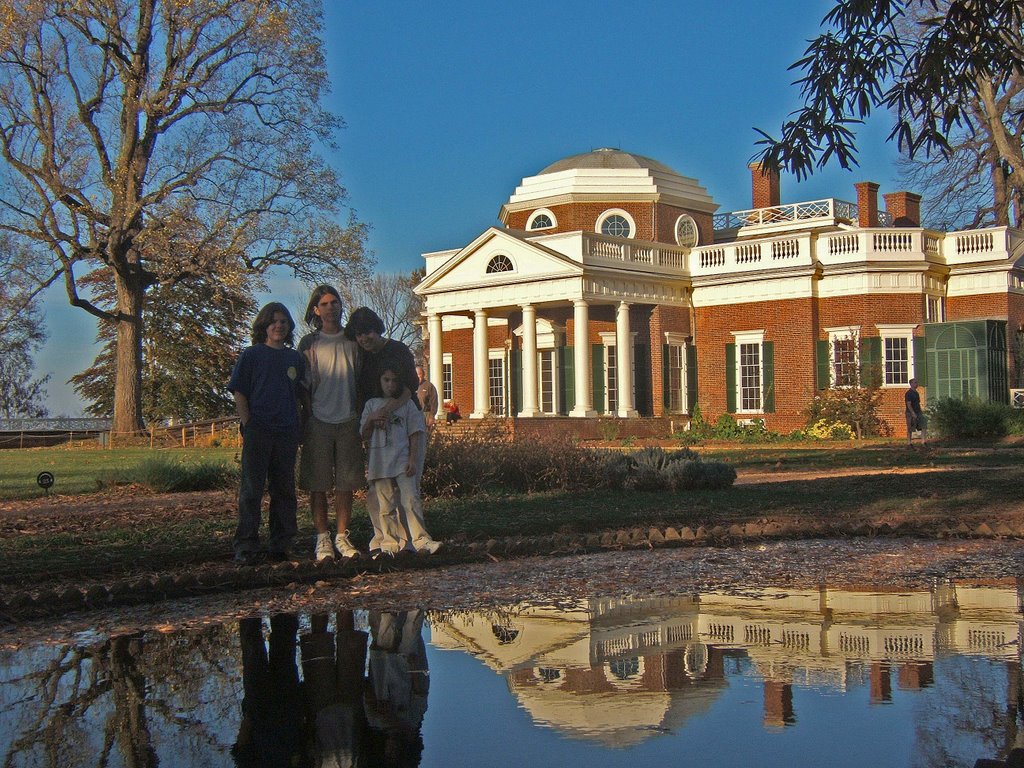
Last week, on a stunningly beautiful autumn day, we loaded up the kids and drove down to Charlottesville to visit Monticello. It was the perfect setting to contemplate the separation of church and state.
In 1802, Jefferson wrote, "Believing... that religion is a matter which lies solely between man and his God, that he owes account to none other for his faith or his worship, that the legitimate powers of government reach actions only, and not opinions, I contemplate with sovereign reverence that act of the whole American people which declared that their Legislature should 'make no law respecting an establishment of religion, or prohibiting the free exercise thereof,' thus building a wall of separation between Church and State."
Of course, Jefferson was wary also of the church mingling in the affairs of state. In 1815, he wrote, "Whenever... preachers, instead of a lesson in religion, put [their congregation] off with a discourse on the Copernican system, on chemical affinities, on the construction of government, or the characters or conduct of those administering it, it is a breach of contract, depriving their audience of the kind of service for which they are salaried, and giving them, instead of it, what they did not want, or, if wanted, would rather seek from better sources in that particular art of science."
Clearly, he did not think too highly of preachers!
But what happens when "lessons in religion" happen to turn on questions of justice? What is the role of the church in a time of war? What should the church say in the face of unjust economic structures? What of "love of neighbor" pushes us to an understanding of neighborliness that transgresses societal or even legal definitions such as Jim Crow laws, slavery, women's suffrage, same-sex relationships?
Just wondering ... that's all. And certainly no offense to Mr. Jefferson, who is one of my heroes.

Wednesday, November 08, 2006

Tending Hearts and Bending Arcs

I know many of our hearts are hurting this morning as a result of the passage of the marriage amendment in Virginia yesterday. But no result of a ballot measure – for better or for worse – is going to herald the coming of the kingdom. The arc of the moral universe is long, but it bends toward justice. Sometimes it seems longer than others, and this is one of those times for GLBT folks and their allies here. But this I know: our fundamental equality does not rise or fall on the result of any election, because each and every one of us is created equally in the image of a loving God.

Let our hearts be reassured by that unshakeable conviction, and let us tend to each other’s hearts with compassion.

While the news on this front was bad, the broader political picture is more hopeful as progressive voices were heard and progressive candidates elected in many places across the country. So maybe the arc bends a bit more today.

The image here -- note the arc -- comes from the Center for the Advancement of Nonviolence.
Now is the time for a season of nonviolence -- especially after the passage of an ugly and violent amendment.

Tuesday, November 07, 2006

Reimagining Christianity 1.6

Affirmation 6 holds that loving our neighbors means standing, as Jesus does, with the outcast and oppressed, the denigrated and afflicted, seeking peace and justice with or without the support of others.
This is the heart of an authentic theology of incarnation. While classical Reformed understandings of the incarnation focus on the challenge of holding God and the human person, Jesus, in creative and saving relationship, this affirmation pushes us to think of incarnation as an unfolding reality in the world.
This affirmation pushes us to think about location: where do we stand, and where does Jesus stand? Taking the gospels seriously -- especially Matthew 25 -- makes it clear that Jesus stands with the outcasts and oppressed, the poor and the sick, those seeking peace and justice. If we want to stand with him, if we feel any desire to know him and be known by him, we have to go where he is.

Monday, November 06, 2006

Bending the Arc

Every once in a while progressive people of faith manage to get their voices heard above the cacaphony of the "religious loud." When 300 or so Virginia clergy came together over the past several weeks to craft, sign and present a public statement of opposition to the proposed Marshall-Newman amendment to the state constitution we did not come close to drowning out the loud, but we did manage to get heard. The voice we raised helped frame the issue for at least one editorial board that came out against the amendment today. If we do the work of love, we will bend the arc one degree at a time closer to justice.

Friday, November 03, 2006

blogging on ... the antichrist

Fifteen or twenty years ago, a Sunday Doonesbury comic showed college students bent over notebooks taking careful but mindless notes. Realizing that the students aren't actually listening to anything, he professor began spouting nonsense: "Up is down. Black is white. Left is right. Thomas Jefferson was the Antichrist." Without pausing in his notetaking, one student whispered to another, "I didn’t know any of this stuff."
Lecturing is a lot like blogging. Suppose I said, "Bush is the Antichrist"? Would anyone respond with a comment?

Thursday, November 02, 2006

Vote No! A Pastoral Plea: Pass It On

On November 7, Virginian's will be asked to write discrimination into a constitution crafted in a spirit of "forbearance, love and charity."
In the name of a narrow and restricted view of marriage based on an impoverished reading of scripture, leaders of the Religious Right are encouraging their followers to support this amendment.
Marshall-Newman is bad law, and such support is bad theology. Bad law and bad theology make a dangerous and volatile mix that Virginia does not need.
Marshall-Newman is bad law because it fails the first measure of good law: clarity of purpose. When two of the commonwealth's statewide elected officials come to diametrically opposed and fundamentally incompatible conclusions about the effects of a proposed constitution amendment -- as Gov. Tim Kaine and Attorney General Bob McDonell have -- you have a recipe for clogged courts and judicial confusion.
Supporting such bad law in the name of one-sided readings of brief passages of scripture taken out of their historical contexts is bad theology. Blaming a loving, grace-filled God for our own human tendency to fear those who are different from ourselves is even worse theology. Acting on those fears in ways that will hurt others is nothing short of demonic. Just as we opponents of Marshall-Newman say "read the whole thing," a faithful response to scripture requires that we read fully as well. A full reading reveals a God in love with all of creation and humankind made fully -- each and every one of us -- in the image of the divine.
As the full text of the proposed Marshall-Newman amendment reads, the amendment could deny legal rights and protections to the more than 100,000 unmarried couples in Virginia -- roughly 90 percent of whom are heterosexual. Domestic violence protections have been threatened in Ohio under an almost identical constitutional amendment.
In other words, a vote for ballot question 1 (the Marshall-Newman amendment) will affect someone you know and it could well hurt them. Passage of the amendment will not help anyone.
That many Virginia families are struggling no one denies. That many Virginia marriages are strained is equally undeniable. Only 17 states have higher divorce rates. Ten percent of Virginians live below the federal poverty rate. Surely these are signs that point to real suffering.
But Marshall-Newman will do nothing to support Virginia families or strengthen marriages in the Commonwealth.
Rather, it seems a smokescreen designed to focus attention on scapegoats instead of on the poverty of ideas that plagues the commonwealth.
In my own Presbyterian tradition we say that we are the church Reformed and always open to being reformed according to the will of God and the movement of the Spirit. In other words, we share a deep conviction that God is not through with us.
Virginia has an opportunity next Tuesday to speak boldly from that very conviction. God is calling forth a new vision of the commonwealth.
God calls us to loving and faithful relationships. Marshall-Newman inscribes hate-filled discrimination into the constitution.
God calls us to be filled with grace and mercy. Marshall-Newman is full of judgment and condemnation.
God calls us to build a commonwealth of belovedness. Marshall-Newman rests on a poverty of compassion.
God is not through with us.
With that deep conviction, I urge you to vote No on ballot question 1.

Wednesday, November 01, 2006

Reimagining Christianity 1.5


Affirmation 5: Loving our neighbor includes engaging people authentically, as Jesus did, treating all as creations made in God’s very image, regardless of race, gender, sexual orientation, age, physical or mental ability, nationality, or economic class.
So, is this the gospel or just a manifesto for identity politics? Do we have to treat meanies as creations made in God's very image? Does that mean no more "mean people suck" bumper stickers? How about those with whom we profoundly disagree? Beyond praying for those who persecute us, do we have to engage them authentically? What might that look like?
The rubber hits the road here, and I'm not so sure I like it. It might require me to hold in my heart people I don't like very much, after all, not every neighbor is loveable.
In fact, last night -- Halloween -- some of them stayed hidden behind closed doors, and missed out seeing my middle child trick-or-treating dressed up as ... me! Clerical collar and all. Pretty scary, I assure you.

Monday, October 30, 2006

Yea, Rick!

Rick Ufford-Chase is at it again. Way to go, Rick!
Arizona Daily StarPublished: 10.30.2006
Guest Opinion: Rick Ufford-Chase -- No on Prop. 107
Proposition 107 would explicitly deny any "marriagelike" benefits to persons who are not married and would constitutionally define marriage as being available only to persons of opposite gender. Like the broader society, the faith community is deeply divided on this issue.
My experience as the highest elected official of the Presbyterian Church (USA) from June 2004 to June 2006 gave me a glimpse into the passion and divisiveness of this debate. Though it is clear that there is currently no consensus in our churches to broaden the definition of marriage, our denomination has been clear that we will not become unwitting participants in any movement to isolate gay and lesbian persons as a group, nor will we condone discriminatory practices against the lesbian, gay, bisexual or transgender community from our legislative, executive or judicial branches of government.
This is entirely consistent with our denomination's historic advocacy for women, persons of color, undocumented persons, and those who live with mental or physical disabilities, all of whom also face the possibility of discrimination because of who they are.
I long for the day when all who desire to make a lifelong commitment to one another are able, as I am, to do so within the bonds of the covenant of marriage. Someday, it could happen. After all, the biblical story is full of examples of God's people being surprised by what God had in mind for them.
We Presbyterians believe that God is constantly being revealed to us in ways that challenge, trouble and occasionally delight us. For that reason, I will continue to be in dialogue with my sisters and brothers with whom I disagree about this matter.
As people of faith, all of whom are struggling to be faithful to their understanding of God, we must find respectful ways to wrestle with this and many other issues that divide us. However, what we must not tolerate are laws motivated by hate or discrimination, or that single out an entire class of people to be treated differently from the rest of us.
Prop. 107 would take away domestic-partner benefits such as health insurance from public employees. It would remove domestic-violence protections from unmarried persons. It makes simple things like the right to visit a loved one in the hospital impossible.
Questions of how marriage is defined will continue to be debated within our faith communities and across our society. In the meantime, let's assure that our laws embody the best of what our country has always been: a safe haven for those who might be targeted elsewhere because of who they are or what they believe.
Let's honor our country's history as a place of tolerance, mutual forbearance, care and concern for all members of our communities. Those are values that all of us, both in and out of the church, ought to be able to affirm.
Please, vote "no" on Proposition 107.
Rick Ufford-Chase was the Moderator of the 216th General Assembly of the Presbyterian Church (USA). He now serves as the Executive Director of the Presbyterian Peace Fellowship. Write to him rickuffordchase@gmail.com.

Tuesday, October 24, 2006

Reimagining Christianity 1.4


Affirmation 4: Loving God means expressing our love in worship that is as sincere, vibrant, and artful as it is scriptural.
What might that entail for a community that calls itself progressive, inclusive, diverse? What, to begin with, constitues "sincere worship"? If you Google the phrase, you get more than 16,000 hits. Now that probably says as much about the search engine as it does about the interest in worship, but clearly a lot of folks are writing about this from perspectives that range from evangelical Christian to Muslim to Native American spirituality to Budhism.
My favorite Biblical definition of worship comes from Paul's letter to the Romans, where he says, "I appeal to you therefore, brothers and sisters, by the mercies of God, to present your bodies as a living sacrifice, holy and acceptable to God, which is your spiritual worship. Do not be conformed to this world, but be transformed by the renewing of your minds, so that you may discern what is the will of God—what is good and acceptable and perfect."
Sincere worship, it seems, has to do with discernment -- with listening for and coming to understand how God calls us to live transformed lives.
There are just as many hits on "vibrant worship," and just as much confusion over what it means. Perhaps any worship in which people come to hear and understand something true, powerful and transformative is, by definition, vibrant.
There are far fewer hits on "artful worship." Why do you suppose that is? What would such worship look like? feel like? sound like? I hope it would be full of beauty, which is why I snagged the painting above for all to look at. It's called Creation.

Wednesday, October 18, 2006

Reimagining Christianity 1.3


Affirmation 3: Loving God includes celebrating the God whose Spirit pervades and whose glory is reflected in all of God’s Creation, including the earth and its ecosystems, the sacred and secular, the Christian and non-Christian, the human and non-human.
Perhaps that is another way of asking "WWJD?" -- what would Jesus drive? One would think that this affirmation would be essentially noncontraversial, what with evangelicals joining the conversation and even the green movement.
Of course, when one affirms that the glory of God is reflected in the non-Christian as well as the Christian one is treading dangerously close the the radical Paul -- in Christ there is no Jew or Greek. At its deepest level, Paul's call for unity is not a call for "conversion" to Christ but rather an affirmation of Paul's faith that the reality of Christ marked God's decisive "yes" to all the world, not simply to the small part of the world that related to God through the community of practice gathered around the traditions of Judaism.
I suppose, though, that a call to reflect our deepest convictions in the way we actually live -- what we drive, what we purchase, how we tread on the planet -- is probably a far more difficult challenge for most of us that grappling with the theological implications of this affirmation. So, how do we make these decisions? What are we driving? What toys are we using right now, to read and comment?

Thursday, October 12, 2006

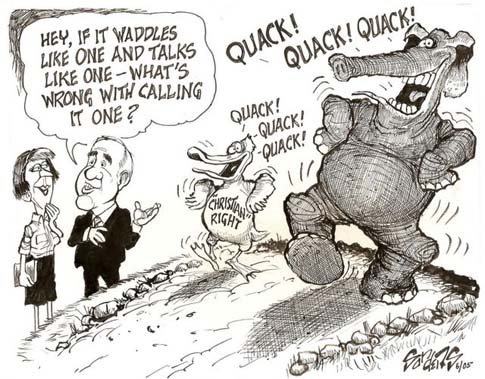
Pastors & Politics


It's not surprising, but it's still worth reading about how the so-called Christian Right is pushing voters toward the Republican party. I particularly love the advice to tell folks that Jesus would be more concerned about gay marriage than about war and peace. Now there is no endorsement of any party or candidate implied here, but I do think it's time to be afraid, be very afraid. There's an election coming and the "Christians" are on the loose. (The cartoon comes from the blog of Bill Sanders, retired cartoonist from the Milwaukee Journal.)